TL;DR
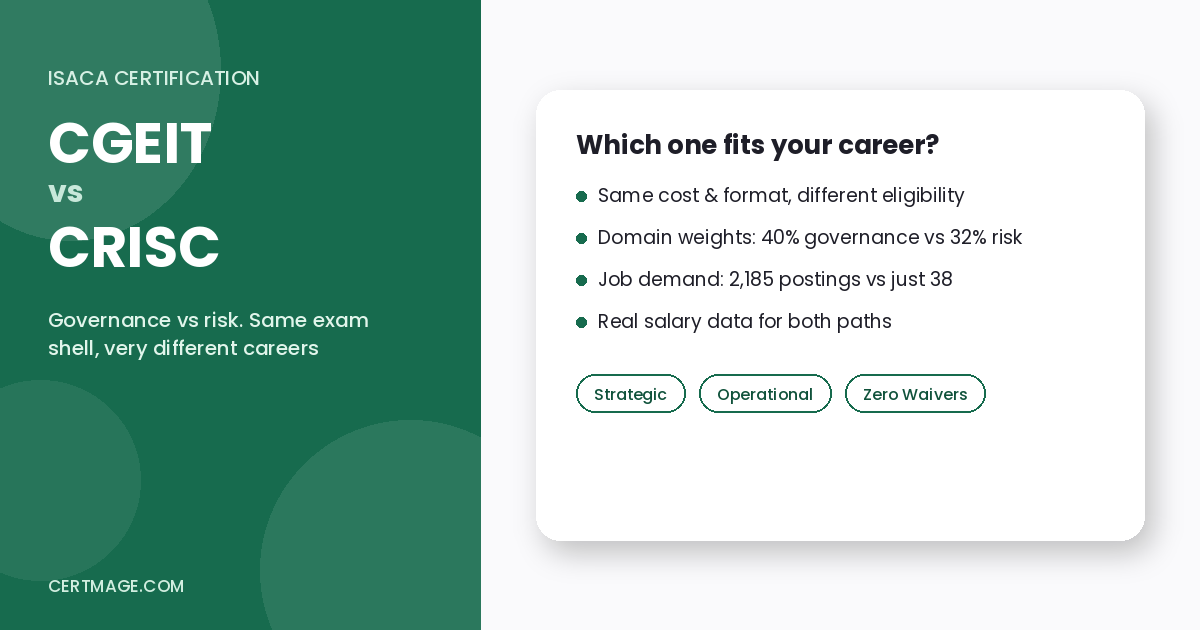
- CGEIT (Certified in the Governance of Enterprise IT) and CRISC (Certified in Risk and Information Systems Control) share almost identical exam mechanics: $575 (member) or $760 (non-member) plus a $50 application fee, 150 questions, 4 hours, and a 450/800 scaled passing score. The similarity ends there.
- CGEIT requires 5 years of experience in an advisory or governance role, with no waivers available. CRISC requires 3 years of cumulative experience in IT risk management, spanning at least 2 of its 4 domains, also with no waivers.
- The real difference is what each one is actually built to validate: CGEIT certifies that you can govern enterprise IT strategically, ensuring technology investment aligns with business value. CRISC certifies that you can identify, assess, and manage IT risk operationally.
- The job market gap between them is stark and worth knowing before you commit: CRISC shows roughly 2,185 active US job postings, ranked #29 of 155 certifications tracked, with postings up 45% in the past 13 weeks. CGEIT shows only 38 active postings, ranked #124 of 155, with postings down 56% over the same window.
- CGEIT holders report a higher starting salary floor, commonly cited around $141,000 to $145,000+, versus CRISC’s roughly $132,000 starting figure, but CRISC’s dramatically larger job market means far more actual opportunities to earn that salary.
- If you’re earlier in a risk, audit, or security career, CRISC is the more practical near-term move. CGEIT is better understood as a late-career, advisory-level credential for people already functioning at a governance or CIO-adjacent level, not a stepping stone to get there.
Quick Facts: CGEIT vs CRISC Side by Side
| CGEIT | CRISC | |
| Full name | Certified in the Governance of Enterprise IT | Certified in Risk and Information Systems Control |
| Cost (member) | $575 | $575 |
| Cost (non-member) | $760 | $760 |
| Application fee | $50 | $50 |
| Questions | 150 | 150 |
| Time limit | 4 hours | 4 hours |
| Passing score | 450/800 scaled | 450/800 scaled |
| Experience required | 5 years, advisory/governance role, no waivers | 3 years cumulative, across 2+ of 4 domains, no waivers |
| Experience window | Not time-boxed the same way | Must fall within 10 years of application |
| Apply-after-passing window | 5 years | 5 years |
| Active US job postings | ~38 | ~2,185 |
| Demand ranking (of 155 tracked) | #124 | #29 |
| 13-week posting trend | Down 56% | Up 45% |
| Reported starting salary | 141,000-145,000+ | ~$132,000 |
Sources: ISACA’s official CGEIT page, ISACA’s official CRISC page, job market and salary data.
Same Exam Shell, Completely Different Certifications
It’s worth pausing on how identical these two exams are mechanically before getting into what makes them different. Same cost structure down to the dollar (575/760/$50 application fee), same 150-question format, same 4-hour time limit, same 450/800 scaled passing threshold. If you only looked at the registration page, you’d assume these were interchangeable variations of the same credential.
They are not. CGEIT is ISACA’s governance credential: it certifies that you understand how to align enterprise IT investment, strategy, and resource allocation with actual business value, the kind of thinking a CIO, IT governance consultant, or board-level technology advisor needs. CRISC is ISACA’s risk credential: it certifies that you can identify, assess, respond to, and report on IT risk in an operational, ongoing way, the kind of work a risk analyst, control owner, or GRC (governance, risk, compliance) professional does day to day.
Both sit under ISACA’s governance-and-risk umbrella, but one is strategic and advisory, the other is operational and risk-focused. Confusing them as “similar-difficulty alternatives” because of the shared exam mechanics is the single biggest mistake candidates make when choosing between them. For how ISACA’s other credentials fit into this same ecosystem, see CCSK vs CCSP and CIA vs CISA comparisons, both of which touch adjacent governance, risk, and audit territory.
Domain Weighting: What Each Exam Actually Tests
| CGEIT Domain | Weight | CRISC Domain | Weight |
| Governance of Enterprise IT | 40% | Risk Response and Reporting | 32% |
| Benefits Realization | 26% | Governance | 26% |
| Risk Optimization | 19% | Risk Assessment | 22% |
| IT Resources | 15% | Technology and Security | 20% |
Look at where each exam puts its weight. CGEIT dedicates 40% of the exam, by far its single heaviest domain, to Governance of Enterprise IT itself: strategic alignment, decision-making frameworks, and ensuring IT investment actually serves business objectives. CRISC’s heaviest domain, Risk Response and Reporting at 32%, is about the operational cycle of actually doing something once a risk is identified, then communicating it up the chain.
Interestingly, both exams include a “Governance” domain (CGEIT’s is the whole exam’s namesake at 40%, CRISC’s own Governance domain is 26%), which is part of why some candidates conflate the two. The overlap is real but partial: CRISC’s governance content is scoped specifically to risk governance, not the broader enterprise IT governance CGEIT tests across all four of its domains.
Eligibility: The Experience Gap That Actually Matters
Both certifications enforce real experience requirements with zero waivers, meaning you cannot buy, test around, or substitute your way past them. But the requirements themselves differ in ways that should drive your decision more than the exam content does.
CGEIT requires 5 years of experience specifically in an advisory role, requiring your active contribution to enterprise IT governance. This isn’t generic “5 years in IT,” it’s 5 years of governance-adjacent, strategic-level work. If you’ve spent your career in hands-on technical or operational roles without governance, strategy, or advisory responsibilities, you likely don’t yet qualify regardless of tenure.
CRISC requires 3 years of cumulative professional experience in IT risk management and information systems control, spanning at least 2 of its 4 domains, and that experience must fall within the 10 years before you submit your application. This is a meaningfully lower bar in both years required and the specificity of role needed, three years of real risk, audit, security, or control-related work across a couple of relevant areas is enough.
The practical read: most candidates weighing these two aren’t actually choosing between them, they’re finding out CGEIT isn’t available to them yet regardless of preference, because they haven’t accumulated 5 years of governance-specific experience. CRISC’s lower, broader threshold makes it the realistic near-term option for far more risk, security, and audit professionals.
The Demand Reality Check
This is the part of the comparison most guides skip, and it’s arguably more important than the exam content itself if you’re choosing where to invest your study time and money.
CRISC shows approximately 2,185 active US job postings, ranking #29 out of 155 certifications tracked by one industry demand tracker, and postings were up 45% over a recent 13-week window, a genuinely strong, growing signal.
CGEIT shows only around 38 active US postings, ranking #124 of 155, with postings down 56% over the same window. That’s not a small gap, it’s roughly a 57-to-1 difference in job posting volume, and the trend line is moving in opposite directions for each credential.
This doesn’t mean CGEIT is a bad certification. It reflects what CGEIT actually is: a niche, advisory-level credential for a genuinely smaller population of governance specialists, CIOs, and IT strategy consultants, not a certification most employers post open requisitions for the way they do for hands-on risk and security roles. If you already hold a governance-adjacent role and CGEIT is the natural credential for where you already are professionally, the thin job posting count matters less, since you’re not job-searching against those postings, you’re validating expertise you already apply daily. If you’re hoping either certification opens up a wider set of new job opportunities, CRISC’s job market reality is dramatically more favorable right now.
Career Path: Where Each One Actually Sits
ISACA’s credential ecosystem implies a rough progression for risk- and governance-minded professionals: CRISC (operational risk management) toward CISM (security management) toward CGEIT (enterprise IT governance), broadly tracking a career arc from hands-on risk and security work to strategic, board-adjacent advisory roles. For the CRISC-to-CISM comparison specifically, see CRISC vs CISM guide.
This framing matters for sequencing: CGEIT isn’t really a competing choice against CRISC for most people, it’s a later destination. If you’re 3-5 years into a risk, security, or audit career, CRISC matches where you actually are. CGEIT becomes relevant once you’re already operating at a governance, strategy, or CIO-adjacent level, typically much later, and by then the 5-year advisory experience requirement will likely already be satisfied by the work itself rather than something you’re specifically pursuing CGEIT to unlock. If you’re weighing a governance-track ISACA credential against a more general senior IT leadership certification, see our PMP vs CISSP comparison for a related “which senior credential actually matters” decision, and our Top 5 Cybersecurity Certification Exams for Audit and Compliance Roles for where CRISC and CGEIT rank against other audit-adjacent options.
Career Impact and Salary Data
ISACA’s own CGEIT page cites an average annual salary of $141,000+ among its 8,000+ certified professionals, while certdemand’s tracking shows a starting salary commonly cited around $145,000. CRISC’s starting salary is commonly reported around $132,000, roughly $10,000 to $13,000 lower at the entry point.
That salary gap might look like it favors CGEIT outright, but it needs to be read alongside the job market data above. A $141,000+ average salary across only 38 active postings nationally is a very different opportunity than a $132,000 starting salary across 2,185 active postings. CRISC offers more actual paths to that salary; CGEIT offers a higher ceiling within a much smaller, more specialized market that’s currently shrinking rather than growing.
Which One Should You Take?
Take CRISC if:
- You have 3+ years of risk, security, audit, or control-related experience, spanning at least 2 relevant domains.
- You want a credential with strong, growing job market demand right now.
- Your work is operational: identifying risks, implementing controls, responding to and reporting on them.
Take CGEIT if:
- You already have 5+ years specifically in an advisory or governance role, actively contributing to enterprise IT governance decisions.
- You’re already functioning at a strategic, CIO-adjacent, or IT governance consulting level and want the credential that matches your actual work.
- You understand the job market for CGEIT specifically is thin, and you’re pursuing it to validate existing expertise rather than to open up new job search volume.
Don’t pursue CGEIT as a first ISACA credential unless you already clearly meet its experience bar. For most professionals building a risk, security, or governance career, CRISC (and later CISM) are the more realistic and market-relevant near-term moves, with CGEIT arriving naturally later if your career trajectory leads there.
How to Prepare for Each
- Confirm your eligibility before you register for either. Both have zero-waiver experience requirements; ISACA can and does reject applications that don’t clearly meet the specific role and domain criteria, not just a generic years-of-IT-experience count.
- For CGEIT, weight your study heavily toward Governance of Enterprise IT (40%) since it dwarfs the other three domains combined in some study plans’ effective difficulty.
- For CRISC, prioritize Risk Response and Reporting (32%) and Governance (26%), which together make up more than half the exam.
- Budget 100-150 hours of study time for either exam, consistent with what candidates commonly report for both credentials given their shared 150-question, 4-hour format.
- Don’t assume passing either exam alone completes your certification. Both require your experience application to be reviewed and approved by ISACA after passing, within the 5-year application window.
Common Mistakes People Make
- Assuming CGEIT is just “CRISC with a harder governance domain.” They’re built for genuinely different roles: one operational and risk-focused, one strategic and advisory-focused.
- Pursuing CGEIT before you have 5 years of specifically advisory or governance-level experience. ISACA does not waive this, and a rejected application wastes the exam fee and the time spent studying against a credential you can’t yet be awarded.
- Ignoring the job market gap when choosing based on salary alone. CGEIT’s higher reported salary sits inside a job market roughly 1/57th the size of CRISC’s, a critical fact for anyone treating either certification as a job-search strategy rather than a validation of existing expertise.
- Treating CRISC’s “3 years across 2 of 4 domains” requirement as flexible. ISACA reviews applications specifically against the domain content, not just generic risk-adjacent job titles.
FAQS
What does CGEIT stand for?
Certified in the Governance of Enterprise IT, ISACA’s credential for professionals who align IT strategy and investment with business value at a governance or advisory level.
What does CRISC stand for?
Certified in Risk and Information Systems Control, ISACA’s credential for professionals who identify, assess, respond to, and report on IT risk operationally.
How much do CGEIT and CRISC cost?
Both cost $575 for ISACA members or $760 for non-members, plus a $50 application processing fee, identical pricing structures for both credentials.
Is CGEIT harder to qualify for than CRISC?
Yes, in eligibility terms. CGEIT requires 5 years of specifically advisory or governance-role experience with no waivers. CRISC requires 3 years of cumulative risk-related experience across at least 2 of its 4 domains, also with no waivers but a lower and broader bar.
Which certification has better job market demand right now?
CRISC, by a wide margin. It shows roughly 2,185 active US postings versus CGEIT’s roughly 38, and CRISC postings were trending up 45% over a recent 13-week period while CGEIT’s were down 56% over the same window.
Which certification pays more?
CGEIT’s reported salary figures (141,000-145,000+) run higher than CRISC’s (~$132,000), but that premium exists within a dramatically smaller job market.
Should I get CRISC before CGEIT?
For most people, yes, if a governance-focused career is the eventual goal. ISACA’s own credential trajectory suggests CRISC toward CISM toward CGEIT as a natural progression from operational risk work toward strategic governance roles.
Can I get CGEIT without governance experience if I have general IT management experience?
No. ISACA specifically requires the 5 years to be in an advisory role contributing to enterprise IT governance, not generic IT management or technical experience, and does not offer waivers.
How many questions are on the CGEIT and CRISC exams?
Both use 150 multiple-choice questions administered over a 4-hour time limit, with a 450/800 scaled passing score.
Are CGEIT and CRISC accredited?
Yes, both are ANAB accredited certifications from ISACA.
Do CGEIT and CRISC expire?
Both require ongoing Continuing Professional Education (CPE) compliance under ISACA’s CPE policy to maintain active certification status.
Is CRISC a good first ISACA certification for someone early in a risk career?
Yes, it’s one of the more accessible ISACA credentials for risk-focused professionals given its 3-year (rather than 5-year) experience threshold and strong current job market demand.