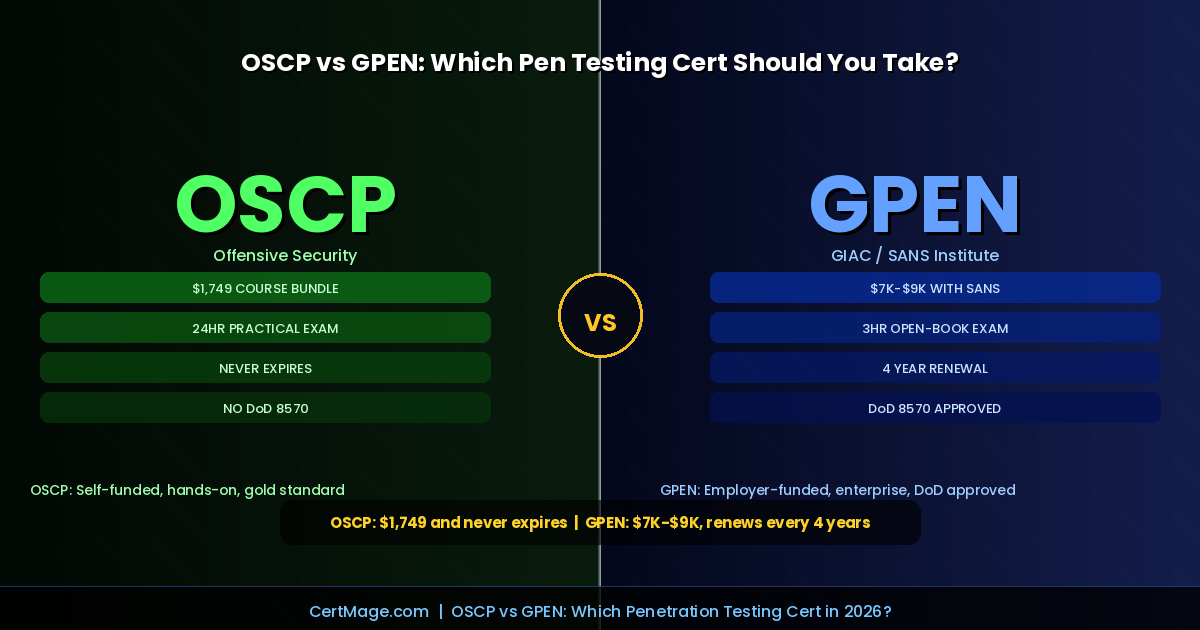
OSCP vs GPEN — take OSCP if you want the most universally recognized hands-on penetration testing credential that proves you can actually compromise systems under pressure. Take GPEN if you work in or target enterprise environments, government contracts, or regulated industries where SANS GIAC credentials carry institutional weight and your employer will fund the significantly higher SANS training cost. Both are valid mid-level penetration testing certifications. The core difference is practical versus methodological — OSCP proves you can do it, GPEN proves you know how it should be done.
Neither is a beginner certification. Both assume you already understand networking, Linux, and basic exploitation concepts before you enroll.
OSCP vs GPEN: Key Differences at a Glance
| Factor | OSCP | GPEN |
| Full name | Offensive Security Certified Professional | GIAC Penetration Tester |
| Issuing body | Offensive Security (OffSec) | GIAC (affiliate of SANS Institute) |
| Exam format | 24-hour practical — compromise live machines | 3-hour open-book exam — 82 to 115 questions |
| Question types | Performance-based — actual exploitation required | Multiple choice and some lab questions |
| Passing score | 70 out of 100 points | 73 to 75 percent |
| Exam duration | 23 hours 45 minutes hacking plus 24 hours reporting | 3 hours |
| Cost — exam only | $1,699 for standalone with 2 attempts | $999 to $1,699 exam voucher only |
| Cost — full path | $1,749 Course and Cert Bundle (recommended) | $7,000 to $8,780 for SANS SEC560 plus exam |
| Typical funding | Self-funded or employer-funded | Almost always employer-funded |
| Prerequisites | None formally — Linux and networking recommended | None formally — SANS SEC560 strongly recommended |
| Expiration | Never expires — lifetime validity | 4 years — requires 36 CPE credits to renew |
| Renewal fee | None | $499 every 4 years |
| DoD 8570 approved | No | Yes — multiple categories |
| Technical hiring manager respect | Extremely high — gold standard | Very high — especially in enterprise and government |
| HR filter recognition | High — named in most pen test job postings | High in regulated sectors and government |
| Active Directory coverage | Core component — 40 percent of exam points | Covered methodologically |
| Exam style | Try Harder philosophy — self-directed under pressure | Open-book structured methodology |
| Average US salary | $95,000 to $140,000 | $95,000 to $145,000 |
What Is the Main Difference Between OSCP and GPEN?
The GPEN exam is more methodological and knowledge-based while the OSCP exam involves more hands-on penetration testing.
OSCP puts you in a live network with real machines and gives you 23 hours and 45 minutes to compromise them and write a professional penetration testing report. You either own the boxes or you do not. You cannot fake it. This is why OSCP is often cited as the gold standard of penetration testing certifications — it validates practical skills that no amount of theoretical study can substitute.
GPEN is an open-book exam where you answer 82 to 115 questions over 3 hours drawing from your SANS SEC560 course notes and understanding of penetration testing methodology. It rewards structured thinking, planning, and methodological correctness across legal, technical, and reporting dimensions of professional penetration testing.
OSCP is the sword. GPEN is the blueprint. Both professionals end up in the same engagements. They prove their competence differently.
What Does OSCP Cover?
OSCP is delivered through the PEN-200 (Penetration Testing with Kali Linux) course. It teaches penetration testing methodology, tools, and techniques in a hands-on self-paced environment with access to intentionally vulnerable lab machines.
OSCP Exam Structure
| Component | Details |
| Standalone machines | 3 machines worth 20 points each — 60 points total |
| Active Directory set | 1 AD environment worth 40 points total |
| Total points available | 100 |
| Passing score | 70 points minimum |
| Report requirement | Professional penetration testing report submitted within 24 hours |
| Proctoring | Webcam and screen sharing throughout entire 24-hour period |
| Automated exploitation tools | Not permitted for standalone machines |
OSCP Technical Content Areas
| Area | What You Must Demonstrate |
| Network enumeration | Identify services, open ports, and attack vectors across multiple targets |
| Privilege escalation | Windows and Linux local privilege escalation through multiple techniques |
| Active Directory attacks | Kerberoasting, Pass-the-Hash, lateral movement, domain compromise |
| Web application attacks | SQL injection, file inclusion, command injection, XXE |
| Password attacks | Online and offline cracking, hash capture and relay |
| Port forwarding and pivoting | Tunneling through compromised hosts to reach internal networks |
| Professional reporting | Clear, reproducible documentation of all findings and exploitation steps |
The Try Harder philosophy: OSCP is built around learning through frustration, research, and persistence. OffSec does not give you hints. You either figure it out or you do not pass. This philosophy is exactly what makes the credential respected — candidates who hold OSCP have demonstrated they can work through difficult problems independently under time pressure without guidance.
What Does GPEN Cover?
GPEN is delivered through the SANS SEC560 Enterprise Penetration Testing course. It covers the complete penetration testing methodology with particular emphasis on planning, legal considerations, documentation, advanced password attacks, and exploitation techniques across enterprise environments.
GPEN Exam Content Areas
| Area | What You Prove |
| Penetration testing planning and scoping | Legal agreements, rules of engagement, scope definition, compliance requirements |
| Reconnaissance and scanning | Open-source intelligence gathering, network scanning, service enumeration |
| Exploitation techniques | Exploiting vulnerabilities across operating systems, services, and applications |
| Password attacks | Advanced techniques including hash cracking, pass-the-hash, Kerberoasting |
| Windows and Active Directory | Domain enumeration, privilege escalation in Windows environments |
| Post-exploitation | Maintaining access, lateral movement, data exfiltration methodologies |
| Reporting and documentation | Professional penetration test report writing and findings communication |
The open-book advantage and limitation: GPEN is an open-book exam. You can bring your printed SANS course notes and reference them during the 3-hour exam window. This rewards candidates who have organized and indexed their notes well and genuinely understood the material rather than memorized it. The trade-off is that the exam can only test knowledge and methodological reasoning — not actual exploitation ability. You cannot demonstrate you can actually compromise a system in an open-book written test.
OSCP vs GPEN: Difficulty Comparison
| Factor | OSCP | GPEN |
| Type of difficulty | Practical exploitation under 24-hour time pressure | Breadth of methodology knowledge organized for retrieval under time pressure |
| Hardest aspect | Active Directory attack chains and maintaining composure over 24 hours | Organizing course material for effective open-book retrieval within 3 hours |
| Preparation time | 3 to 6 months with 20 plus hours per week | 1 to 2 months intensive with SANS SEC560 course |
| First attempt pass rate | 15 to 20 percent without adequate preparation, 60 to 70 percent with proper preparation | 70 to 80 percent across most GIAC exams — GPEN slightly lower |
| Most common failure reason | Insufficient Active Directory lab practice | Insufficient note organization for open-book exam retrieval |
| Recommended experience before attempting | Consistently root medium-difficulty Hack The Box machines | Complete the SANS SEC560 course — the exam is designed around it |
| Mental demand | 48 hours of continuous pressure — hacking plus reporting | 3-hour structured exam with notes available |
OSCP is objectively harder in terms of what it demands from candidates under exam conditions. GPEN is structured and methodological — a professional who has thoroughly studied SANS SEC560 and organized their notes well has a strong foundation for passing. An OSCP candidate must actually exploit systems under pressure without help.
OSCP vs GPEN: Cost Comparison
This is where the decision becomes practically important for most candidates.
OSCP Cost Breakdown
| Option | Cost | Includes |
| Standalone exam | $1,699 | 2 exam attempts, 90-day validity |
| Course and Cert Bundle (recommended) | $1,749 | 90 days PEN-200 lab access plus 1 exam attempt |
| Learn One subscription | $2,749 per year | 365 days lab access plus 2 exam attempts |
| Retake fee | $249 per attempt | After included attempts exhausted |
| Total realistic investment | $1,800 to $2,500 | Including supplementary platforms |
GPEN Cost Breakdown
| Option | Cost | Includes |
| GIAC exam voucher only | $999 to $1,699 | Exam only — no training |
| SANS SEC560 with exam | $7,000 to $8,780 | Full course plus one exam attempt |
| Additional exam attempt | $1,999 | Single retake |
| Renewal fee | $499 every 4 years | 36 CPE credits required |
| Total with training | $7,000 to $9,000 plus | For the full GPEN path |
The cost reality: GPEN’s full path through SANS SEC560 costs 4 to 5 times more than OSCP’s full path. This is why GPEN is almost always employer-funded while OSCP is frequently self-funded. The SANS training cost often means GPEN is pursued by professionals in established security roles at organizations with professional development budgets, while OSCP is pursued by professionals investing in their own career advancement.
OSCP vs GPEN: Employer Perception and Job Market
OSCP remains the industry standard, appearing as a requirement in most penetration tester job postings globally. GPEN adds enterprise credibility especially in regulated sectors.
Job Market Comparison
| Factor | OSCP | GPEN |
| Private sector pen test firm requirement | Near-universal | Common but OSCP more frequently listed |
| Government and defense contractor | Not DoD 8570 | DoD 8570 approved |
| Enterprise security team hiring | Very high recognition | Very high recognition — especially SANS alumni networks |
| Dedicated red team roles | Frequently listed as requirement | Accepted alongside OSCP |
| SANS network alumni advantage | Not applicable | Significant — SANS alumni networks are extensive |
| Salary premium | Strong in technical roles | Strong in enterprise and government roles |
The honest assessment: OSCP appears by name more frequently in penetration testing job postings across all sectors. The SANS brand and GIAC network provide GPEN with strong institutional recognition particularly in government and regulated enterprise environments. Candidates who want the widest possible job market access should prioritize OSCP. Candidates targeting specific government or SANS-adjacent enterprise environments should consider GPEN.
OSCP vs GPEN: Salary Comparison
Both certifications command comparable salaries because they open similar roles at similar career stages. The differences are in which specific employers and sectors value each credential most.
OSCP Salary by Role
| Role | Average US Salary |
| Penetration Tester (OSCP level) | $95,000 to $130,000 |
| Red Team Operator | $115,000 to $160,000 |
| Security Consultant (offensive) | $105,000 to $145,000 |
| Senior Penetration Tester | $130,000 to $170,000 |
GPEN Salary by Role
| Role | Average US Salary |
| Penetration Tester (GPEN level) | $95,000 to $135,000 |
| Enterprise Security Consultant | $105,000 to $145,000 |
| Government Security Contractor | $100,000 to $150,000 |
| Senior Security Engineer (pen test) | $130,000 to $165,000 |
Who Should Take OSCP?
Take OSCP if:
You are building a career in penetration testing and want the most credible hands-on certification. OSCP is cited by hiring managers as the strongest signal of practical exploitation ability available at the mid-career level. Dedicated penetration testing firms nearly universally respect OSCP in a way that knowledge-based certifications cannot replicate.
You are self-funding your certification journey. At $1,749 for the Course and Cert Bundle versus $7,000 to $9,000 for the GPEN path through SANS, OSCP is the only realistic self-funded option for most professionals. The value per dollar of OSCP is significantly higher for candidates without employer sponsorship.
You want a credential that never expires. OSCP has lifetime validity. You earn it once and it stays on your transcript permanently with no renewal fees. GPEN requires 36 CPE credits every 4 years and a $499 renewal fee.
Your target employers are penetration testing firms, red teams, or technical security consulting. In these environments, OSCP is not just respected — it is frequently the minimum expected credential for senior roles. Our CEH vs OSCP guide covers the full comparison of OSCP against the other most common penetration testing credential in detail.
Do not take OSCP if you cannot commit 20 plus hours per week during your lab period, if you are not yet consistently rooting medium-difficulty machines on Hack The Box or Proving Grounds, or if your employer specifically requires DoD 8570 compliance where CEH or GPEN are more appropriate.
Who Should Take GPEN?
Take GPEN if:
Your employer is funding your certification and operates in enterprise or government environments. GPEN through SANS is a significant investment that most individuals do not make alone. When employer-funded, GPEN provides exceptional value — SANS training quality is among the highest available anywhere in cybersecurity, and the GIAC credential carries genuine institutional weight.
You need DoD 8570 compliance that OSCP does not provide. GPEN meets DoD 8570 requirements. OSCP does not. For professionals working in government contracting or defense sector roles where DoD compliance drives certification requirements, GPEN fills a gap that OSCP cannot.
You want to build toward the GIAC ecosystem and stack multiple GIAC credentials. GPEN holders frequently pair their credential with GWAPT (web application penetration testing) or GXPN (advanced exploitation) to build a comprehensive GIAC penetration testing portfolio. The GIAC brand recognition compounds across multiple credentials in regulated enterprise environments.
You are an experienced professional who wants methodological depth alongside practical skills. GPEN’s emphasis on planning, legal frameworks, and documentation methodology provides structured frameworks that self-taught practitioners sometimes lack. The SANS SEC560 course is widely considered one of the best structured penetration testing training experiences available.
Can You Get Both OSCP and GPEN?
Yes — and many senior penetration testers and red team operators hold both. The combination signals complete penetration testing competency from two different validation approaches and two different respected credentialing bodies.
OSCP proves you can do the work under pressure. GPEN proves you understand the methodology, planning, legal framework, and documentation requirements of professional penetration testing. Together they present a profile that satisfies both technical hiring managers who look for OSCP and enterprise or government procurement officers who look for GIAC credentials.
The most practical sequence for most candidates is OSCP first then GPEN when an employer provides funding. OSCP is self-fundable and opens doors immediately. GPEN through SANS is employer-funded and adds institutional credibility when the opportunity arises.
The Complete Penetration Testing Certification Landscape in 2026
Understanding where OSCP and GPEN sit relative to other pen testing certifications helps you plan your full career roadmap.
| Level | Certification | Format | Cost | Best For |
| Entry | CompTIA PenTest+ | Multiple choice and PBQ | $404 | Career starters needing foundational pen test credential |
| Entry | PNPT | Practical 5-day exam | $399 | Budget-conscious candidates wanting hands-on validation |
| Mid-level | OSCP | 24-hour practical | $1,749 | Most pen testers — industry standard |
| Mid-level | GPEN | 3-hour open-book | $7,000 to $9,000 | Enterprise and government, employer-funded |
| Advanced | OSEP | 48-hour practical | $1,499 | Experienced pen testers evading modern defenses |
| Advanced | GXPN | Open-book exam | $8,000 to $10,000 plus | Advanced exploitation specialists |
| Specialist | OSWE | 48-hour practical | $1,499 | Web application penetration testing specialists |
Both OSCP and GPEN represent the mid-level tier where most career penetration testers spend the majority of their professional credential journey. OSCP remains the most universally recognized mid-level certification appearing as a requirement in most penetration tester job postings globally.
CertMage covers the complete cybersecurity certification path including OSCP preparation resources and guidance in our CEH vs OSCP guide. For the broader picture of where penetration testing certifications fit in the full cybersecurity credential landscape, our Best Cybersecurity Certifications 2026 guide covers every major path.
How to Prepare for OSCP
Step 1: Build your foundation on Hack The Box and Proving Grounds before enrolling. Do not spend $1,749 on OSCP labs until you can consistently root medium-difficulty machines on Hack The Box or Proving Grounds. Candidates who enroll before they are ready waste their 90-day lab period on basics and fail their first exam attempt.
Step 2: Master Active Directory attack chains specifically. Active Directory attacks account for 40 percent of the OSCP exam. Kerberoasting, Pass-the-Hash, Golden Ticket attacks, and lateral movement through AD environments must become second nature. Build a home AD lab and practice these techniques repeatedly before your exam date.
Step 3: Write a professional report for every machine you compromise during labs. Reporting is mandatory and graded in OSCP. Candidates who do not practice report writing during lab time consistently struggle with the 24-hour reporting window under exam pressure. Develop your report template early and use it for every lab machine.
Step 4: Use current practice materials. CertMage’s OSCP preparation materials include resources aligned to the current PEN-200 blueprint and exam requirements.
How to Prepare for GPEN
Step 1: Complete SANS SEC560 as your primary preparation. GPEN is explicitly designed around SEC560 content. The exam draws directly from course material. Candidates who attempt GPEN without SEC560 or equivalent structured preparation significantly underperform compared to those who use the official training.
Step 2: Build an indexed reference system for your open-book exam. The GPEN exam is open-book — you can bring printed course notes. Success depends on how well you have organized and indexed those notes for rapid retrieval within 3 hours. During SEC560, build a comprehensive index by topic, command, and technique that allows you to locate any information within seconds.
Step 3: Practice penetration test planning and legal framework questions. GPEN goes deeper than OSCP into the legal, planning, and documentation aspects of professional penetration testing. Understand rules of engagement, scope limitations, legal considerations for different engagement types, and professional reporting standards.
Step 4: Build hands-on skills alongside methodological study. Even though GPEN is not a 24-hour practical exam, it includes lab-style questions requiring you to reason through exploitation scenarios. Build hands-on experience in a lab environment alongside your methodological study.
Decision Framework: OSCP vs GPEN
| Your Situation | Take This |
| Self-funding your certification | OSCP — significantly lower cost |
| Employer is funding certification | GPEN through SANS — highest quality training |
| Target employers are private pen test firms | OSCP |
| Target employers are government or defense | GPEN — DoD 8570 approved |
| Want a credential that never expires | OSCP |
| Prefer open-book structured exam | GPEN |
| Prefer hands-on practical exam | OSCP |
| Need DoD 8570 compliance | GPEN — OSCP does not qualify |
| Want widest job posting recognition | OSCP |
| Building a GIAC credential portfolio | GPEN |
| Budget is primary concern | OSCP at $1,749 versus $7,000 to $9,000 for GPEN |
| Want both eventually | OSCP first, GPEN when employer funds it |
| Cannot commit 20+ hours weekly during labs | Consider GPEN — shorter structured preparation |
| Already hold OSCP, want enterprise credibility | GPEN is the natural complement |
Frequently Asked Questions: OSCP vs GPEN
What is the difference between OSCP and GPEN?
OSCP is a 24-hour practical exam where you compromise live machines and write a professional report — it validates actual hands-on exploitation skills. GPEN is a 3-hour open-book exam testing penetration testing methodology and knowledge — it validates structured thinking and methodological understanding. Both are respected mid-level penetration testing certifications targeting different validation approaches.
Which is harder — OSCP or GPEN?
OSCP is significantly harder in terms of what it demands under exam conditions. OSCP requires 24 hours of live exploitation under proctored conditions with no guidance. GPEN is a 3-hour open-book exam where you can reference your printed notes. The GPEN pass rate across GIAC exams is approximately 70 to 80 percent. The OSCP first-attempt pass rate is 15 to 20 percent without adequate preparation.
Which pays more — OSCP or GPEN?
Both certifications open comparable salary ranges of $95,000 to $145,000 at the mid-level. The difference is in which employers value each. OSCP commands stronger premiums at private penetration testing firms and red teams. GPEN commands stronger recognition in government contracting and regulated enterprise environments.
Does OSCP expire?
No. OSCP has lifetime validity and never expires. You earn it once and it stays on your transcript permanently with no renewal fees or continuing education requirements.
Does GPEN expire?
Yes. GPEN requires renewal every 4 years through 36 Continuing Professional Experience credits and a $499 renewal fee. This ongoing maintenance requirement is one of the key differentiators from OSCP’s lifetime validity.
Is GPEN worth the cost?
GPEN is worth it when employer-funded. The SANS SEC560 training is among the highest quality penetration testing education available and the GIAC credential carries genuine institutional weight in enterprise and government environments. At $7,000 to $9,000 out of pocket, most candidates prioritize OSCP for self-funded certification.
Which certification is better for government contracting?
GPEN. It is DoD 8570 approved. OSCP is not DoD 8570 approved. For government contractor roles requiring DoD compliance, GPEN satisfies requirements that OSCP cannot meet.
Can I take GPEN without the SANS course?
Technically yes — there is no mandatory prerequisite. However GPEN is explicitly designed around SEC560 content and GIAC strongly recommends the training. Candidates who attempt GPEN without SEC560 or equivalent structured preparation typically find the exam significantly more difficult.
What comes after OSCP?
Common next steps after OSCP include OSEP (Experienced Penetration Tester) for advanced evasion and red team techniques, OSWE for web application specialization, GXPN for advanced exploitation, or GPEN to add enterprise and government credibility alongside your existing OSCP.
What comes after GPEN?
Common next steps after GPEN include GXPN (advanced exploitation and penetration testing), GWAPT (web application penetration testing), or OSCP if you want to add practical hands-on validation to your methodological GPEN credential.