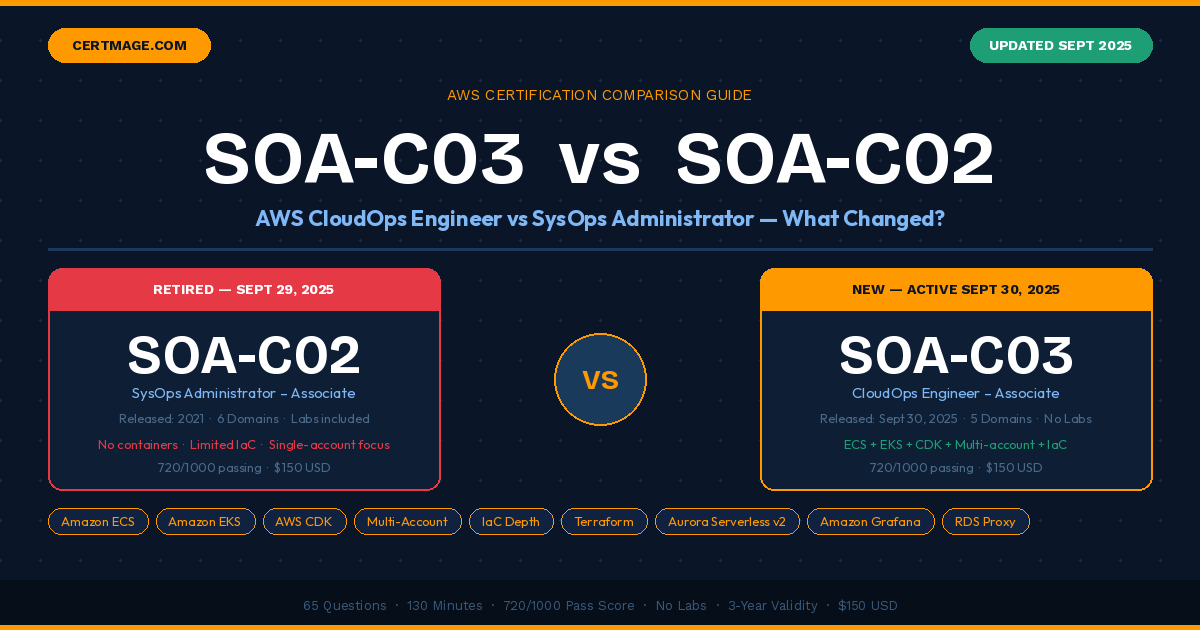
Quick Answer: The AWS SOA-C02 (SysOps Administrator – Associate) was retired on September 29, 2025 and replaced by the SOA-C03 (AWS Certified CloudOps Engineer – Associate), which launched on September 30, 2025. The biggest changes are: containers (ECS, EKS, ECR) are now officially in scope, AWS CDK and Terraform are now tested, multi-account and multi-Region architectures are heavily emphasized, and the domain structure shrank from 6 domains to 5. The exam labs from SOA-C02 were not brought back. The exam format remains 65 questions in 130 minutes, passing score is 720/1000, and cost is $150 USD. If you are starting fresh in late 2025 or 2026, you must study for SOA-C03.
Introduction: Why This Rename Is a Much Bigger Deal Than It Looks
When AWS announced in July 2025 that the SysOps Administrator – Associate certification was being renamed to the CloudOps Engineer – Associate, plenty of people assumed it was a cosmetic rebranding exercise. A new name, a fresh coat of paint, same exam underneath. That assumption is wrong, and it is costing candidates exam passes right now.
Yes, the majority of the content carries over. Yes, candidates who were deep into SOA-C02 preparation had a significant head start on SOA-C03. But the 13% of genuinely new content — containers, CDK, multi-account governance, modern observability, and infrastructure as code depth — is precisely the content AWS scenario questions love to test. It is fresh, it is relevant, and it is the content most study guides written before September 2025 do not cover adequately.
This guide gives you the complete, honest picture. Every meaningful difference between SOA-C02 and SOA-C03, broken down domain by domain, service by service, with a study plan based on your background and career goals. Whether you are starting from scratch, transitioning from SOA-C02 preparation, or already hold the SysOps credential and want to understand what the new certification means for your career — this is the guide you actually need.
Section 1: The Essential Facts — Everything Side by Side
Before anything else, here are the hard facts directly from AWS’s official exam guides:
| Detail | Old: SOA-C02 | New: SOA-C03 |
| Full Name | AWS Certified SysOps Administrator – Associate | AWS Certified CloudOps Engineer – Associate |
| Exam Code | SOA-C02 | SOA-C03 |
| Released | 2021 | September 30, 2025 |
| Retired / Status | Retired September 29, 2025 | Active — valid until ~2027/2028 |
| Questions | 65 (50 scored + 15 unscored) | 65 (50 scored + 15 unscored) |
| Question Types | Multiple-choice, multiple-response | Multiple-choice, multiple-response |
| Exam Labs | Removed March 2023 | Not returned |
| Time Limit | 130 minutes | 130 minutes |
| Passing Score | 720 / 1,000 | 720 / 1,000 |
| Exam Cost | $150 USD | $150 USD |
| Number of Domains | 6 domains | 5 domains |
| Containers in Scope? | Officially out of scope | ECS, EKS, ECR now in scope |
| AWS CDK Tested? | Not explicitly | Yes — explicitly in objectives |
| Terraform Tested? | No | Yes — third-party IaC now covered |
| Multi-Account Emphasis | Minimal | Heavy emphasis |
| New Services Added | — | ~25 additional services in scope |
| Languages | English, Japanese, Korean, Simplified Chinese | English, Japanese, Korean, Simplified Chinese |
| Delivery | Pearson VUE testing center or online proctored | Pearson VUE testing center or online proctored |
| Certification Validity | 3 years from passing date | 3 years from passing date |
| Recommended Experience | 1+ years AWS operations | 1+ years AWS operations |
| Target Role | SysOps Administrator, Cloud Administrator | CloudOps Engineer, Cloud Operations Engineer, Site Reliability Engineer |
Critical: The SOA-C02 exam retired on September 29, 2025. It cannot be taken. Everyone starting in late 2025 or 2026 must take SOA-C03. If you passed SOA-C02 before retirement, your SysOps Administrator credential remains valid for 3 years from your pass date — and it will NOT be renamed retroactively.
Section 2: Why AWS Changed the Name — And Why It Actually Matters
The name change from “SysOps Administrator” to “CloudOps Engineer” is not just marketing. It signals a genuine philosophical shift in what AWS expects from professionals in operational cloud roles.
The term “SysOps Administrator” has roots in on-premises infrastructure management. A SysOps admin kept servers running, managed patches, monitored disk space, and responded to alerts. That job still exists, but it is increasingly a small fraction of what cloud operations professionals actually do in 2025. The modern operational role at any mature AWS environment involves building automation pipelines, managing container workloads, governing multi-account organizations, designing observability systems, and writing infrastructure as code. These are engineering tasks, not just administration tasks.
AWS renamed the certification to “CloudOps Engineer” to reflect this shift explicitly. The word “engineer” is deliberate — it signals to employers and hiring managers that a certified professional can not just maintain systems but architect and engineer solutions for reliability, scalability, and operational excellence.
This matters for you practically because the new exam tests engineering judgment, not just operational knowledge. Where SOA-C02 might ask “which CloudWatch metric indicates high CPU utilization,” SOA-C03 asks “a container workload is experiencing intermittent performance degradation during peak traffic — which combination of CloudWatch Container Insights metrics and ECS service configuration changes would resolve this most cost-effectively?” The distinction is significant and shapes how you need to study.
Section 3: Domain Structure — The Most Visible Change
The most structural change between SOA-C02 and SOA-C03 is the consolidation from 6 domains to 5. Here is the full comparison:
SOA-C02 Domains (Old — 6 Domains)
| Domain | Weight |
| Domain 1: Monitoring, Logging, and Remediation | 20% |
| Domain 2: Reliability and Business Continuity | 16% |
| Domain 3: Deployment, Provisioning, and Automation | 18% |
| Domain 4: Security and Compliance | 16% |
| Domain 5: Networking and Content Delivery | 18% |
| Domain 6: Cost and Performance Optimization | 12% |
SOA-C03 Domains (New — 5 Domains)
| Domain | Weight |
| Domain 1: Monitoring, Logging, Analysis, Remediation & Performance Optimization | 22% |
| Domain 2: Reliability and Business Continuity | 20% |
| Domain 3: Deployment, Provisioning, and Automation | 18% |
| Domain 4: Security and Compliance | 16% |
| Domain 5: Networking and Content Delivery | 14% |
| Total | 100% |
What the Domain Changes Tell You
The most important change is that Domain 1 in SOA-C03 absorbed what used to be two separate domains — Monitoring/Logging/Remediation (Domain 1) and Cost/Performance Optimization (Domain 6). Combined and at 22%, this is now the single heaviest domain on the exam. The message is clear: AWS expects CloudOps Engineers to treat observability, performance management, and cost optimization as a unified discipline, not separate concerns.
Domain 2 (Reliability and Business Continuity) increased from 16% to 20%, reflecting the growing importance of designing for failure, multi-Region resilience, and disaster recovery automation. This domain now includes multi-account and multi-Region architecture considerations that barely appeared in the SOA-C02 version.
Domain 5 (Networking and Content Delivery) decreased slightly from 18% to 14%. This does not mean networking is less important — it means the scope was refined to focus on operational networking tasks rather than overlapping with design concepts better tested in Solutions Architect exams.
Section 4: What Is Actually New in SOA-C03 — Complete Breakdown
This is where most guides fail candidates. They say “containers are now in scope” and leave it at that. Here is the complete picture of every significant addition, organized by domain.
New in Domain 1: Monitoring, Logging, Analysis, Remediation & Performance Optimization (22%)
Container Observability — Brand New: Amazon ECS and Amazon EKS are now in scope, which means monitoring containers is now a tested skill. Specifically, the SOA-C03 expects you to understand:
- CloudWatch Container Insights — AWS’s managed monitoring solution for ECS and EKS clusters. Container Insights collects metrics like CPU reservation, memory utilization per task, and network throughput at the container level. You need to know how to enable it, interpret its dashboards, and use it to troubleshoot container performance issues.
- Log collection from ECS tasks and EKS pods using the CloudWatch Agent and the Fluent Bit log driver
- Distinguishing between task-level metrics, service-level metrics, and cluster-level metrics in Container Insights
Advanced Observability Stack — Significantly Expanded: The SOA-C02 monitoring domain was heavily focused on basic CloudWatch — alarms, metrics, and log groups. SOA-C03 takes this significantly further:
- Amazon Managed Grafana (AMG) — AWS’s managed Grafana service is now in scope. You need to understand when to use AMG vs. native CloudWatch dashboards, how to connect AMG to CloudWatch as a data source, and how to share dashboards across accounts.
- Amazon Managed Service for Prometheus (AMP) — AMP is the AWS-managed Prometheus offering used primarily for monitoring containerized workloads. The SOA-C03 tests when to use AMP (container metrics at scale) vs. CloudWatch (general AWS service metrics).
- AWS X-Ray Distributed Tracing — X-Ray received significantly more emphasis, particularly for tracing requests across microservices and identifying latency bottlenecks in distributed architectures.
- CloudWatch RUM (Real User Monitoring) — monitors end-user experience for web applications, measuring page load times, JavaScript errors, and user interactions. New in SOA-C03.
- CloudWatch Synthetics — allows you to create canaries that monitor endpoints and APIs on a schedule, proactively detecting failures before users do. Explicitly in SOA-C03 scope.
- Composite CloudWatch Alarms — the ability to combine multiple alarms into a single parent alarm using boolean logic. This reduces alert noise in complex environments and is now explicitly tested.
- Metric Math — using mathematical functions to derive new metrics from existing ones (for example, calculating error rate as a percentage of total requests). SOA-C02 barely touched this; SOA-C03 makes it a legitimate exam topic.
Performance Optimization — Moved and Expanded: Performance optimization was previously its own domain (Domain 6) in SOA-C02. In SOA-C03 it has been incorporated into Domain 1, making monitoring and optimization a unified discipline. This includes:
- Right-sizing EC2 instances using AWS Compute Optimizer recommendations
- EBS volume performance optimization — choosing between gp3, io2, and io2 Block Express based on IOPS and throughput requirements
- RDS performance optimization using Performance Insights, read replicas, and connection pooling via RDS Proxy (newly in scope)
- S3 storage optimization — S3 Intelligent-Tiering configuration, lifecycle policies, and multipart upload tuning
New in Domain 2: Reliability and Business Continuity (20%)
Multi-Account and Multi-Region Architecture — The Biggest Conceptual Shift: This is where SOA-C03 most clearly separates itself from SOA-C02. The old exam assumed you were primarily operating within a single AWS account. The new exam explicitly tests multi-account operations:
- AWS Organizations and Service Control Policies (SCPs) — understanding how to use Organizations to manage multiple accounts, how SCPs restrict what even root users can do within member accounts, and how to apply SCPs at the organizational unit (OU) level.
- AWS Control Tower — AWS’s landing zone solution for managing multi-account environments at scale. You need to understand what Control Tower does, when to use it vs. manual Organizations setup, and how guardrails (mandatory vs. elective) work.
- Cross-Account CloudWatch Dashboards — the ability to build dashboards that display metrics from multiple accounts in a single view. This is now explicitly tested because enterprise environments routinely span dozens or hundreds of accounts.
- Cross-Account Resource Sharing (AWS RAM) — sharing resources like Transit Gateways, subnets, and Route 53 Resolver rules across accounts using AWS Resource Access Manager.
- Multi-Region Failover — designing and implementing automated failover between AWS Regions using Route 53 health checks, global tables in DynamoDB, and cross-region replication.
Disaster Recovery — Expanded and More Practical: The SOA-C02 covered disaster recovery concepts at a relatively high level. SOA-C03 goes deeper into implementation:
- RPO and RTO for specific AWS architecture patterns and which pattern achieves which recovery objectives
- AWS Elastic Disaster Recovery (AWS DRS) — AWS’s managed disaster recovery service for replicating on-premises and cloud workloads
- CloudFormation StackSets for deploying consistent infrastructure across multiple accounts and regions simultaneously
- AWS Backup — centralized backup management across services including EC2, EBS, RDS, DynamoDB, EFS, and FSx
New Database Services in Scope: Several database services added in SOA-C03 are directly relevant to reliability:
- Amazon Aurora Serverless v2 — Aurora’s auto-scaling serverless variant that scales in fine-grained increments. Key operational considerations include how scaling works, what “ACUs” (Aurora Capacity Units) are, and how to monitor Aurora Serverless v2 performance.
- RDS Proxy — a fully managed database proxy that pools and shares connections to RDS and Aurora, improving application resilience during failovers and reducing connection exhaustion.
- Amazon DynamoDB Accelerator (DAX) — the in-memory cache for DynamoDB. You need to know when DAX is appropriate (read-heavy workloads), how it integrates with existing DynamoDB applications, and how to monitor DAX cluster health.
New in Domain 3: Deployment, Provisioning, and Automation (18%)
This domain saw some of the most substantive additions in the entire exam. Infrastructure as Code went from a secondary topic to a major focus.
AWS CDK — Officially In Scope: The AWS Cloud Development Kit (CDK) allows you to define AWS infrastructure using familiar programming languages like Python, TypeScript, Java, and C#. CDK was not tested in SOA-C02. In SOA-C03, it is explicitly listed in the exam objectives. You need to understand:
- What CDK is and how it differs from CloudFormation (CDK generates CloudFormation templates; CloudFormation deploys them)
- The CDK workflow: app → stack → construct → synthesize → deploy
- CDK bootstrapping — the process of preparing an AWS account and Region for CDK deployments
- When to use CDK vs. raw CloudFormation vs. Terraform — this is a common SOA-C03 scenario question
Terraform and Third-Party IaC — New Territory: SOA-C02 was entirely AWS-native. SOA-C03 explicitly includes third-party tools, with Terraform being the most prominent:
- Understanding Terraform’s role in AWS deployments alongside native IaC tools
- Using Git for version-controlling infrastructure definitions
- The general concept of IaC state management and why it matters for operational consistency
- CI/CD pipeline integration for infrastructure deployment
Container Provisioning — Entirely New: Amazon ECS and EKS are not just monitored — they are deployed and managed, and SOA-C03 tests your ability to do both:
- ECS Task Definitions — the blueprint for container workloads. Understanding task roles vs. execution roles (a consistently tested distinction — task role is the role the container uses to access AWS services; execution role is the role ECS uses to pull images and send logs).
- ECS Launch Types: Fargate vs EC2 — knowing when to choose Fargate (serverless containers, no infrastructure management) vs. EC2 launch type (more control, specific instance requirements) is a common scenario question.
- ECS Service Auto Scaling — configuring Application Auto Scaling for ECS services based on custom CloudWatch metrics or ECS service utilization.
- Amazon ECR (Elastic Container Registry) — storing, versioning, and managing container images. Understanding ECR lifecycle policies (automatically removing old images), ECR image scanning, and cross-account ECR access.
- Amazon EKS operational basics — deploying workloads to EKS, understanding the difference between managed node groups and Fargate profiles, and monitoring EKS with Container Insights.
CloudFormation — Deeper Coverage: CloudFormation was already in SOA-C02, but SOA-C03 goes deeper into operational scenarios:
- CloudFormation Drift Detection — identifying when deployed resources have been manually modified outside of CloudFormation and how to remediate drift
- StackSets — deploying stacks across multiple accounts and regions simultaneously, with an understanding of StackSet drift and self-managed vs. service-managed permissions
- Change Sets — previewing the impact of CloudFormation updates before applying them, reducing the risk of unexpected resource deletions
- CloudFormation Stack Policies — preventing specific resources from being updated or deleted during stack updates
Systems Manager — Expanded Automation: Systems Manager was already heavily tested in SOA-C02 and remains central in SOA-C03 with expanded automation coverage:
- Automation Runbooks — creating reusable automation workflows for common operational tasks like AMI creation, instance patching, and resource tagging
- Change Manager — a change management workflow tool for reviewing and approving automation changes before they execute
- Incident Manager — AWS’s incident management service for tracking, escalating, and resolving operational incidents
New in Domain 4: Security and Compliance (16%)
Multi-Account Security — Significantly Expanded: The security domain in SOA-C03 mirrors the broader multi-account theme with significant new content:
- AWS Security Hub — aggregating security findings from multiple services and accounts into a centralized view. Understanding how to enable Security Hub organization-wide, configure standards (AWS Foundational Security Best Practices, CIS AWS Foundations), and act on findings.
- AWS Config Organization Rules — deploying conformance packs and Config rules across all accounts in an Organization to continuously assess compliance.
- Service Control Policies (SCPs) for Security — using SCPs as preventative security controls that override even administrative permissions within member accounts.
- AWS IAM Identity Center (formerly SSO) — centralized access management for multiple AWS accounts and business applications. Understanding permission sets and how they map to IAM roles in member accounts.
Modern Encryption — Updated Coverage:
- AWS Key Management Service (KMS) multi-Region keys — creating and managing KMS keys that are synchronized across multiple AWS Regions for disaster recovery scenarios
- AWS Secrets Manager rotation — automating the rotation of database credentials and API keys without application downtime
New in Domain 5: Networking and Content Delivery (14%)
Refined Scope — More Operational Focus: While networking weight decreased from 18% to 14%, the content shifted from overlapping with Solutions Architect design concepts to focusing on networking operations and troubleshooting:
- VPC Reachability Analyzer — a network diagnostics tool that allows you to verify connectivity between resources in a VPC without sending traffic. Useful for troubleshooting routing issues and security group configurations without trial and error.
- VPC Flow Logs — Advanced Analysis — using Athena to query VPC Flow Logs for security analysis and troubleshooting, including filtering for specific traffic patterns.
- AWS Transit Gateway — managing hub-and-spoke network connectivity across multiple VPCs and accounts. TGW is the primary networking service for multi-account architectures and is more heavily tested in SOA-C03.
- Route 53 Resolver — DNS resolution in hybrid environments including inbound and outbound resolver endpoints for on-premises DNS integration.
- AWS Network Firewall — managed stateful firewall service for VPC traffic inspection. Understanding deployment models (centralized vs. distributed) and how to monitor firewall logs.
Section 5: What Was Removed or Reduced
One of the most reassuring facts about the SOA-C03 update is this: no task statements were removed from SOA-C02. Everything that was tested in SOA-C02 is still in scope in SOA-C03. AWS only added new content — they did not take anything away.
However, some topics received reduced emphasis due to the domain reorganization and expanded scope:
- Basic CloudWatch alarm configuration — still tested but less deeply, in favor of advanced observability patterns
- Simple single-account deployment scenarios — scenarios now assume multi-account environments more frequently
- Legacy EC2 management details — some older EC2 specifics de-emphasized in favor of modern automation approaches
- Cost Explorer basics — still tested but absorbed into the broader performance/cost optimization coverage in Domain 1
The absence of exam labs deserves specific mention. SOA-C02 launched with hands-on lab sections where candidates performed actual tasks in a simulated AWS console. AWS removed the labs in March 2023 due to technical and operational challenges. They did not return for SOA-C03. The exam is now entirely multiple-choice and multiple-response questions. This means hands-on practice for the exam itself is unnecessary, but hands-on experience with AWS services remains essential for answering scenario-based questions correctly.
Section 6: The ~25 New Services Now In Scope
AWS added approximately 25 additional services to the SOA-C03 exam scope. Here is the complete list of the most significant additions, organized by category:
Container Services (Entirely New): Amazon ECS, Amazon EKS, Amazon ECR, AWS Fargate
Database Services (New or Expanded): Aurora Serverless v2, RDS Proxy, Amazon DynamoDB Accelerator (DAX)
Observability Services (New): Amazon Managed Grafana, Amazon Managed Service for Prometheus, CloudWatch RUM, CloudWatch Synthetics
Infrastructure as Code (New): AWS CDK, Terraform (third-party), AWS CloudFormation StackSets (expanded)
Security and Governance (New or Expanded): AWS IAM Identity Center, AWS Control Tower, AWS Security Hub (expanded), AWS Config organization rules
Operations (New or Expanded): AWS Systems Manager Change Manager, AWS Systems Manager Incident Manager, AWS Elastic Disaster Recovery
Networking (New or Expanded): VPC Reachability Analyzer, AWS Network Firewall, AWS Transit Gateway (expanded)
Section 7: Who Should Take SOA-C03 — Complete Decision Guide
| Your Situation | What You Should Do |
| Starting fresh in late 2025 or 2026 | Study for SOA-C03 only — SOA-C02 is retired and unavailable |
| Deep into SOA-C02 study before retirement | Your prep covers ~87% of SOA-C03. Add containers, CDK, multi-account, and new services to fill the gap |
| Passed SOA-C02 before September 29, 2025 | You are certified as SysOps Administrator for 3 years from your pass date. No action required. |
| Hold SOA-C02 cert and want the CloudOps Engineer title | Pass SOA-C03 to earn the new credential title. Your old cert is not renamed retroactively. |
| Recertifying SOA-C02 before expiry | You can recertify by passing SOA-C03 or by passing the AWS DevOps Engineer Professional (DOP-C02). |
| AWS Solutions Architect Associate already earned | Your SAA prep gives you strong AWS fundamentals but limited operational depth — plan 6-8 weeks for SOA-C03 additional study |
Section 8: Step-by-Step Study Plan for SOA-C03
What You Must Know Before Starting
SOA-C03 is the most operationally focused exam in the AWS Associate tier. Unlike the Solutions Architect exam which tests design decisions in theory, SOA-C03 tests what you would actually do at 2 a.m. when something breaks in production. This means hands-on experience is not optional — it is the foundation of your preparation.
Before starting your SOA-C03 study plan, you should be comfortable with:
- Navigating the AWS Management Console and using the AWS CLI
- Core AWS services: EC2, S3, VPC, IAM, RDS, CloudWatch
- Basic networking concepts: subnets, routing tables, security groups, NACLs
- The AWS shared responsibility model
If you are missing any of these, spend two to three weeks building that foundation first. The SOA-C03 assumes this knowledge and does not explain it.
Step 1: Download and Map the Official Exam Guide
Download the official SOA-C03 exam guide from AWS’s website. This document lists every domain, task statement, and skill explicitly tested. Print it and treat it as your master checklist. Every topic you study should map to at least one skill in the official guide.
Pay specific attention to the skill statements — they tell you exactly what level of knowledge is required. A skill that says “identify” requires recognition-level knowledge. A skill that says “implement and troubleshoot” requires hands-on, practical knowledge. Map your study time accordingly.
Step 2: Build Your Lab Environment
The SOA-C03 cannot be passed by reading alone. You need hands-on experience with the services that appear in scenario questions. Set up an AWS Free Tier account and build this lab environment progressively:
Week 1 Lab Setup:
- Deploy an EC2 instance with the CloudWatch agent installed, sending custom metrics
- Create a CloudWatch dashboard with alarms and an SNS notification action
- Enable CloudWatch Logs and practice writing CloudWatch Logs Insights queries
Week 2 Lab Setup:
- Deploy a simple ECS cluster using Fargate with a containerized application
- Enable CloudWatch Container Insights on your ECS cluster
- Push a container image to ECR and deploy it to your ECS service
Week 3 Lab Setup:
- Create a CloudFormation stack, then detect and remediate stack drift
- Write a simple CDK app in Python or TypeScript that deploys an S3 bucket with lifecycle rules
- Set up AWS Systems Manager Session Manager to connect to an EC2 instance without SSH
Week 4 Lab Setup:
- Create two AWS accounts under an Organization
- Apply an SCP that prevents deletion of CloudTrail trails in member accounts
- Build a cross-account CloudWatch dashboard displaying metrics from both accounts
This hands-on progression builds the practical pattern recognition that makes SOA-C03 scenario questions answerable, not just familiar.
Step 3: Study Each Domain in Order of Weight
Allocate your study time proportional to domain weights:
- Domain 1 (22%) → most time, covers containers, observability, performance
- Domain 2 (20%) → second priority, covers multi-account, disaster recovery
- Domain 3 (18%) → third priority, covers CDK, containers deployment, CloudFormation
- Domain 4 (16%) → security governance, SCPs, Security Hub
- Domain 5 (14%) → networking operations, VPC troubleshooting
Step 4: Master the CloudOps Mindset
This is the most important and most frequently overlooked study strategy for SOA-C03. The exam does not just test whether you know what services do — it tests whether you can make the right operational decision under constraints.
When reading scenario questions, look for these signal words:
- “Most operationally efficient” — usually points toward automation over manual process
- “Most cost-effective” — often involves Reserved Instances, Savings Plans, or right-sizing
- “Least operational overhead” — usually favors managed services over self-managed
- “Most secure” — usually involves least-privilege IAM, encryption at rest and in transit, and VPC isolation
- “Highly available” — usually involves multi-AZ or multi-Region deployments
Develop the habit of reading every answer choice through these lenses before selecting. The wrong answers in SOA-C03 are deliberately plausible — they often describe correct actions that simply do not best address the specific constraint in the question.
Step 5: Practice with SOA-C03-Specific Exam Questions
Practice exams are essential, but only if they are written for the SOA-C03 objectives. Questions recycled from SOA-C02 question banks will not cover containers, CDK, multi-account governance, or the new observability services. You will get a misleadingly high practice score on old material that does not reflect your readiness for the actual exam.
CertMage offers verified SOA-C03 PDF exam dumps with complete answer explanations, updated for the September 2025 exam objectives, at certmage.com.
Target a consistent score of 80% or above on practice exams before scheduling your real exam. Below 75% consistently means you have domain gaps that need more time.
Section 9: Realistic Study Timelines by Background
| Your Background | Recommended Study Period | Daily Hours |
| No AWS experience at all | 16–20 weeks (get Cloud Practitioner first) | 1–2 hrs/day |
| Cloud Practitioner passed, no ops experience | 12–14 weeks | 1.5–2 hrs/day |
| 1+ years AWS experience, limited ops | 8–10 weeks | 1–1.5 hrs/day |
| Active AWS ops role (1+ years daily AWS work) | 4–6 weeks | 1–1.5 hrs/day |
| Was deep into SOA-C02 study before retirement | 2–3 weeks top-up | 1.5 hrs/day |
| Already hold SOA-C02, want CloudOps Engineer title | 4–5 weeks focused on new content | 1 hr/day |
Section 10: The Career Picture — What SOA-C03 Is Actually Worth
Salary Data for 2025/2026
The SOA-C03 is one of the better-paying associate-level certifications in the AWS ecosystem, reflecting the operational criticality of the role:
| Role | Median Salary (USA) | Typical Requirements |
| Cloud Operations Engineer | $110,000 – $135,000 | SOA-C03 often required or preferred |
| Site Reliability Engineer (SRE) | $120,000 – $160,000 | SOA-C03 or equivalent experience |
| Cloud Administrator | $90,000 – $120,000 | SOA-C03 or SOA-C02 accepted |
| DevOps Engineer | $115,000 – $155,000 | SOA-C03 + DOP-C02 path |
| Cloud Support Engineer | $95,000 – $125,000 | SOA-C03 common requirement |
These figures are US-based averages from 2025–2026 market data. UK-based professionals can expect £55,000–£85,000 in equivalent roles, with significant variation by location and employer.
Why SOA-C03 Often Outpays Other AWS Associate Certs
The AWS Solutions Architect Associate (SAA-C03) is more popular and more widely recognized, but the CloudOps Engineer Associate (SOA-C03) often correlates with higher immediate salaries for a simple reason: operational roles require someone who can be reached at 2 a.m. and solve a production crisis. Organizations pay a premium for proven operational competence versus architectural design skills.
The Career Path
SOA-C03 sits at a natural crossroads in the AWS certification hierarchy:
Getting Here: Cloud Practitioner (CLF-C02) → Solutions Architect Associate (SAA-C03) → CloudOps Engineer Associate (SOA-C03) is the most common path, though SAA is not a prerequisite.
Going Forward: The natural next step after SOA-C03 is the AWS Certified DevOps Engineer – Professional (DOP-C02). This professional-level certification validates your ability to implement and manage continuous delivery systems and build automation tools on AWS. Importantly, passing DOP-C02 also recertifies both your CloudOps Engineer Associate and any professional credentials you hold — a significant efficiency advantage.
Alternative paths after SOA-C03 include AWS Certified Security – Specialty (SCS-C02) for those moving toward cloud security roles, or AWS Certified Advanced Networking – Specialty (ANS-C01) for those specializing in complex networking architectures.
Section 11: Exam Day Strategy — What to Actually Do
Before Exam Day
Register through Pearson VUE. The SOA-C03 is available at testing centers globally and through online proctored delivery. Online proctoring requires a clean, quiet room with no monitors other than your primary screen, a stable internet connection, and a government-issued photo ID.
Take at least two full-length timed practice exams in the week before your exam. Do them under actual exam conditions — 130 minutes, no notes, no breaks. This builds stamina for the real thing and identifies any remaining weak areas.
Review your AWS lab notes and runbook of common operational scenarios the day before. Do not try to learn new material the night before the exam. Light review of your notes is the maximum.
During the Exam
The SOA-C03 question style is scenario-driven and long. Most questions are 3–5 sentences describing an operational situation followed by 4–5 answer choices. Read the entire question before looking at answers — the final sentence often contains the key constraint that determines the correct answer.
Use the flag feature aggressively. Flag any question where you are genuinely uncertain and move on. Spending 5 minutes on a single hard question is not worth it when there are 64 other questions to complete. The SOA-C03 does not penalize guessing — an unanswered question and a wrong answer both count against you equally, so always make your best guess before moving on.
The 15 unscored questions are randomly distributed throughout the exam. You will not know which questions are unscored, so treat every question as if it counts.
How to Read Answer Choices
SOA-C03 answer choices are designed to be plausible. The wrong answers often describe things that are technically correct but not optimal given the question’s constraints. To eliminate wrong answers efficiently:
First, identify the constraint keywords in the question (most cost-effective, least operational overhead, most secure, highest availability). Second, immediately eliminate any answer that violates the primary constraint, even if it solves the technical problem. Third, between the remaining answers, choose the one that best addresses all aspects of the scenario with the fewest moving parts.
Section 12: Is SOA-C03 Worth It in 2025/2026?
Honest answer: yes, with one important caveat.
The SOA-C03 is worth pursuing if you are in or targeting an operational role — cloud administrator, operations engineer, SRE, DevOps engineer, or cloud support. The certification validates exactly the skills these roles require and the salary data consistently shows certified professionals earn 15–25% more than uncertified peers in equivalent roles.
The caveat is that SOA-C03 is one of the more technically demanding associate-level certifications. It is widely considered harder than the Solutions Architect Associate because it requires not just knowing what services exist but knowing how to operate them under realistic production scenarios. Candidates without genuine hands-on AWS experience consistently struggle regardless of how much they study.
If you are looking for the fastest path to an AWS certification to put on a resume, Cloud Practitioner or Solutions Architect Associate are easier paths. If you are looking for a certification that validates genuine operational depth and correlates with meaningful salary improvement in cloud operations roles, SOA-C03 is one of the best options in the AWS ecosystem.
Section 13: Should You Still Study SOA-C02 Materials?
If you purchased SOA-C02 study materials before September 2025 and are wondering whether to use them — here is the honest answer:
They are partially useful but not sufficient alone. The content overlap means your existing materials cover the majority of the SOA-C03 exam. CloudWatch fundamentals, VPC operations, EC2 management, IAM, S3, RDS, Systems Manager — all of this carries over completely. If you have a solid SOA-C02 foundation, you are probably 70–80% ready for SOA-C03 already.
The gap is in the new content: containers (ECS, EKS, ECR), AWS CDK, Terraform concepts, multi-account governance with Organizations and Control Tower, new observability services (AMG, AMP, CloudWatch RUM, Synthetics), Aurora Serverless v2, RDS Proxy, DAX, and CloudFormation StackSets. These areas need dedicated study with current materials that specifically address the SOA-C03 objectives.
Do not rely on any SOA-C02 practice exam questions as your primary readiness test. They will not include the new content and will give you a falsely optimistic score. Use SOA-C03-specific practice questions for your assessment.
Frequently Asked Questions
Is the SOA-C02 exam still available in 2025 or 2026?
No. The AWS Certified SysOps Administrator – Associate (SOA-C02) retired on September 29, 2025. It cannot be taken. All candidates must now take the SOA-C03 (AWS Certified CloudOps Engineer – Associate).
What is the difference between SOA-C02 and SOA-C03?
SOA-C03 adds containers (ECS, EKS, ECR), AWS CDK, Terraform coverage, multi-account and multi-Region architecture emphasis, and approximately 25 new AWS services in scope. The domain count decreased from 6 to 5, with monitoring/observability and performance optimization combined into a single 22% domain. No content from SOA-C02 was removed.
Do I need to retake the exam if I already passed SOA-C02?
No. Your SysOps Administrator – Associate certification remains valid for 3 years from your pass date. Your credential title will NOT be renamed to CloudOps Engineer retroactively. If you want the new title, you must pass SOA-C03.
Is SOA-C03 harder than SOA-C02?
For candidates who studied specifically for SOA-C02, the new content (containers, CDK, multi-account) represents additional difficulty. For candidates starting fresh, the overall difficulty level is comparable — both are scenario-heavy, operationally focused exams. The removal of exam labs actually simplifies preparation.
Are there still exam labs in SOA-C03?
No. AWS removed the hands-on lab component from the SysOps exam in March 2023. The labs did not return in SOA-C03. The exam is 65 multiple-choice and multiple-response questions in 130 minutes.
How long does it take to prepare for SOA-C03?
Preparation time depends heavily on your AWS experience. Candidates with 1+ years of daily AWS operations work typically need 4–6 weeks. Those newer to AWS operations need 8–12 weeks. Former SOA-C02 candidates need 2–3 weeks to fill the gaps with new content.
Can I use SOA-C02 study materials for SOA-C03?
Partially. Old materials cover approximately 70–80% of SOA-C03 content. You must supplement them with current resources covering containers, CDK, multi-account governance, and the new observability services. Old practice question banks will not include the new content and will give misleading readiness scores.
What is the passing score for SOA-C03?
The minimum passing score is 720 on a scaled score of 100–1,000. The passing score is the same as SOA-C02. AWS uses compensatory scoring, meaning you do not need to achieve 720 in each domain individually — just an overall 720.
Where can I get SOA-C03 practice exam dumps?
CertMage offers verified PDF dumps for SOA-C03 with complete answer explanations, updated to reflect the September 2025 exam objectives and new service scope. Download at certmage.com.
What certification should I pursue after SOA-C03?
The most natural next step is the AWS Certified DevOps Engineer – Professional (DOP-C02). Passing DOP-C02 also recertifies your CloudOps Engineer Associate, making it a highly efficient path. Alternatively, AWS Security Specialty (SCS-C02) or Advanced Networking Specialty (ANS-C01) are strong options depending on your career focus.
Final Verdict
Bottom Line: SOA-C02 is gone. SOA-C03 is the only option. The new exam is not dramatically harder than the old one — it is broader and more modern. The shift from SysOps Administrator to CloudOps Engineer is not just a name change; it reflects genuine changes in what cloud operations professionals do every day. Containers, CDK, multi-account governance, and modern observability are now standard skills for anyone operating AWS at scale. The certification tests exactly these skills. If you build the right foundation with hands-on lab experience and use SOA-C03-specific practice materials, you can pass on your first attempt and position yourself for roles paying $110,000–$160,000 in the US market.