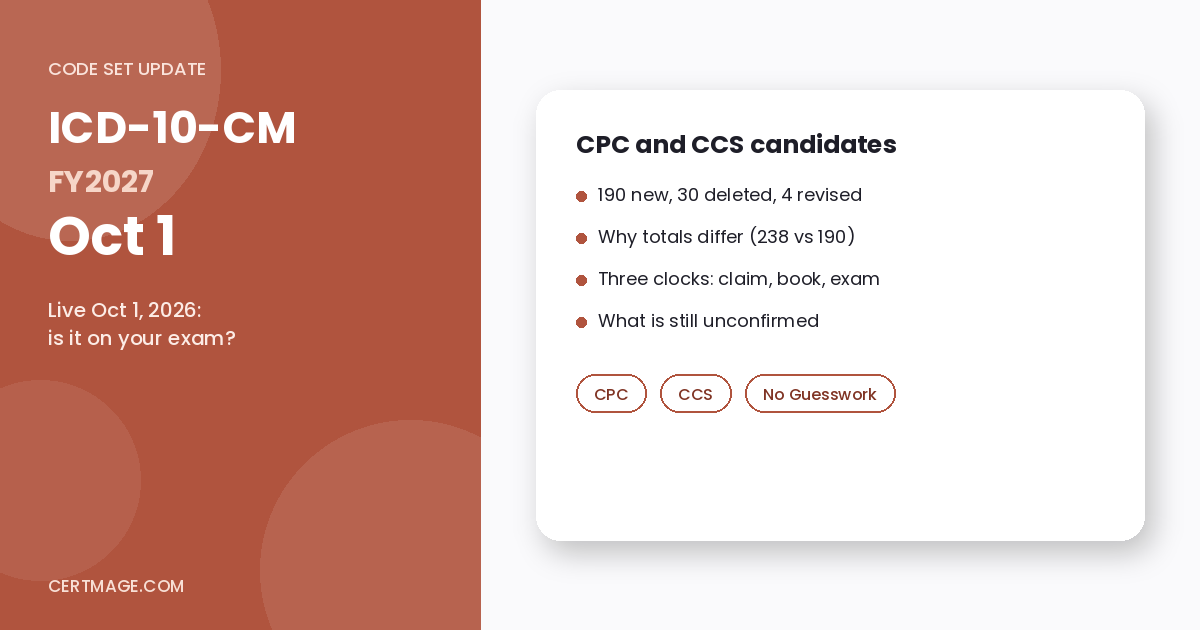
TL;DR: The FY2027 ICD-10-CM code set took effect on October 1, 2026. Most published summaries count 190 new codes, 30 deleted codes and 4 revised codes. The update is small by historical standards, but it touches everyday coding: plantar fasciitis, sternoclavicular sprains, cardiomyopathy, secondary cancers, BMI and toxic effects. For exam takers, the real question is not “what changed” but “which code set will my exam use, and when does that switch?” AHIMA has published its 2026 CCS book list (effective May 1, 2026) with no FY2027 transition guidance. AAPC does not state a first-test date for the October update on the pages we could read. This guide separates what is confirmed from what is inference, so you can decide what to study and which books to carry.
Candidates who work in medical coding, or are studying to start, often hear “new codes are live” and assume the exam changed overnight. It usually does not work that way. Claims, exams and code books run on three different clocks. This post walks through each one.
Quick Facts
| Item | What the sources say |
| Code set | FY2027 ICD-10-CM (diagnosis codes) |
| Released | July 2, 2026 (per ACDIS) |
| Effective for claims | October 1, 2026 through September 30, 2027 (per CMS) |
| New codes | 190 (most summaries) |
| Deleted codes | 30 (most summaries) |
| Revised codes | 4 (most summaries) |
| Alternate count | 238 additions and 21 deletions when non-billable headings are counted (reported by Libman Education) |
| Guideline changes | Described as minimal: one new guideline plus refinements |
| Grace period | None reported for claims |
| CCS exam code books | 2026 editions required for exams on or after May 1, 2026 (AHIMA) |
| CPC exam FY2027 start | Not stated on the pages we could read |
| Average pay (reported) | CPC about $60,920; CCS about $62,579 (ZipRecruiter averages) |
The Three Clocks: A Simple Way to Think About FY2027
Most confusion about code set updates comes from mixing up three separate dates.
| Clock | Who controls it | What it decides | FY2027 status |
| Claim clock | CMS and CDC | Which codes you must use on real encounters | Switched October 1, 2026 |
| Book clock | Publishers | When 2027 books are on shelves | AAPC shows many 2027 titles as pre-order |
| Exam clock | AAPC, AHIMA | Which code set the exam tests and allows in the room | Not confirmed for FY2027 |
The claim clock is the only one that has already ticked. If you work as a coder today, you are coding to FY2027. If you are sitting an exam, the exam clock decides, and it is set by the credentialing body, not by CMS.
How Many Codes Actually Changed? Reconciling the Numbers
If you searched this topic, you saw different totals. That is not a mistake in one article. It is a counting difference.
| Count | Where it appears | What it likely includes |
| 190 new, 30 deleted, 4 revised | ACDIS, AGS Health, Physicians Practice, Libman Education | Reportable (billable) codes |
| 238 new, 21 deleted | Reported by Libman Education as an alternate view | Adds non-billable headings to the new total |
| 150 new, 6 revised | One third-party code lookup site | Does not reconcile with the others |
The gap between 190 and 238 is 48. That matches the idea that 48 of the “new entries” are non-billable headings, which you cannot report on a claim. For a coder, the 190 figure is the one that matters, because those are the codes you can actually assign.
The “30 deleted” figure also hides a detail. One reconciliation of the addenda we reviewed split it into about 15 codes removed outright and about 15 that stopped being reportable because they became headings (parent categories that now need a more specific child code). We could not re-open the addenda files for this post, so treat that split as a reading to confirm against the official addenda rather than a published CMS statement.
What to do with this: quote 190 / 30 / 4 if someone asks, and know that a bigger number elsewhere usually counts headings.
Is FY2027 on My Exam? A Matrix for CPC and CCS Candidates
This is the section most readers came for. Here is what we can and cannot say.
| Question | CPC (AAPC) | CCS (AHIMA) |
| Official book requirement published? | AAPC’s books page says its ICD-10 books “can be used during certification exams” but does not state a required year | Yes. The CCS 2026 book list is effective May 1, 2026 and requires 2026 editions |
| FY2027 transition date stated? | Not on the pages we could read | No. The list says nothing about FY2027 |
| What a third-party prep source says | CodingClarified describes the CPC as using current calendar-year code sets with CPT updating each January and gives no first-test date for the October ICD-10-CM update | Not applicable |
| Risk if you guess wrong | Carrying the wrong book edition may cost you reference accuracy during the test | AHIMA states candidates without the correct books “will not be allowed to test and will forfeit their exam fees” |
| Safest move | Confirm the allowed edition with AAPC before your test date | Bring exactly the editions on the current AHIMA list, and check the page again before your exam |
Our inference, labeled as such: credentialing bodies typically publish a transition notice before a new ICD-10-CM year is tested, and the CCS list was last updated in January 2026. A notice for the 2027 code set may appear later. We have not seen one, and we will not pretend we have.
The practical rule: do not buy or throw away books based on this post. Check the AAPC and AHIMA pages the week you register, and again the week you test.
What Changed, Chapter by Chapter
The update is spread across 33 clinical topics according to AGS Health. Chapter-level counts below come from Libman Education and should be read as approximate.
| Chapter area | Approximate change | Examples |
| Injury and poisoning (Ch. 19) | About 60 new, about 15 deleted | Toxic effects of cycloparaffins (T52.82) and alkenes (T52.81) with 12 new codes each, medetomidine tracked as a fentanyl adulterant |
| Pregnancy (Ch. 15) | About 44 new | 33 codes in O31.4 for continuing pregnancy after vanishing twin syndrome, plus site-specific ectopic pregnancy codes |
| Musculoskeletal (Ch. 13) | About 31 new | Osteomyelitis by site, plantar fasciitis split by laterality (M67.A-) |
| Factors influencing health status (Ch. 21) | About 16 new | Exposure history, underweight BMI ranges, gender identity related Z codes |
| Neoplasms | New specific sites | C78.31 larynx, C78.32 pharynx, C79.83 oral cavity secondary malignancies |
| Circulatory | Cardiomyopathy detail | I42.0 dilated cardiomyopathy expands; arrhythmogenic cardiomyopathy, CPVT, Brugada syndrome, ventricular bigeminy added |
| Respiratory | New sinusitis detail | Odontogenic sinusitis (J34.83-) |
| Digestive | New category | K6A for pelvic diseases |
Why these matter for exam prep
Exam questions tend to reward specificity: laterality, trimester, encounter type, and the difference between a parent heading and a reportable code. Several FY2027 changes are built around exactly those skills.
- Laterality: plantar fasciitis now requires you to choose a side.
- Trimester and episode of care: O31.4 codes are structured by trimester and encounter.
- Intent and encounter: the new toxic effect codes carry specificity you must read from documentation.
- Parent versus child: I42.0 becomes a heading that needs a more specific code.
The D05 and C50 Disagreement
This is a good example of why we disclose conflicts.
| Source | What it says |
| AGS Health | D05 (carcinoma in situ of breast) codes can no longer be reported together with a C50 (malignant neoplasm of breast) code |
| Libman Education | The D05 note changes from Excludes1 to Excludes2 |
These two statements point in different directions. An Excludes1 note means two conditions generally cannot be reported together. An Excludes2 note means they can be. Both cannot describe the same rule. We could not open the official tabular addenda while writing this, so we cannot say which is right. Check the FY2027 tabular list before you code or study this one.
Deleted Codes: What Stops Working
| Deleted or retired item | Source | Note |
| Sternoclavicular sprain codes (S23.420 series) | ACDIS, AGS Health | Removed entirely, so documentation pathways must be rechecked |
| Organic solvent poisoning family | Physicians Practice | Described as an entire family being deleted |
| Old plantar fasciitis code | Physicians Practice | Replaced by three new codes requiring laterality |
| I42.0 as a billable code | Libman Education | Becomes a non-billable parent |
Old habits cause denials. If a coder has used the same sprain or heel pain code for years, October 1 is when it stops working.
Guideline Changes: Small, But Not Zero
Libman Education describes the guideline changes as minimal: one entirely new guideline about family history of diethylstilbestrol exposure, plus refinements for hypertension and congenital anomalies. We did not verify this against the official guidelines document, so treat it as a secondary summary. Exams test the official guidelines, so read the primary document for the year your exam uses.
Why Employers Care: Claims Do Not Wait
Physicians Practice warns the update takes effect with no grace period, and that the affected areas are high volume: shoulders, feet, bones and hearts. For a working coder this means:
- Encoder and EHR updates must be live on October 1.
- Old codes on new dates of service will reject.
- Documentation specificity (laterality, trimester, intent) becomes more valuable.
For an entry level candidate, that is a hiring argument. A coder who already knows the new specificity rules is easier to onboard.
Five Practice Scenarios Built From the FY2027 Changes
These are study prompts, not official exam questions. Each one shows the kind of specificity decision FY2027 rewards. Work out your answer first, then confirm it in the FY2027 tabular list.
| # | Scenario | What to decide | Where to look |
| 1 | A patient has heel pain diagnosed as plantar fasciitis in the left foot | Which M67.A- code applies, and why laterality is now required | M67.A- subcategory and its notes |
| 2 | A pregnant patient in her second trimester is seen for continuing pregnancy after a vanishing twin | Which O31.4 code fits trimester and encounter type | O31.4 category (33 new codes) |
| 3 | A patient with a known primary cancer has a new metastasis to the oral cavity | Which secondary malignancy code is now available instead of an unspecified site | C79.83 and neighboring C78 and C79 codes |
| 4 | A cardiology note documents dilated cardiomyopathy with a familial genetic cause | Why I42.0 alone is no longer enough and which child code is needed | I42.0 and its new subdivisions |
| 5 | A patient is seen for carcinoma in situ of the breast and an invasive breast cancer | Whether D05 and C50 can be reported together | D05 notes, which sources describe differently |
Scenario 5 is deliberately unresolved. It is the same conflict described earlier, and it is a good reminder that a coder resolves a disagreement by opening the primary file, not by choosing the summary they prefer.
What these scenarios have in common
Each scenario asks you to read documentation closely and pick the most specific supported code. That is the core skill both exams measure. The FY2027 changes are a fresh set of examples of that skill, which is why they are useful practice even if your exam has not switched to the new code set.
A Study Plan by Test Date
Your plan depends on how close your exam is. This table assumes you have confirmed which code set your exam uses.
| Your exam is… | Focus | Avoid |
| Within 30 days | Stay on the code set your credentialing body allows. Review guidelines, laterality, and parent versus child codes using the edition in your exam room | Switching books or re-learning a new edition the week before |
| In 1 to 3 months | Confirm the code set year, then build a short list of FY2027 changes as a side study so you are ready when the exam transitions | Treating the side list as the main study plan |
| More than 3 months away | Check for a published transition notice monthly. Study the FY2027 changes by chapter and practice with the official guidelines for the year your exam uses | Buying books too early if a transition notice has not been published |
A simple weekly rhythm
- Two sessions on guidelines. Read a section, then apply it to three short cases.
- Two sessions on code selection. Use the practice scenarios above and time yourself.
- One session on weak spots. Track the questions you missed and the reason: laterality, a missed note, or a parent code.
- One review session. Re-read your error log. Patterns matter more than any single miss.
If you are weighing your first credential, our CPC vs COC comparison and the CCS-P vs CPC guide help you pick the path before you pick the books.
Career and Salary: Does FY2027 Change Math?
It does not change pay directly. A code set update is routine for working coders. But it does reinforce one point: credentials matter because they show you can keep up with annual changes.
| Credential | Reported average salary | Source |
| CPC | About $60,920 | ZipRecruiter |
| CCS | About $62,579 | ZipRecruiter |
These are averages from one aggregator. Pay varies widely by state, setting (hospital inpatient versus physician practice), experience and remote status. Do not treat them as offers.
If you are deciding between credentials, these CertMage guides go further:
- CPC vs COC for outpatient hospital versus physician office coding
- CCS-P vs CPC for the AHIMA versus AAPC choice
- CPB vs CPC if billing is part of your plan
- CIRCC vs CPMA for specialty and auditing paths
- Which coding certification pays the highest salary for a wider comparison
- Remote medical coding jobs if working from home is the goal
What We Don’t Know Yet
| Open question | Why it matters |
| The first exam date AAPC will test FY2027 ICD-10-CM | Decides which book edition you should study |
| Whether AHIMA will publish a 2027 CCS book list and when | Wrong books mean you cannot test |
| Whether D05 and C50 can be reported together | Affects one common oncology scenario |
| The exact split between deleted and heading conversions in the 30 | Affects how you describe the update |
| Whether the guideline summary above matches the official document | Exams test the official guidelines |
How to Prepare If Your Exam Is Soon
- Confirm your exam’s code set year. Check AAPC or AHIMA directly. Do this before buying books.
- Keep the books on the official list. For the CCS, that means the 2026 list until AHIMA says otherwise.
- Learn the pattern, not just the codes. Laterality, trimester, intent and parent versus child headings show up repeatedly.
- Read the guidelines for the correct year. Do not rely on summaries for what the exam tests.
- Practice with the right edition. Using a mismatched book in practice builds the wrong habits.
- Plan for renewal. Learning new code sets counts toward continuing education. See medical coding certification renewal and CEU requirements.
Common Mistakes
| Mistake | Why it hurts |
| Assuming the exam switched on October 1 | The claim clock and exam clock are different |
| Buying 2027 books before confirming the exam | You may not be allowed to use them |
| Quoting 238 new codes as “billable” | That figure includes headings |
| Using the old plantar fasciitis or sternoclavicular sprain codes | They no longer work for new dates of service |
| Trusting one summary on D05 and C50 | Sources disagree |
| Skipping the official guidelines | Exams test the official document |
FAQS
Did the ICD-10-CM code set change on October 1, 2026?
Yes. The FY2027 code set applies to encounters and discharges from October 1, 2026 through September 30, 2027, according to CMS.
How many new codes are in FY2027 ICD-10-CM?
Most summaries report 190 new codes, 30 deleted and 4 revised. Some sources report 238 new entries when non-billable headings are included.
Why do sources report different totals?
Counting methods differ. The larger totals appear to include headings that cannot be reported on a claim, and one lookup site’s totals do not reconcile with the rest.
Is the FY2027 code set on the CPC exam?
We could not find an official statement of the first test date for the October update. Confirm with AAPC before your exam date.
Do I need 2027 code books for the CPC?
Do not assume so. AAPC’s books page does not state a required year, and 2027 titles were shown as pre-order. Confirm the allowed edition with AAPC first.
Which books does the CCS exam require?
AHIMA’s list, effective May 1, 2026, requires 2026 editions of ICD-10-CM, ICD-10-PCS and the AMA CPT Professional Edition. Candidates without the correct books will not be allowed to test.
Will AHIMA publish a 2027 CCS code book list?
We do not know. The current list contains no FY2027 transition guidance. Check AHIMA’s page before you register and again before you test.
What are the biggest FY2027 changes to know?
Plantar fasciitis by laterality, the removal of sternoclavicular sprain codes, new secondary cancer sites, expanded cardiomyopathy codes, the O31.4 vanishing twin codes, new toxic effect codes and BMI refinements.
Can D05 and C50 be reported together?
Sources disagree. One says no, another says the note changed to Excludes2. Check the FY2027 tabular list.
Are there any new coding guidelines for FY2027?
One summary describes one new guideline about family history of diethylstilbestrol exposure and refinements to hypertension and congenital anomaly guidance. Read the official guidelines to confirm.
Does the update change CPC or CCS salary?
Not directly. Reported averages are about $60,920 for CPC and $62,579 for CCS, and pay depends more on setting, experience and location.
Should I delay my exam to wait for the new code set?
Only if the credentialing body tells you the exam will change on a date near yours. Without that notice, there is no published reason to delay.
Where can I read the official FY2027 files?
The CMS ICD-10 page and the CDC ICD-10-CM page host the code files, guidelines and addenda.