Quick Answer: The Azure AI certification path runs from AI-900 (fundamentals, no prerequisites, $99) through AI-102 (associate engineer, $165) to DP-100 (data scientist, $165), with expert-level credentials like AZ-305 at the top. For most people entering or growing in AI in 2026, the fastest path to a high-salary role is AI-900 followed directly by AI-102. This guide covers every exam, every domain, every salary figure, and exactly which path is right for your specific situation.
Why the Azure AI Certification Path Matters More in 2026 Than Any Year Before It
Artificial intelligence in 2026 is no longer experimental. 71% of companies are already operationalizing AI, and there is a 52% talent shortage of professionals who can implement it. The gap between demand and supply has created one of the strongest salary premiums in technology history.
Microsoft Azure sits at the center of this opportunity. Azure skills appear in 40% of cloud job postings, and Azure professionals with AI and cloud skills command 40 to 50% salary premiums over their non-certified peers. The reason is structural: Microsoft Azure powers 85% of Fortune 500 companies and has integrated generative AI directly into the Microsoft 365 stack via Copilots, making it the backbone of corporate productivity.
The global cloud market is projected to grow from $738 billion in 2026 to $1.6 trillion by 2030, and Microsoft invested $55.7 billion in cloud and AI infrastructure in FY2024 alone.
For anyone building or repositioning a technology career, the Azure AI certification path is not a nice-to-have. It is the most direct route to the jobs the market is hiring for right now.
The Complete Azure AI Certification Path at a Glance
Before going deep on each certification, here is the full path so you can see where every exam fits.
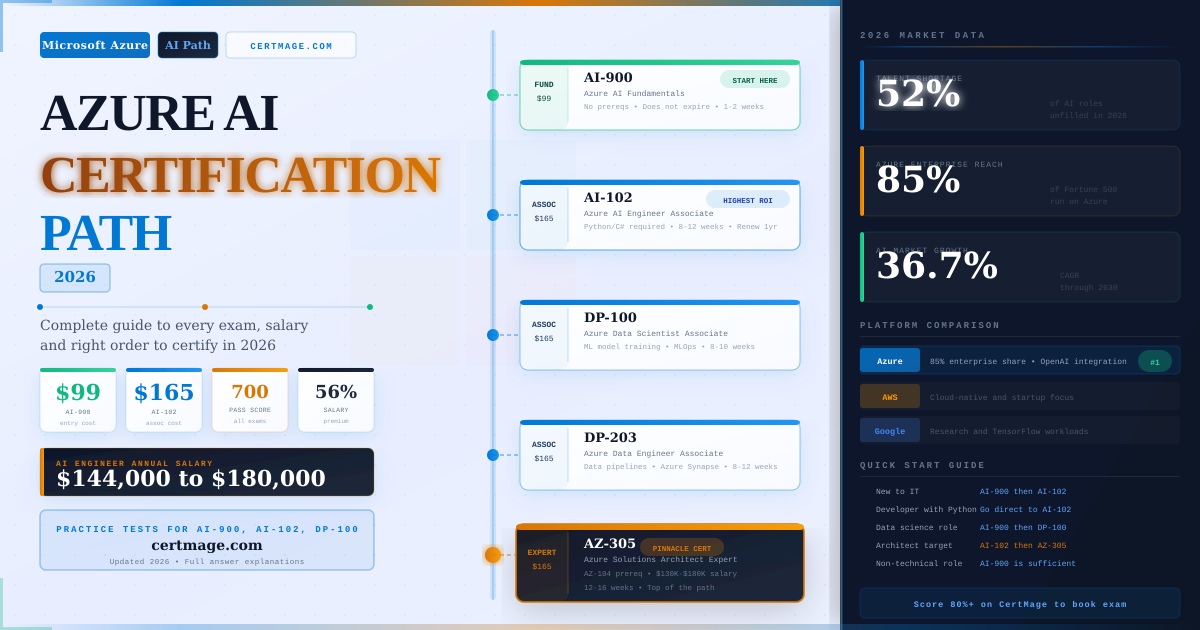
| Certification | Exam | Level | Cost | Validity | Time to Prepare |
| Azure AI Fundamentals | AI-900 | Fundamentals | $99 | Does not expire | 1 to 2 weeks |
| Azure AI Engineer Associate | AI-102 | Associate | $165 | 1 year | 8 to 12 weeks |
| Azure Data Scientist Associate | DP-100 | Associate | $165 | 1 year | 8 to 10 weeks |
| Azure Data Engineer Associate | DP-203 | Associate | $165 | 1 year | 8 to 12 weeks |
| Azure Solutions Architect Expert | AZ-305 | Expert | $165 | 1 year | 12 to 16 weeks |
Three facts about this path that candidates frequently get wrong:
First, AI-900 does not expire. As a fundamentals-level certification, the Microsoft Certified: Azure AI Fundamentals certification does not expire. No renewal is necessary. Every other AI certification on the path requires annual renewal.
Second, the AI-102 certification must be renewed annually by passing a free, online, unproctored renewal assessment on Microsoft Learn. This assessment is shorter and focuses on recent updates to Azure AI technologies.
Third, the path is not linear for everyone. Your background, your target role, and your timeline determine the optimal sequence. The sections below give you a clear decision framework.
Stage 1: AI-900 Azure AI Fundamentals (The Starting Point)
Who This Is For
The AI-900 is a foundational, entry-level certification that proves your AI literacy. It is the perfect first step for anyone who wants to understand AI before building with it. This includes students, business professionals, IT administrators, project managers, sales engineers, and developers who want a structured introduction before investing time in AI-102.
There are no official prerequisites. The exam is open to anyone, regardless of their technical background. No coding is required. No cloud experience is required.
Exam Details
The AI-900 exam consists of 40 to 60 questions in multiple-choice and drag-and-drop formats. Time is 60 minutes. The passing score is 700 on a scale of 100 to 1,000. The standard exam fee is $99 USD.
Five Domains and Their Weightings
Domain 1: AI Workloads and Considerations (15 to 20%)
This domain covers what AI actually is, how it differs from traditional software, and the scenarios where it is applied. You need to understand common AI workloads including machine learning, computer vision, natural language processing, and conversational AI. Responsible AI principles are also tested here: fairness, reliability, privacy, transparency, inclusiveness, and accountability.
Domain 2: Fundamental Principles of Machine Learning on Azure (20 to 25%)
This domain covers core machine learning concepts including regression, classification, and clustering models, and identifies the Azure Machine Learning service and its core features like automated machine learning (AutoML). At 20 to 25% this is the most heavily weighted domain on AI-900 and deserves the most study time.
Domain 3: Features of Computer Vision Workloads (15 to 20%)
This section covers image classification, object detection, and OCR. You need to know what each Azure Computer Vision service does and which real-world scenarios each applies to, not how to code them.
Domain 4: Features of Natural Language Processing (15 to 20%)
This domain covers sentiment analysis, speech recognition, and entity extraction. Know the Azure NLP services: Language service, Speech service, Translator, and their core capabilities.
Domain 5: Features of Generative AI Workloads (15 to 20%)
This domain covers the capabilities of Azure OpenAI Service and the basics of large language models. In the 2026 version this domain carries significant weight given how central generative AI has become. Know what large language models are, what prompt engineering means at a conceptual level, and what Azure OpenAI Service provides.
Retake Policy
If you do not pass on your first attempt, you must wait 24 hours before retaking it. For any subsequent attempts, a 14-day waiting period is imposed. You may not take the same exam more than five times in a 12-month period.
How Long to Study
For most individuals, 1 to 2 weeks of focused study is sufficient. If you are completely new to technology concepts, plan for 3 to 4 weeks. Microsoft Learn provides free training modules covering every exam objective. Use the Cert Mage AI-900 practice test bank to validate your readiness in the final week.
Salary After AI-900
AI-900 alone is an entry point, not a destination. Entry-level AI professionals with the AI-900 certification can earn around $70,000 per year, while experienced AI engineers or cloud specialists can earn over $100,000 annually. The certification is most valuable as a foundation that reduces time-to-pass on AI-102, which is where the significant salary premium begins.
Stage 2: AI-102 Azure AI Engineer Associate (The Career-Defining Credential)
Who This Is For
The AI-102 is a developer exam. It requires significant coding experience. You should have built several small applications that call Azure AI services using the SDKs before sitting this exam.
This credential requires proficiency in Python or C#. The exam was overhauled to include agentic AI and RAG architectures, reflecting how dramatically enterprise AI engineering has evolved in the past two years.
If AI-900 is the driver’s manual, AI-102 is the mechanic’s guide. One teaches you concepts. The other tests whether you can actually build.
Exam Details
The AI-102 exam has a passing score of 700 on a scale of 100 to 1,000. The standard exam fee is $165 USD. The typical preparation window is 8 to 12 weeks, depending heavily on your existing development experience, particularly with Python or C#.
Five Domains and Their Weightings
Domain 1: Plan and Manage an Azure AI Solution (25 to 30%)
Candidates often find the breadth of services to be the biggest challenge. You need to understand the specific capabilities of various services and, more importantly, which service is the best choice for a particular business problem. The “Plan and manage an Azure AI solution” domain tests this decision-making skill heavily.
This domain tests your ability to select the right Azure AI service for a given scenario, design solution architectures, manage costs and quotas, secure AI services with keys and managed identities, and monitor service health and performance.
Domain 2: Implement Decision Support Solutions (10 to 15%)
This domain covers Azure AI Personalizer and recommendation systems. While the smallest domain by weight, it appears frequently in scenario-based questions where candidates must determine whether a decision support solution is appropriate versus a classification model or custom logic.
Domain 3: Implement Azure AI Vision Solutions (15 to 20%)
Practical implementation of Azure Computer Vision, Custom Vision, Face API, and Document Intelligence. Questions here go beyond conceptual understanding and test your ability to configure services, interpret API responses, and handle edge cases in production implementations.
Domain 4: Implement Natural Language Processing Solutions (25 to 30%)
Tied with Domain 1 as the highest-weighted domain. Covers Azure AI Language service, Azure AI Speech, Azure AI Translator, and question answering solutions. You need hands-on experience calling these services through their SDKs and APIs.
Domain 5: Implement Generative AI Solutions (10 to 15%)
This domain covers content generation, token management, and prompt engineering, as well as creating custom autonomous agents that perform multi-step tasks through agentic AI patterns. This domain has grown in importance with the 2026 exam update and now includes RAG implementation using Azure AI Search alongside Azure OpenAI Service.
What Makes AI-102 Challenging
The biggest challenge is service selection at scale. The exam presents realistic business scenarios and expects you to know not just what each Azure AI service does but which combination of services best solves the stated problem within the stated constraints. Two services might both technically work. The correct answer is the one that works most efficiently, securely, or cost-effectively given everything the scenario specifies.
Hands-on lab work is non-negotiable for this exam. Reading about Azure AI services is insufficient preparation. You need to have called the APIs, handled authentication, debugged SDK errors, and built end-to-end solutions that connect multiple services.
Salary After AI-102
According to ZipRecruiter, the average annual salary for an Azure AI Engineer in the United States is approximately $158,110, with many roles ranging from $141,500 to $173,500. Glassdoor reports the estimated total pay for a general AI Engineer is around $144,228 per year.
Roles that align with this certification commonly fall in the $120,000 to $180,000 salary band, especially in companies that already live in Azure, Microsoft 365, and Dynamics.
Research shows that certified IT professionals earn an average of 8 to 15% more than those without certifications. In high-demand specializations like Azure AI, that gap widens even further.
Renewal
The Microsoft Certified: Azure AI Engineer Associate certification is valid for one year. You must renew annually by passing a free, online, unproctored renewal assessment on Microsoft Learn.
Stage 3: DP-100 Azure Data Scientist Associate (The Data Path)
Who This Is For
DP-100 is the right next step if your work focuses on training, experimenting with, and deploying machine learning models rather than integrating pre-built Azure AI services. Where AI-102 is about implementing AI solutions using Azure’s managed services, DP-100 is about building and managing the models themselves.
If you work in data science, ML engineering, or research, DP-100 is your primary credential. If you work in application development and AI integration, AI-102 delivers more immediate career return.
Exam Details
The DP-100 exam costs $165 USD. The passing score is 700 on a scale of 100 to 1,000. Preparation typically requires 8 to 10 weeks for candidates with Python and data science foundations.
Four Domains and Their Weightings
Domain 1: Design and Prepare a Machine Learning Solution (20 to 25%)
This domain covers setting up Azure Machine Learning workspaces, data assets, and compute clusters. You need to know how to configure Azure ML environments, manage datastores, and design the infrastructure for a scalable ML project before a single experiment is run.
Domain 2: Explore Data and Train Models (35 to 40%)
This is the largest domain and covers using the Azure ML SDK to run experiments and track models with MLflow. At 35 to 40%, this is the most important domain on DP-100. Know how to use the Azure ML Python SDK v2, run training scripts as jobs, track metrics with MLflow, compare experiment runs, and use automated ML to identify optimal model configurations.
Domain 3: Prepare a Model for Deployment (20 to 25%)
This domain covers converting models to ONNX format and managing environment dependencies. It also covers online and batch deployment to managed endpoints, real-time inference configuration, and testing deployed models.
Domain 4: Implement Responsible AI (10 to 15%)
This domain covers using tools like Fairlearn to debug model bias. It also includes the Azure ML Responsible AI dashboard, model interpretability with SHAP values, and generating responsible AI scorecards for compliance documentation.
Salary After DP-100
Data scientists with the DP-100 credential in the United States typically earn between $125,000 and $165,000 depending on industry, experience level, and location. The certification is particularly valuable in financial services, healthcare, and technology sectors where custom ML model development is core to the business.
Stage 4: DP-203 Azure Data Engineer Associate (The Pipeline Path)
Who This Is For
DP-203 is the credential for professionals who build and manage the data infrastructure that feeds AI models. If AI-102 represents the engineer who deploys the AI application and DP-100 represents the scientist who trains the model, DP-203 represents the engineer who ensures clean, reliable, and scalable data flows into both of them.
This certification is highly valuable in organizations with large data estates because AI quality is fundamentally constrained by data quality. Every AI system is only as good as the data it receives.
What It Covers
DP-203 covers designing and implementing data storage solutions using Azure Data Lake Storage, Azure Synapse Analytics, and Azure Cosmos DB. It also covers data processing with Azure Databricks, Azure Stream Analytics, and Azure Data Factory for orchestrating pipelines. Security, monitoring, and optimization of data infrastructure round out the exam.
Salary After DP-203
Azure Data Engineers in the United States earn between $120,000 and $160,000 on average. The combination of DP-203 and AI-102 is particularly compelling in the job market because it covers the full data-to-production AI pipeline, a combination very few candidates hold and many organizations urgently need.
Stage 5: AZ-305 Azure Solutions Architect Expert (The Top of the Path)
Who This Is For
The AZ-305 is widely regarded as the pinnacle of the Azure certification path. It validates your ability to design and implement robust, secure, and scalable solutions on Azure. Solutions Architects are master translators who can convert business requirements into technical cloud architecture, making them indispensable to any organization.
AZ-305 requires the AZ-104 Azure Administrator Associate credential as a prerequisite. It is the appropriate target for professionals with 3 or more years of hands-on Azure experience who want to move into architecture, leadership, or high-level consulting roles.
Salary After AZ-305
According to ZipRecruiter, the average salary for an Azure Solutions Architect is $146,601 a year. Even the associate-level Azure certifications command an average salary of $129,253.
You can target job roles like Cloud Solutions Architect, Enterprise Architecture Lead, and Digital Transformation Architect, with salaries scaling from $130,000 to $180,000 and above.
Which Path Is Right for You: A Decision Framework
The Azure AI path branches based on your role, background, and career goals. Here is the direct guidance most guides avoid giving.
If you are new to IT and new to AI: Start with AI-900. Do not start with AI-102. The conceptual foundation AI-900 builds makes everything in AI-102 easier to absorb. Two to three weeks on AI-900 saves significant time in AI-102 preparation.
If you are a developer with Python or C# experience: You can move directly to AI-102 without AI-900. The AI-900 concepts are covered implicitly in AI-102 preparation. Take AI-900 afterward if you need it for a specific job requirement or want the credential on your resume.
If your work is in data and machine learning: Your primary target is DP-100. AI-900 is a fast optional foundation. AI-102 becomes relevant later if you move toward AI solution integration.
If you want to build data pipelines for AI: DP-203 is your primary target. It feeds into both AI-102 and DP-100 naturally and creates a highly employable combined skill set.
If you are targeting architect or leadership roles: Build through AI-102 and then pursue AZ-305 via the AZ-104 pathway. The combination of AI implementation depth and architecture breadth positions you for the highest-paid roles on the path.
If you are in a non-technical role: AI-900 is sufficient to demonstrate AI literacy and opens doors to AI-adjacent roles in sales, project management, consulting, and business analysis without requiring any technical implementation skills.
How to Save Money on Azure AI Exams
Microsoft offers several legitimate ways to reduce exam costs significantly.
Microsoft Virtual Training Days: Microsoft periodically offers free training events that include a free exam voucher upon completion. These events are announced on Microsoft Learn and are typically tied to specific certification tracks including Azure AI.
ESI Portal through your employer: If you work for a major corporation that uses Azure, you likely have access to the Microsoft ESI Portal, which provides 100% or 50% discount on all Azure exams.
Microsoft Learn Challenges at Ignite and Build: Twice a year during the Ignite or Build conferences, Microsoft hosts learning challenges. By completing a learning path on Microsoft Learn within 30 days, you earn a 100% free exam voucher.
Exam Replay bundle: The Exam Replay bundle on the Mindhub store provides the exam voucher plus one guaranteed retake and a practice test for approximately $160. For AI-900 at $99, this represents significant peace-of-mind value if you are not confident in your preparation.
Academic pricing: Students and educators can access reduced pricing on most Microsoft exams. Verify eligibility through the Microsoft certification portal when registering.
Azure AI vs Google Cloud AI vs AWS AI: Which Certification Path Wins in 2026
Candidates frequently ask how Microsoft Azure AI certifications compare to the equivalent Google Cloud and AWS paths. Here is the direct comparison.
Azure AI (AI-102): The strongest enterprise footprint by far. Azure currently leads in enterprise-level job postings due to its exclusive OpenAI integration. The AI-102 aligns directly with how Fortune 500 companies are implementing AI in 2026, through Azure OpenAI Service, Azure AI Search, and Microsoft Copilot integrations. Best choice for professionals targeting enterprise and government roles.
AWS (AIF-C01 and AIP-C01): Strongest in cloud-native and startup environments. AWS dominates cloud market share overall, and the new AWS Certified Generative AI Developer Professional (AIP-C01) is highly regarded for deep AWS implementation expertise. Best choice for professionals in AWS-centric organizations.
Google Cloud (Professional ML Engineer): Strongest in research-heavy environments and organizations with TensorFlow-based workloads. Less enterprise market share than Azure but highly respected in ML research and data-heavy industries. Best choice for professionals in companies with significant Google Cloud or research AI commitments.
For most professionals in 2026, Azure AI-102 delivers the highest return because the enterprise market where Azure dominates is also the market paying the highest salaries for AI implementation skills.
Building Your Study Plan: Week by Week
For AI-900 (2 to 3 Weeks)
Week 1: Complete the official Microsoft Learn AI-900 learning path. It is free, structured, and covers every exam objective. Focus particularly on Domain 2 (Machine Learning fundamentals) as the highest-weighted domain.
Week 2: Take practice exams on CertMage. Identify your weak domains from your practice scores and return to the relevant Microsoft Learn modules. Target 80% or above on timed practice tests before booking.
Optional Week 3: If you are scoring below 75% on practice tests, spend the additional week on weak domains before scheduling the exam.
For AI-102 (8 to 12 Weeks)
Weeks 1 to 2: Azure fundamentals review covering IAM, resource groups, and core service concepts. Set up your Azure free account and begin hands-on work immediately. Understanding the Azure portal and CLI is not optional for this exam.
Weeks 3 to 5: Domains 1 and 4, which together represent 50 to 60% of the exam. For Domain 1, focus on service selection decision-making. For Domain 4, build real NLP applications using the Language, Speech, and Translator SDKs. Call the APIs. Handle the responses. Fix the authentication errors.
Weeks 6 to 8: Domain 3 (Vision) and Domain 5 (Generative AI). For Domain 5, build a working RAG solution using Azure AI Search and Azure OpenAI Service. The exam now tests RAG architecture understanding specifically.
Weeks 9 to 12: Full-length timed practice exams using CertMage’s AI-102 practice bank. Review every incorrect answer with explanations. Target 80% or above consistently before booking your exam date.
For DP-100 (8 to 10 Weeks)
Focus the bulk of preparation on Domain 2 at 35 to 40%. Use Azure ML SDK v2 hands-on throughout. MLflow tracking, automated ML, and pipeline creation are the three highest-yield skill areas for exam day.
The Real Market Demand in 2026
The numbers are unambiguous. According to Pearson VUE’s 2026 Value of IT Certification Report, 63% of professionals received or expected a job promotion after earning their certification.
Azure-certified professionals earn 8 to 15% higher salaries than non-certified peers. Certification holders report an average $10,000 salary premium. AI-driven services now account for a growing share of Azure revenue, and GenAI-based cloud offerings saw 140 to 180% growth in 2026.
According to Payscale, the average salary of a professional with certified AI skills in the United States is $144,000. In general, individuals who earn AI certifications are expected to earn around $110,000 to $162,000, with entry-level roles often starting around $80,000.
AI certifications command a 56% premium over standard IT roles, and 92% of global businesses plan to adopt AI-powered solutions by 2028.
The talent shortage is real and structural. Companies cannot hire fast enough. Professionals who hold current, hands-on AI certifications are not competing with a large pool of equivalent candidates. They are entering a market where demand significantly outpaces supply.
Frequently Asked Questions
Which Azure AI certification should I get first?
For most people, AI-900 is the right starting point. It requires no prerequisites, costs $99, does not expire, and builds the conceptual foundation that makes AI-102 preparation faster and more effective. If you already have strong Python or C# development experience and understand cloud fundamentals, you can start directly with AI-102.
Is AI-102 or DP-100 better for my career?
It depends on your role. AI-102 is for developers who build AI-powered applications using Azure managed services. DP-100 is for data scientists who train, experiment with, and deploy machine learning models. If you write application code and want to add AI capabilities, take AI-102. If you work in data science and model development, take DP-100. Many professionals eventually take both.
How hard is the AI-102 exam?
AI-102 represents a massive leap in technical depth from AI-900. The exam requires hands-on coding experience with Azure AI SDKs, and candidates often find the breadth of services to be the biggest challenge. Plan for 8 to 12 weeks of preparation and make hands-on lab work the centerpiece of your study plan.
How much does the full Azure AI certification path cost?
At standard pricing: AI-900 is $99. AI-102 is $165. DP-100 is $165. DP-203 is $165. AZ-305 requires AZ-104 ($165) as a prerequisite and costs $165 itself. The full path from AI-900 through AZ-305 costs approximately $924 at standard pricing, significantly less if you qualify for ESI, student, or challenge voucher discounts.
Does the Azure AI certification expire?
The AI-900 certification does not expire. The AI-102 and all associate and expert-level Azure certifications are valid for one year and must be renewed annually via a free online assessment on Microsoft Learn.
Is Azure AI certification worth it in 2026?
The return on investment is well documented. Earning a certification is one of the quickest ways to increase your salary. The $99 to $165 exam investment against a $10,000 average salary premium represents one of the highest ROI credentials in technology. For professionals targeting AI roles specifically, the Azure AI path is the most direct route to the highest-paying positions in the market.
How many times can I retake Azure AI exams?
You can take a specific exam a maximum of five times within a 12-month period. This 12-month clock starts from the date of your very first attempt. The first retake requires a 24-hour wait. Subsequent retakes require a 14-day wait. Each attempt requires a new exam fee payment.
What jobs can I get with Azure AI certifications?
AI-900 opens doors to AI-adjacent roles including project manager, business analyst, pre-sales engineer, and AI consultant without requiring implementation skills. AI-102 opens engineering roles including Azure AI Engineer, AI Solutions Architect, Machine Learning Engineer, Conversational AI Developer, and Cognitive Services Developer. DP-100 targets Data Scientist, ML Engineer, and AI Researcher roles.
The Bottom Line
The Azure AI certification path is the most clearly defined, employer-recognized, and financially rewarding credential sequence in AI for 2026. Every step of the path maps to a specific set of real job titles with documented salary ranges and genuine employer demand.
The path is not complicated. Start with AI-900 if you need the foundation. Move to AI-102 to become the developer who builds real AI solutions on Azure, which is the credential with the highest current market demand. Add DP-100 if your work involves model training and data science. Build toward AZ-305 if architecture is your destination.
The market shortage of certified Azure AI professionals is not closing any time soon. A job role like computer and information research scientists, which encompasses numerous AI roles, is expected to rise by 26% between 2023 and 2033. The professionals who certify now enter a market where demand outpaces supply at every experience level.
The CertMage Azure AI practice test library covers AI-900, AI-102, and DP-100 with full scenario-based question banks, updated for 2026, with complete answer explanations for every question. When you consistently score 80% or above on timed full-length practice exams, you are ready to pass.