The CCNA 200-301 exam. It’s one of those tests that can either launch your network career or crush your confidence if you walk in unprepared. And truth be told, with the way Cisco has shaped the CCNA over the years, it’s no longer about just memorizing a few facts or knowing what a router does. They want you to actually understand stuff, how routing protocols interact, how to configure devices, and why that IP address just won’t behave.
In 2026, the CCNA 200-301 by Cisco is still a beast of a certification. If you’re planning to become a Cisco Certified Network Associate, your preparation must include putting in the time, grinding through practice questions, and seriously learning what you’re doing. But here’s the thing: most folks overcomplicate the whole prep process. They get tangled up in 300-page books, go down rabbit holes on YouTube, and lose weeks trying to understand subnetting like it’s rocket science.
We’ll break down how to actually pass the exam using real CCNA 200-301 dumps, targeted study sessions, and a 7-day sprint method that’s worked for tons of network engineers before you with strategies to tackle various exam questions . If you are on your first attempt or trying again, this approach is different.
Why The CCNA Still Matters in 2026?
Before diving into the dumps and the study sprint, let’s address the obvious: Is the CCNA or Cisco Certified Network Associate even worth it in 2026?
Absolutely. Companies still need folks who can configure network devices like routers, assign IP addresses, set up switching, secure the network, and keep packets flowing. Whether it’s a service provider, a small biz, or a giant data center, someone has to keep the devices connected and the services online.
Getting your certification shows you understand the primary function of network devices. You’re not just clicking buttons; you know what those commands mean. That alone gives you a massive edge over job applicants who just talk tech but can’t configure squat.
What’s Inside the CCNA 200-301 Exam?
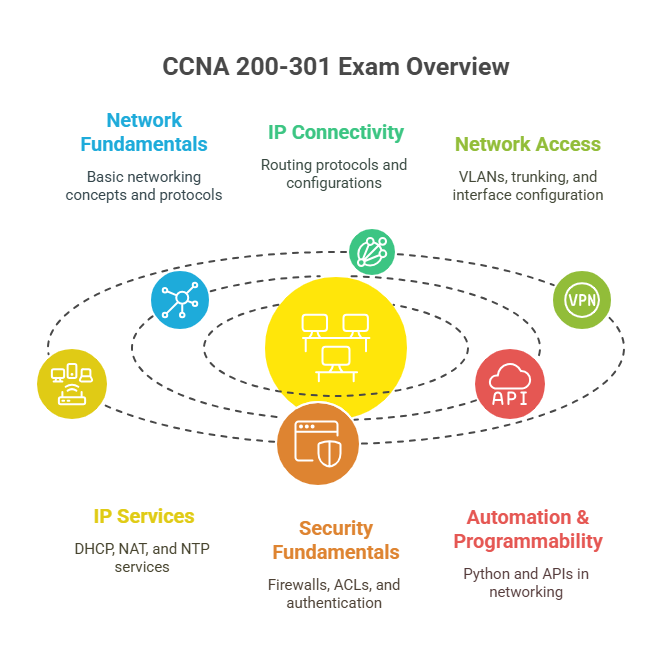
The 200 301 exam covers a lot. You will get hit with questions on:
- Network Fundamentals: Think of the basics, TCP/IP, what happens to packets, MAC addresses, switches, routers, etc.
- IP Connectivity: Static route setups, routing table decisions, and some basic routing protocols like OSPF.
- Network Access: VLANs, trunking, STP, interface configuration.
- IP Services: DHCP, NAT, NTP, and more.
- Security Fundamentals: Firewalls, ACLs, and authentication.
- Automation & Programmability: Yep, some Python and APIs show up too.
The test is mostly multiple choice, drag and drop, a few command line questions, and maybe some simulation-style ones. Expect around 100–120 questions with a time limit of 120 minutes.
So how do you beat this thing?
You build a strong foundation, review smart, and train your brain to pick the correct answers fast.
And that’s where the dumps and the 7-day sprint come in to prepare you for the exam .
The Myth & Truth Behind CCNA 200-301 Dumps
People get weird about dumps.
You hear, “Oh, don’t use dumps, they’re cheating.” But here’s what most folks miss: Good dumps aren’t about cheating; they’re about a structured process of practice . They’re about practice.
There’s a huge difference between memorizing answers blindly and using dumps to understand patterns, question logic, and reinforce what you’ve already studied.
The right kind of dumps help you:
- Spot trick questions in Cisco’s style.
- Get familiar with the phrasing and answer structure.
- Focus your review time on repeated weak spots.
And let’s be real. You can read the textbook all you want, but if you can’t recognize how Cisco twists questions on subnetting or static route configs, you’ll lose points fast.
The top-quality CCNA 200-301 dumps are loaded with exam questions and practice questions that mimic the real thing. They help you train your brain for the test format, not just the theory.
How to Use Dumps Without Getting Burned?
Look, dumps are just files. If they’re outdated or full of wrong answers, you’re wasting your time.
Here’s how to tell if a dump is worth it:
- Are the answers correct? Double-check answers with lab tools or Cisco docs.
- Are the explanations detailed? A good dump doesn’t just say what’s right, it tells you why.
- Is it updated for 2026? This matters. Cisco rotates its pool often.
Once you’ve got a solid dump file, break your study time into short, repeated sessions. Practice questions in sets of 25 or 50. Don’t go for 200 at once; you will just burn out. Every wrong answer? Dig in. Learn it. Understand it.
The 7-Day CCNA Study Sprint (Yes, It’s Intense)
This is for those who’ve got basic networking knowledge, maybe from work, YouTube, or previous attempts, and want to cram smart for the CCNA 200-301 exam. No dragging it out. No boring theory dumps. Just what you need to pass fast.
Each day mixes focused review, hands-on practice, and targeted use of CCNA 200-301 dumps. If you commit to this for one week, you’ll walk into the exam way more confident.
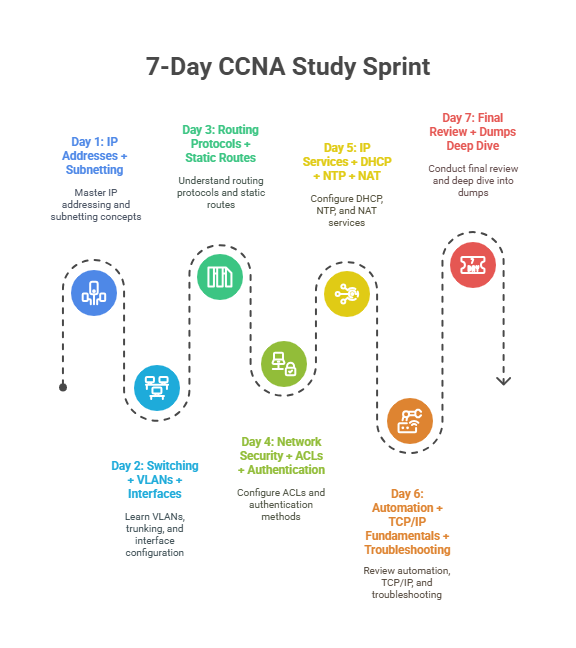
Day 1: IP Addresses + Subnetting
This is non-negotiable. You can’t pass CCNA without mastering IP addressing and subnetting.
- Study IP classes (A/B/C), private vs. public IPs.
- Learn to convert decimal to binary and back.
- Drill CIDR notation and subnet masks (/24, /30, etc.).
- Understand how to calculate usable hosts and subnet ranges.
- Make a cheat sheet showing powers of 2 and common subnet masks.
Use CCNA dumps to run through 50+ questions just on IP addresses, subnetting, and static routes. Track what confuses you and review those weak spots until they’re gone.
Day 2: Switching + VLANs + Interfaces
Switching is core CCNA content. You’ll get tested on VLANs, trunking, and interface configuration a lot.
- Learn to create and assign VLANs using vlan, name, and switchport commands.
- Understand trunk ports vs. access ports.
- Study interface states (up/down, err-disabled, etc.).
- Practice switchport security options (MAC sticky, shutdown, restrict).
- Read up on basic STP (Spanning Tree Protocol) operation.
Use Cisco Packet Tracer to simulate basic topologies. Then do 40–60 practice questions focused on VLANs, interfaces, and switching logic. Know how to spot and fix trunk mismatches and VLAN misconfigs.
Day 3: Routing Protocols + Static Routes
This day is all about Layer 3: making routers talk.
- Review how to set up static routes, including default routes (0.0.0.0/0).
- Study the logic behind the routing table, what gets added, what’s preferred.
- Learn the basics of OSPF (single-area is enough for CCNA).
- Practice how to route between VLANs (inter-VLAN routing).
- Know the impact of route metrics and administrative distances.
Aim for 60+ exam-style questions today. Be sure you understand what each command does (ip route, router ospf 1, network). Don’t just memorize, build mini labs and test it.
Day 4: Network Security + ACLs + Authentication
Security questions are common in CCNA. Cisco wants to see if you understand access control and basic authentication.
- Configure standard and extended ACLs (placement matters!).
- Use access-list, permit, deny, and access-group commands.
- Learn how to secure switch ports (port security).
- Set up SSH for remote access, using username/password authentication.
- Know how to use enable secret and line password configs.
Focus on ACL logic: where to apply them, in or out, and how they affect traffic. Do 40–50 practice questions on network security, ACLs, and authentication. Know the difference between filtering by IP and filtering by port.Day 5: IP Services + DHCP + NTP + NAT
This day covers IP services that run in the background but are critical to network function.
- Configure a DHCP pool and understand DHCP relay (ip helper-address).
- Learn how NTP (Network Time Protocol) keeps device clocks in sync.
- Understand the 3 types of NAT: Static NAT, Dynamic NAT, and PAT (Port Address Translation).
- Practice NAT inside/outside interface logic.
Revisit dumps focused on DHCP, NAT translation tables, and NTP setups. These aren’t tough topics, but Cisco throws in small syntax tricks to test if you’re actually reading configs. Try at least 30–40 practice questions.
Day 6: Automation + TCP/IP Fundamentals + Troubleshooting
Cisco includes automation and programming basics to test how familiar you are with modern networking trends.
- Know the purpose of APIs, REST, and JSON data formats.
- Understand how tools like Postman or Cisco DevNet fit into real networks.
- Review TCP vs. UDP, port numbers, and session establishment (SYN, ACK, FIN).
- Learn basic troubleshooting steps: ping, traceroute, interface status, config mismatches.
Then… take a full mock exam using your dumps or test software. Use a timer. No pausing, no notes—simulate the real thing. You should start to notice question patterns and spot wrong answers faster now.
Day 7: Final Review + Dumps Deep Dive
Now it’s time to clean up everything.
- Go through every question you got wrong in mock exams—understand why, not just what.
- Redo subnetting drills, static route configs, and ACL setups.
- Revisit weak areas: automation, routing protocols, IP services.
- Read through your corrected CCNA 200-301 dumps again. Focus on question patterns and answer logic.
- If possible, take one more mock exam or timed practice set.
End your day with confidence. If you’ve followed all 7 days properly, reviewed your mistakes, and understood the core networking functions, you’re ready.
When Studying More Actually Hurts Your Chances?
This part might sound backward, but it’s real; even as a developer, too much studying can mess you up.
Too much studying, especially the wrong kind, can mess you up. If you keep re-reading the same definitions, spending hours trying to memorize the OSI model for the 10th time, or watching 4-hour videos without ever touching the CLI, you’re not studying… you are procrastinating.
A lot of people fall into this trap. They think the more time they spend around CCNA content, the better they’ll do. But the CCNA 200-301 exam doesn’t test how many hours you studied, it tests how fast you can recognize what a certain config does, spot mistakes, and solve real-world network issues. That’s why practice questions and hands-on configs crush textbook-only learning.
You need to train like it’s a sport. Short bursts. High focus. Feedback loops.
That’s where good CCNA 200-301 dumps come in again. You’re not just reading info, you are stress-testing your understanding.
The Study Secrets CCIEs Don’t Always Share
Talk to someone who’s CCIE certified and they’ll often tell you something like: “Just read the official guide and do some labs.” Sounds simple, right?
But behind the scenes, they:
- Built configs by hand
- Used dumps to identify weird question patterns
- Failed once or twice before they passed
Here’s what they really did, even if they don’t say it openly:
- They focused 80% on hands-on and dumps-based practice.
- They ignored fluff chapters and drilled key concepts like routing protocols, authentication, and interface configs.
- They practiced subnetting until it became second nature.
- They created tiny networks to see how devices behave when routes break.
So don’t fall for the “read the book and pray” approach. Do what works. Lab and dump your way to a pass.
Network Simulators vs. Real Understanding
GNS3, Packet Tracer, Eve-NG, all of them are great. But people waste hours trying to build perfect labs that mirror enterprise setups. You don’t need all that.
What you need is function over form.
If you’re studying switching, spin up two switches. Configure VLANs. Watch how packets move. That teaches you more than watching a video or diagram.
If you’re learning routing, create three routers. Do static route configs. Break the connection. See how the routing table changes.
Same goes for DHCP, NAT, or NTP, build simple test setups and observe. That’s where real CCNA technical knowledge builds up. You’ll answer Cisco exam questions way faster after seeing how it all works.
Your First Attempt Matters More Than You Think
You only get one chance at your first attempt. If you go in unprepared, guessing through 60% of the test, you’re not just risking a fail, you’re damaging your confidence.
There’s something powerful about walking into that testing center with the feeling: I’ve seen every type of question already. That confidence comes from doing full-length dumps-based mock exams, reading the explanations, and practicing every weak spot.
Even if you fail later, your first attempt should feel like a serious shot, not a test run. Prep like it’s the only one you’ll take.
Don’t Just Memorize: Understand What the Answer Is Doing
Here’s a thing most CCNA learners don’t get: Cisco wants you to think.
You might get a question that looks familiar, but Cisco changes just one word and suddenly your memorized answer is wrong.
Example:
“Which interface command assigns an IP address to a router’s interface?”
If you memorized the answer “ip address,” you might pick that blindly. But they might change the context like:
“Which command is used in global config to define the IP address for a VLAN interface?”
Now you need to know about SVIs and how to enter interface config mode.
That’s why CCNA 200-301 dumps with explanations are gold. They help you understand why an answer works, not just what the answer is.
Let’s Talk About Time: How Much Study Time Is Enough?
There’s no single right number, but here’s a real breakdown for the average CCNA candidate:
- If you’re already working in networking: 2–3 weeks of targeted study with dumps + lab work is enough.
- If you’re brand new: Give yourself 5–6 weeks minimum, even with good dumps.
- 7-Day sprints work only if you’re laser-focused and already familiar with the basics.
Daily study time? 2 to 4 hours per day is realistic.
Remember, this exam doesn’t care about how long you studied. It cares about whether you can:
- Assign an IP address correctly
- Configure a static route
- Secure a switch port
- Understand how TCP sessions behave
- Set up DHCP properly
- Interpret a routing table quickly
That’s what counts.
How to Spot Fake or Useless Dumps (And Avoid Them)
The internet’s full of sketchy dumps. Some are filled with garbage questions that don’t reflect the current 200 301 exam. Others have outdated formats, wrong answers, or just zero explanations.
Here’s how to sniff out the bad ones:
- Outdated file format: If it says “CCNA v2” or “640-802” or anything before 2020, skip it.
- No question structure: If all questions are just one-liners with no context, skip it.
- Bad grammar or gibberish answers = red flag.
- No explanations for answers? It’s not useful.
- All answers are A or B? Definitely fake.
Look for quality dumps that reflect current CCNA standards, have a range of topics like IP services, routing table logic, automation, security fundamentals, and real switching configurations. A good one will include both the questions and the reasoning behind correct answers.
Why Best Exam Dumps in 2026 Actually Work (And Work Well)
A lot of dumps are just files with questions. No logic, no feedback, no learning. Cert Mage doesn’t play that game. Here’s what makes Cert Mage different, and honestly, the best exam dumps website for CCNA 200-301 dumps right now:
- Up-to-date exam questions: The content is aligned with the 2026 version of the 200 301 exam. You won’t be wasting time on old junk or questions that were retired years ago.
- Accurate answers with solid explanations: Every practice question comes with a breakdown of the correct answer. And if you get something wrong, you’ll actually learn from it instead of just memorizing.
- Covers the full range of CCNA topics: You get solid exposure to IP connectivity, routing protocols, VLAN configs, IP services like DHCP and NTP, network security, static route logic, subnetting, and even light automation.
- Real-world scenarios: Some of the best practice questions from Cert Mage simulate what you’d see in a real Cisco network setup. You’ll get configs with routing table entries, interface logs, and questions that actually test your brain.
- Mock exams that feel like the real deal: You can run full tests under timed conditions, which is super useful for training your brain to work fast under the actual time limit.
What Cert Mage Isn’t (And Why That’s a Good Thing)
It’s not a shortcut. It’s not a magic bullet. And it doesn’t promise to give you a brain dump that’ll let you pass without understanding a single config command.
But that’s exactly why it works. Cert Mage helps you build actual technical knowledge, so you’re not just passing the test, but also getting job-ready as a certified network associate (CCNA).
If your goal is to pass the written exam without panicking, skip the garbage dumps. If you want to pass with confidence and walk into a junior network engineer role where you actually know what the hell you’re doing, Cert Mage’s got your back.
Frequently Asked Questions
Can I pass using just dumps?
Not really. Dumps are great for practice and spotting Cisco’s question style, but they’re not a complete prep method. If you don’t understand the concepts, like how a static route works or what an ACL blocks, you’ll still get tripped up. Use dumps to test yourself after you study the topics properly.
What’s the best way to study subnetting?
Start with binary. Practice converting IPs and calculating subnets on paper. Understand how CIDR, masks, and address ranges work. Then reinforce it by solving 20–30 subnetting practice questions regularly until it clicks. Don’t rely on shortcuts, understand the math.
What if I fail on my first attempt?
No big deal, it happens. What matters is what you do next. Go back, review every weak area (especially routing protocols, IP services, or security fundamentals), redo those practice questions, and use detailed dumps with explanations. Then rebook the test while your memory’s still fresh.
Do I need to know automation or programming?
Only the basics. Know what APIs are, how JSON looks, and what Cisco’s automation tools can do. You won’t be coding, but you should understand terms like REST, network automation, and where they fit in today’s networks. It’s just 5–10% of the exam.
Is Packet Tracer enough for labs?
Yep. For CCNA-level skills, Packet Tracer is more than enough. You can configure routers, test IP addressing, set up DHCP, simulate NAT, and even build small topologies to practice. No need for expensive software, it covers everything you’ll face in the real exam.
Question preview
Sample CCNA 200-301 Exam Questions
Review representative questions, correct answers, and concise explanations from this exam resource.
-
Question 1
Which attribute does a router use to select the best path when two or more different routes to the same destination exist from two different routing protocols.
View answer and explanation
Correct answer: C. administrative distance
Explanation: Administrative Distance (AD) is the criterion a router uses to determine the trustworthiness of a routing information source. When a router receives routing information for the same destination prefix from multiple routing protocols (e.g., OSPF and EIGRP), it will prefer the route from the protocol with the lowest AD. This value, ranging from 0 to 255, is the first attribute checked to select the best path among different routing sources. A lower AD value indicates a more believable or preferred source.
-
Question 2
Which command prevents passwords from being stored in the configuration as plain text on a router or switch?
View answer and explanation
Correct answer: B. service password-encryption
Explanation: The service password-encryption command is a global configuration command that applies a weak, proprietary encryption (known as Type 7) to all currently unencrypted passwords and all future passwords configured on a Cisco device. This includes passwords for the console, auxiliary, and VTY lines, as well as local user account passwords set with the password keyword. Its primary function is to prevent casual viewing of passwords in plain text when examining the configuration files (running-config or startup-config), thereby providing a basic level of security.
-
Question 3
A frame that enters a switch fails the Frame Check Sequence. Which two interface counters are incremented? (Choose two)
View answer and explanation
Correct answer: D. CRC; E. input errors
Explanation: The Frame Check Sequence (FCS) field in an Ethernet frame trailer is used to verify the integrity of the received frame. The value is calculated using a Cyclic Redundancy Check (CRC) algorithm. If a receiving device, such as a switch, calculates an FCS value that does not match the value in the frame's trailer, it concludes the frame is corrupted. This specific type of error increments the CRC counter on the interface. The input errors counter is a cumulative total of all receive-side errors, including CRCs, runts, and giants. Therefore, whenever the CRC counter increments, the input errors counter also increments.