
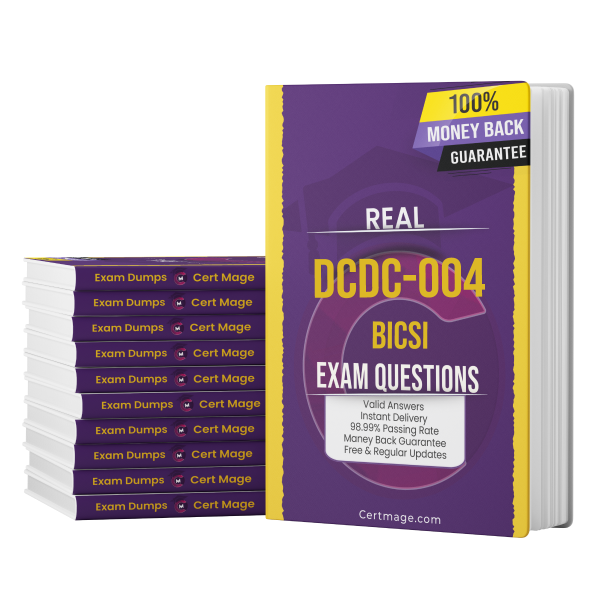

DCDC-004 Practice Questions for BICSI DCDC Certification
The DCDC-004 exam is the current assessment for the BICSI Data Center Design Consultant (DCDC) certification. It is intended for professionals involved in data center design, construction, operations, facility systems, ICT infrastructure, security, and commissioning. Candidates take it to demonstrate that they can turn business and operational requirements into coordinated data center solutions covering space, power, cooling, connectivity, resilience, security, and project delivery. Cert Mage supports this preparation with updated PDF-based exam-style practice questions, instant PDF access, an interactive test engine, 24/7 customer support, and refund and pass-guarantee options subject to the current published policy terms.
Current DCDC-004 Exam and Certification Details
BICSI offers the DCDC credential through the BICSI ICT Certification Institute. The current Version 4 exam uses code DCDC-004 and is aligned with ANSI/BICSI 002-2024 and Essentials of Data Center Projects, 2nd edition. Candidates preparing from older DCDC-002 or DCDC-003 material should check its relevance before relying on it.
| Exam detail | Current information |
|---|---|
| Exam code | DCDC-004 |
| Exam title | BICSI Data Center Design Consultant |
| Provider | BICSI ICT Certification Institute |
| Credential | Data Center Design Consultant (DCDC) |
| Exam version | Version 4 |
| Status | Active |
| Number of questions | 100 scored items |
| Duration | 2 hours |
| Question formats | Multiple-choice and enhanced items, including multiple-response, drag-and-drop, and hotspot questions |
| Delivery | Computer-based testing through Pearson VUE |
| Language | English |
| Passing score | No fixed public percentage; determined through psychometric analysis |
| Application fee | $510 for BICSI members and $725 for nonmembers |
| Renewal cycle | 36 months |
| Retirement notice | No announced DCDC-004 retirement or replacement found in current official information |
BICSI confirms that the application fee includes the first Pearson VUE exam attempt. Fees, scheduling policies, and testing availability can change, so candidates should verify them before applying. BICSI’s current DCDC page lists the exam format, study guidance, and current application fees.
Who Should Prepare for the BICSI DCDC Exam?
DCDC-004 is an advanced professional exam rather than an entry-level introduction to data centers. It suits data center designers, ICT consultants, facility engineers, architects, project managers, commissioning specialists, operations professionals, and technical staff who coordinate electrical, mechanical, architectural, and communications systems.
BICSI provides multiple eligibility routes. These include holding an active RCDD credential, or combining relevant data center experience with an accepted BICSI credential or qualifying degree. Another route is based on a longer period of verifiable full-time-equivalent experience in data center design, construction, or operations. Applicants should check the current DCDC Certification Handbook because BICSI may request proof of employment and project responsibilities.
Candidates with general networking knowledge but little exposure to facility power, cooling, capacity planning, fire protection, or commissioning should build those foundations first. The exam evaluates decisions across the full facility, not simply server and network administration.
DCDC-004 Exam Domains and Study Priorities
The current blueprint has six areas. The percentages make the first three domains responsible for 70 percent of the exam, but the smaller domains should not be ignored.
| Exam domain | Weight | Practical study focus |
|---|---|---|
| Concept Planning and Analysis | 30% | Requirements, capacity, growth, site selection, risk, availability, feasibility, costs, and design objectives |
| Systems: Architectural and Space Design, Mechanical, Electrical | 20% | Room layouts, equipment space, cooling, power distribution, redundancy, grounding, fuel, fire and life safety |
| Systems: IT, Ancillary Systems, Communications Connectivity | 20% | Servers, storage, networks, copper and fiber cabling, pathways, racks, BAS, fire protection, and supporting systems |
| Data Center Operations and Maintenance Assessment | 10% | Capacity, performance, efficiency, documentation, safety, maintenance, monitoring, and technology refresh |
| Security Assessment | 10% | Threat analysis, physical protection, access control, security layers, risk treatment, and recovery considerations |
| Construction Administration and Commissioning | 10% | Bid support, coordination, submittals, change control, testing, commissioning, closeout, and acceptance |
Concept Planning Requires the Most Time
This domain carries the highest weight because early decisions affect every later system. Candidates must connect client requirements with availability, capacity, growth, site conditions, risk, cost, and operational needs.
A useful exercise is to create a short requirements matrix for a fictional data center. Record the required IT load, growth period, availability objective, operating model, security needs, utility risks, and budget limitations. Then explain how each requirement changes the proposed design.
Power, Cooling, and Space Must Be Studied Together
Mechanical and electrical questions can be difficult for candidates who have worked mainly in ICT. Avoid studying power, cooling, and layout as separate lists. Learn how a change in rack density affects cooling demand, electrical distribution, floor space, pathways, redundancy, and future capacity.
Draw a simple one-line power path from utility service to the IT equipment. Create a second diagram showing heat removal from the rack to the external environment. For each component, identify failure points, maintenance needs, and possible redundancy choices.
Commissioning and Operations Need Practical Understanding
Some candidates focus heavily on design and leave commissioning until the final week. This is risky. The exam can test the order and purpose of submittal review, inspections, functional testing, issue tracking, acceptance, and project closeout.
Review how design intent moves into construction documents, testing procedures, operating records, and maintenance processes. Knowing what happens next in a project is often more useful than memorizing an isolated definition.
Prepare with Current Official Sources
BICSI recommends more than 125 hours of study for this credential. Experienced candidates may divide that work across 10 to 14 weeks. Someone who needs additional electrical or mechanical preparation may require a longer schedule.
The primary references for DCDC-004 are:
- ANSI/BICSI 002-2024, The Standard for Data Center Design
- Essentials of Data Center Projects, 2nd edition
- The current DCDC Certification Handbook and exam blueprint
- BICSI’s DCDC Test Preparation Course
- BICSI Data Center Flash Cards v4.0
- DC102 Applied Data Center Design and Best Practices, where formal training is appropriate
BICSI confirms that the current credential source set contains ANSI/BICSI 002-2024 and EDCP, 2nd edition. Its DCDC 24 Credential Set combines these two digital references.
Official publications should remain the source of truth. Practice material helps candidates retrieve, apply, and check that knowledge, but it should not replace the standards and official blueprint.
Cert Mage DCDC-004 PDF and Exam Simulator
Cert Mage provides DCDC-004 exam-preparation material in two complementary formats. Candidates receive updated PDF-based exam-style practice questions for flexible review and a test engine for structured, interactive practice.
These resources may also be described by searchers as DCDC-004 exam dumps. Cert Mage uses this term responsibly to refer to exam-style preparation material. The product does not claim to provide leaked, recalled, stolen, or unauthorized live examination content.
PDF-Based DCDC-004 Practice Questions
The downloadable PDF supports offline study, topic-focused revision, answer checking, and repeated review. Instant access allows candidates to begin without waiting for physical delivery.
The PDF works well for:
- Reviewing questions during travel or work breaks
- Studying one blueprint area at a time
- Marking uncertain or incorrect answers
- Rechecking difficult questions at a comfortable pace
- Building short 15-minute or 30-minute revision sessions
- Returning to official documentation when an explanation reveals a knowledge gap
Candidates should avoid memorizing an answer without understanding the design principle behind it. For scenario questions, identify the client requirement, the affected system, the main risk, and the reason one choice is more suitable than the alternatives.
Interactive DCDC-004 Test Engine
The exam simulator supports timed practice, interactive answer selection, performance checking, and weaker-area identification. It is particularly useful during the final preparation stage, when candidates need to improve pacing across a two-hour session.
A full 100-question exam allows an average of about 72 seconds per question. Faster factual questions can preserve time for calculations, diagrams, and longer scenarios. Simulator sessions help candidates test this pacing before the Pearson VUE appointment.
A Practical PDF and Simulator Workflow
Use the two formats in a repeating study cycle:
- Study one official blueprint domain from the current BICSI sources.
- Complete related PDF-based practice questions.
- Review each incorrect or uncertain answer.
- Return to the official standard for unclear concepts.
- Run a timed test-engine session.
- Record weak domains and recurring errors.
- Repeat targeted revision before the next simulator attempt.
This process turns practice scores into study decisions. A low result in electrical systems, for example, should lead to focused work on power paths, redundancy, grounding, capacity, and failure scenarios rather than another random question set.
Cert Mage also provides 24/7 customer support for product-access and download concerns. Refund eligibility and pass-guarantee eligibility depend on the current published Cert Mage terms. These policies do not promise that every purchaser will pass, and candidates should review the conditions before purchase or before submitting a claim.
A Realistic DCDC-004 Study Plan
During the first four weeks, read the blueprint and official references while creating concise notes. Spend about 30 percent of this phase on concept planning, 20 percent on architectural, mechanical, and electrical systems, and 20 percent on IT and supporting systems. Use the remaining time for operations, security, and commissioning.
During the next four weeks, shift from reading to application. Work through design scenarios and DCDC-004 practice questions. Build a mistake log with four columns: domain, misunderstood concept, correct principle, and official reference location.
In the final two to four weeks, use the simulator more often. Run both domain-focused sessions and complete timed practice tests. Review every uncertain answer, including correct guesses. Aim for consistent performance across all six domains rather than relying on one strong technical area.
Common preparation mistakes include using an older standard, studying only ICT systems, ignoring project sequence, memorizing practice answers, and postponing timed sessions. Another mistake is answering according to one employer’s internal method when the question asks for the principle supported by BICSI’s current source material.
Exam-Day Decisions and Time Management
Confirm the Pearson VUE appointment, identification requirements, location, and arrival time in advance. The exam contains interactive item types, so read the instructions before moving or selecting elements.
A practical approach is to answer clear questions first, flag uncertain items, and return later. Do not spend several minutes protecting one answer while leaving easier questions unseen. Pay close attention to wording such as “best,” “first,” “most appropriate,” and “based on the stated requirement.”
Career Relevance, Value, and Renewal
The DCDC credential can support work in data center consulting, facility design, ICT infrastructure, construction coordination, commissioning, capacity planning, operations assessment, and technical project leadership. Relevant titles may include data center design consultant, data center engineer, ICT consultant, facilities engineer, commissioning specialist, data center project manager, and infrastructure design lead.
Its return depends on the candidate’s experience, location, employer, and project responsibilities. Reliable DCDC-specific salary data is limited, so a fixed salary increase should not be assumed. The strongest value appears when employers, clients, or bids specifically require recognized data center design knowledge.
DCDC credentials follow a 36-month recertification cycle. The current policy requires 36 Continuing Education Credits, including at least one CEC from a BICSI Ethics Course. Credential holders should track activities throughout the cycle and check BICSI’s current recertification policy before renewal.
Professionals interested in expanding beyond data center design can also review our RCDDv14.1 exam questions. This related BICSI exam covers structured cabling, pathways, telecommunications spaces, and broader ICT distribution design, complementing the data center-specific knowledge assessed by DCDC-004.
Frequently Asked Questions
What is the DCDC-004 exam?
DCDC-004 is the current exam for BICSI’s Data Center Design Consultant credential. It tests integrated data center planning, facility systems, ICT connectivity, operations, security, construction administration, and commissioning knowledge.
Is DCDC-004 suitable for beginners?
It is intended for professionals with relevant data center experience. Candidates coming from general networking or IT support should first learn facility power, cooling, space planning, risk, availability, and commissioning fundamentals.
Is the DCDC-004 exam difficult?
The breadth makes it challenging. Candidates must connect architectural, electrical, mechanical, ICT, security, operational, and project-delivery decisions rather than depend on one technical specialty.
How long should I study for DCDC-004?
BICSI recommends more than 125 study hours. Many experienced candidates can distribute this work across 10 to 14 weeks, while those building mechanical or electrical knowledge may need longer.
Does Cert Mage provide updated DCDC-004 practice questions?
Yes. Cert Mage provides updated PDF-based exam-style practice questions for revision. They should be combined with the current BICSI blueprint, ANSI/BICSI 002-2024, and EDCP, 2nd edition.
Does the Cert Mage product include an exam simulator?
Yes. The test engine supports timed practice, interactive revision, answer review, performance checking, weaker-area identification, and pacing practice for the 100-question, two-hour exam format.
Can I download the DCDC-004 PDF immediately?
Yes. Instant PDF access lets candidates begin reviewing after purchase. The downloadable format also supports offline preparation during travel, work breaks, or locations with limited connectivity.
Does Cert Mage offer support, refunds, and a pass guarantee?
Cert Mage offers 24/7 customer support plus refund and pass-guarantee policies. Eligibility depends on the current published terms and conditions. These policies should not be interpreted as a promise of passing.

Reviews
There are no reviews yet.