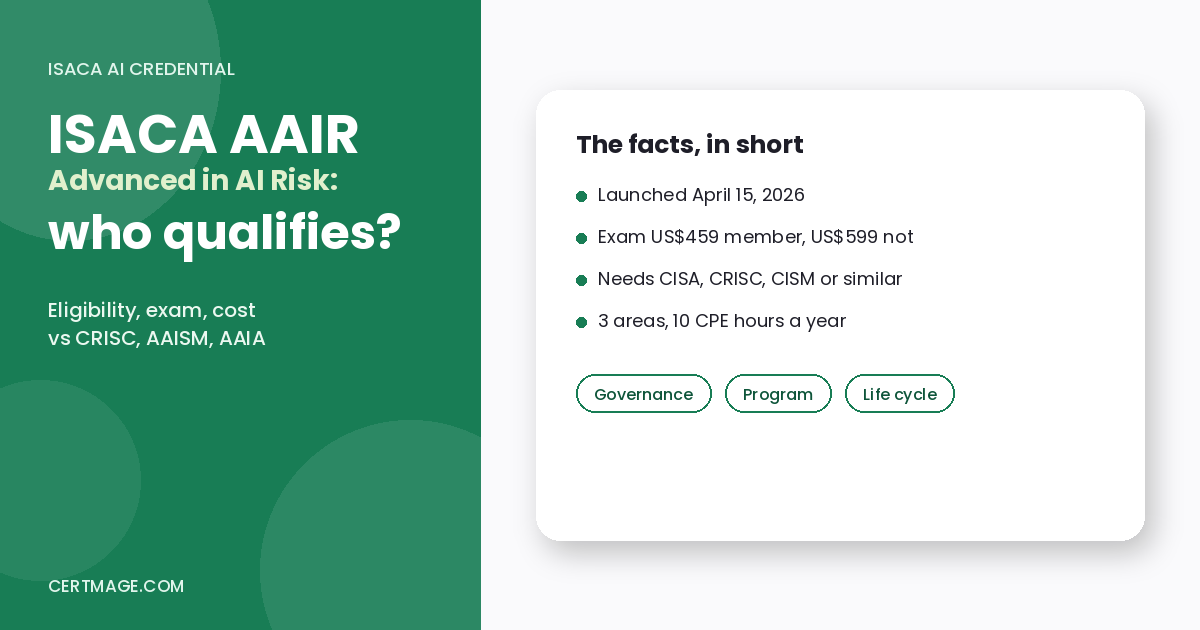
TL;DR: AAIR is ISACA’s AI risk credential for experienced IT risk, audit, security and governance professionals. It launched on April 15, 2026, after a beta in late 2025, and it is not an entry-level exam: you must already hold an approved credential such as CISA, CISM, CRISC, CGEIT, CDPSE or CISSP before you can certify. ISACA lists the exam at USD 459 for members and USD 599 for non-members, plus a one-time USD 50 application fee after you pass, and an annual maintenance fee of USD 45 (members) or USD 85 (non-members). The content is organized around three areas: AI governance, AI life cycle risk management and AI risk program management. If your daily work is risk assessment, control design, audit or board reporting and your organization is deploying AI, AAIR is the closest ISACA credential to your job. If you run security operations, look at AAISM. If you audit, look at AAIA. This guide covers who qualifies, what the exam tests, what it costs, how to apply, and how to decide.
AI risk is the part of governance, risk and compliance that has moved fastest in the last two years. Boards are asking for AI risk reporting, regulators are scrutinizing AI governance and third-party AI tools are showing up in business units that never went through a security review. AAIR is ISACA’s answer for the people who have to manage that.
Quick Facts
| Item | Details |
| Full name | Advanced in AI Risk (AAIR) |
| Awarding body | ISACA |
| Launched | April 15, 2026 (beta ran in late 2025 and early 2026) |
| Audience | Experienced IT risk, audit, security, GRC and governance professionals at staff, manager and director levels |
| Prerequisite credential | One of about 25 approved credentials, including CISA, CISM, CRISC, CGEIT, CDPSE, CRMP, CRMA, CGRC, CISSP, CIA, PMI-RMP and a list of accounting designations |
| Content areas | AI governance, AI life cycle risk management, AI risk program management |
| Exam fee | USD 459 (ISACA members), USD 599 (non-members) |
| Certification application fee | USD 50, paid after you pass |
| Annual maintenance fee | USD 45 (members), USD 85 (non-members), lower for a third and later ISACA credential |
| CPE | At least 10 hours per year and 30 AAIR-related hours over a three-year period |
| Delivery | Computer-based at PSI test centers or remotely proctored |
| Remote proctoring | Not allowed for residents of India, Mainland China and Hong Kong, who must use test centers |
| Eligibility window | Six months from registration to sit the exam |
| Time to apply after passing | Five years |
| Exam question count and duration | Not stated on the ISACA pages we could read, see the format section below |
All fees above are from ISACA’s own pages as we read them. Fee schedules change, so confirm at checkout before you pay.
What AAIR Is For
ISACA positions AAIR as an AI-focused IT risk management credential. It validates your ability to evaluate AI-related vulnerabilities, recommend responses that fit the organization’s risk appetite, embed oversight across the AI life cycle, support cross-functional decisions and deal with regulatory and ethical considerations.
Notice what is missing from that description. It does not say “build models”, “secure infrastructure” or “audit controls”. AAIR sits at the advisory and program level. The question it asks is: given an AI system in your organization, what are the risks, who owns them, how are they measured, what is the risk appetite and what do you tell leadership?
ISACA also says AAIR does not cover foundational IT risk concepts. That is why it needs a prerequisite credential: it assumes you already know how risk assessments, control frameworks and risk registers work, and it builds on that.
Who benefits most
| Role | Why AAIR fits |
| Risk manager or director | You need to put AI into the enterprise risk framework and report on it to boards and executives |
| Audit and assurance professional | You are asked whether AI governance is documented, robust and defensible |
| GRC specialist | You interpret regulatory expectations and map AI controls into the risk program |
| Cross-functional AI governance member | You work with technology, legal and data teams on deployment and life cycle oversight |
| CRISC or CISM holder with AI exposure | It extends a credential you already hold into the area your organization is asking about |
Signals that your organization needs this skill
ISACA’s own guidance points to a few situations where structured AI risk capability becomes necessary:
- AI is already running in operations or customer-facing processes
- Someone has asked for formal reporting on AI risk posture
- Third-party AI tools are embedded across business units
- Regulatory scrutiny of AI governance is increasing
- You have to explain AI exposure in non-technical language
If three or more of those describe your situation, the credential is a practical investment, not a trophy.
Eligibility: The Prerequisite Is the Real Gate
This is the most important thing to check before you spend anything. AAIR is open only to people who hold an approved qualifying credential. ISACA’s page lists:
| Group | Qualifying credentials |
| ISACA | CISA, CISM, CRISC, CGEIT, CDPSE |
| Risk and security | CRMP and CRMP-FED, CRMA, CERP and CRCM, CGRC, CISSP, CIA, PMI-RMP |
| Accounting | CGMA, Canadian CPA, ACCA, FCCA, U.S. CPA, Japanese CPA, ACA, FCA (ICAEW), CA ANZ, FCA ANZ, CPA and FCPA (HKICPA), and the Nigerian ANAN CNA |
Two notes. First, one ISACA sub-page describes the requirement more narrowly (an active CRISC or another qualified designation), while the main AAIR page lists the broader set above. Treat the main page and the “get certified” application as the controlling source and confirm that your credential is accepted before you register. Second, you need the credential to be active, so check that your own CPE and fees are up to date.
If you do not hold any of these yet, the realistic path is to earn one first. For an audit-oriented person, our CISA exam page is the starting point. For governance, look at the CGEIT exam page. For privacy-leaning roles, the CDPSE exam page is the route.
What the Exam Covers
ISACA organizes AAIR around three areas. The naming differs slightly between ISACA pages (the certification page calls the first one AI Enterprise Governance, while ISACA’s announcement and launch materials call it AI Risk Governance and Framework Integration), so use the exam content outline as the authority. We did not find published weightings for the areas.
| Area | What it covers | What to expect |
| AI governance and framework integration | How AI risk fits into enterprise governance and existing frameworks, roles and accountability, policies, risk appetite | Questions about ownership of AI risk, how to embed AI into an existing risk framework, what leadership needs to see, and how to align AI use with policy and appetite |
| AI risk program management | Building and running the AI risk program, identification, assessment, treatment, monitoring and reporting | Questions about risk registers for AI systems, assessment methods, third-party and vendor AI, metrics and reporting to executives |
| AI life cycle risk management | Risk across the stages of an AI system, from design and data through deployment, monitoring and retirement | Questions about data quality and bias, model validation and drift, change management, monitoring in production and decommissioning |
The “what to expect” column is our reading of what each area implies, built from ISACA’s descriptions. It is meant as a study guide, not a list of exam topics.
How the content is likely to feel
If you hold CRISC, the structure will look familiar. You are still identifying, assessing, responding to and monitoring risk. What changes is the subject. You are asked to apply it to systems that learn from data, change over time, depend on third parties and produce outputs that are hard to explain. The exam rewards candidates who think like an advisor to management, not like a technician.
Exam format
This is where we have to be careful. The ISACA pages we could read describe the exam as computer-based, taken at authorized PSI centers or remotely proctored, with continuous registration, but they do not state the number of questions, the time limit or the scoring method. Those details sit in the candidate’s exam guide, which we could not open. Training providers report an exam of roughly 90 questions scored on ISACA’s usual 200 to 800 scale with 450 as the passing mark. That matches how other ISACA advanced credentials are scored, but treat it as unconfirmed until you read the candidate guide. Do not plan your pacing around a number you have not verified.
Cost: What You Pay
Exam and certification fees
| Item | ISACA member | Non-member |
| Exam fee | USD 459 | USD 599 |
| Application fee (after passing) | USD 50 | USD 50 |
| Annual maintenance fee | USD 45 | USD 85 |
| Maintenance fee for a third or later ISACA credential | USD 25 | USD 50 |
Cost scenarios
| Scenario | First-year fees |
| Member, pass first time | USD 459 + USD 50 + USD 45 = USD 554 |
| Non-member, pass first time | USD 599 + USD 50 + USD 85 = USD 734 |
| Member holding two other ISACA credentials | USD 459 + USD 50 + USD 25 = USD 534 |
These figures cover ISACA’s fees only. They do not include ISACA membership, which you would add if you do not already hold it, and they do not include study materials. ISACA sells an online review course, a review manual and a questions database, and training providers offer boot camps. Whether membership pays for itself depends on how many ISACA credentials you hold and how often you buy exam products, so compare the current membership price against the USD 140 gap between member and non-member exam pricing before you decide.
We did not find a retake fee or waiting period on the pages we read, so check ISACA’s exam policies if there is a chance you will need a second attempt.
How to Apply: Step by Step
- Confirm you hold an accepted credential. Check the list above against your active certifications.
- Check your testing options. Pick a PSI test center or remote proctoring. Residents of India, Mainland China and Hong Kong must use test centers.
- Register through MyISACA. Your name must match your government-issued ID.
- Pay the exam fee in full. This starts a six-month eligibility period.
- Schedule your exam. Use MyISACA, then the PSI dashboard. Appointments open up to 90 days in advance, and you can usually schedule as early as 48 hours after paying.
- Reschedule if needed. Rescheduling is free within the eligibility period if you give at least 48 hours’ notice.
- Pass the exam. Scores are reported through MyISACA.
- Apply for certification. Pay the USD 50 application fee and agree to ISACA’s Code of Professional Ethics and CPE policy. You have five years from your pass date to apply.
The six-month window matters. If you register in January and your work picks up in March, you can run out of time, so book your exam date before you start studying and work backward.
Keeping the Credential
ISACA requires AAIR holders to:
- Earn and report at least 10 CPE hours each year that relate to AAIR knowledge or tasks
- Earn at least 30 AAIR-related CPE hours across a three-year reporting period
- Pay the annual maintenance fee by January 1 each year
Missing the CPE requirement results in revocation of the designation. Because you already hold at least one other ISACA or professional credential, plan your CPE so that AI-related activities count toward both. Webinars, conference sessions, internal AI governance projects and teaching are common sources, but check ISACA’s CPE policy for what qualifies.
AAIR vs the Other ISACA AI Credentials
ISACA now has three AI-focused advanced credentials, plus the long-established CRISC. Here is how they differ, in practical terms.
| AAIR | AAISM | AAIA | CRISC | |
| Focus | Managing AI risk inside enterprise risk programs | AI security management and governance | Auditing AI systems and AI governance | IT risk and information systems control in general |
| Best for | Risk managers, GRC specialists, advisors | Security managers and leaders | Auditors and assurance professionals | Risk professionals needing a foundation |
| Typical prerequisite | One of about 25 approved credentials | An active CISM or CISSP | An active CISA, CIA or CPA, plus other accounting designations | None required to sit, experience required to certify |
| AI emphasis | All of it | All of it | All of it | None specific |
The rows for AAISM and AAIA come from secondary sources and ISACA’s own descriptions, so confirm the exact prerequisites on ISACA’s pages if one of them is your target.
Which one should you pick?
| Your situation | Best fit |
| You manage risk registers, frameworks and risk reporting | AAIR |
| You lead security and need to defend AI systems and set security governance | AAISM |
| You audit controls and need to assess AI systems | AAIA |
| You do not yet hold a prerequisite and your work is risk | CRISC first, then AAIR |
| You do not yet hold a prerequisite and your work is audit | CISA first, then AAIA or AAIR |
| You work in privacy and AI governance rather than ISACA’s risk stream | Look at IAPP’s AIGP, compared in the AAISM vs AIGP guide linked below |
Our AAISM vs AIGP comparison covers the security-management and privacy-governance side in depth, and our AAIA exam page and AAISM exam page show what the neighboring credentials look like in practice. If you work in financial services and want the risk-and-AI angle from a different body, our GARP Risk and AI certificate guide is the one to read. For the wider field, our AI security certifications overview puts the options side by side.
Study Plan: Eight Weeks
This plan assumes you already hold a qualifying credential and work in risk, audit or governance, with about six hours a week to study.
| Week | Focus | Output |
| 1 | Read ISACA’s exam content outline and the candidate guide. Map every task statement to your own experience | A gap list with each item marked strong, partial or new |
| 2 | AI governance: policies, roles, accountability, risk appetite for AI | A one-page AI governance model for your own organization |
| 3 | AI governance continued: framework integration, regulatory themes, board and executive reporting | A draft board-level AI risk summary |
| 4 | Risk program management: identification and assessment for AI systems, vendor and third-party AI | An AI risk register template with five real entries |
| 5 | Risk program management continued: treatment, metrics, monitoring and reporting | Two or three key risk indicators for AI systems |
| 6 | Life cycle: data quality and bias, model validation, drift, change management | A life-cycle checklist from design to retirement |
| 7 | Life cycle continued: production monitoring, incidents and decommissioning, then mixed practice | A first timed practice set and an error log |
| 8 | Weak-area review, second timed practice set, rest before exam day | A final revision sheet |
A rule that works well for ISACA exams: when a question gives you several technically correct actions, choose the one that matches the role. In AAIR the role is usually an advisor to management, so the right answer tends to be about governance, ownership, risk appetite and reporting before it is about a technical fix.
Common Mistakes
- Registering before checking the prerequisite. The exam fee is paid in advance. Confirm your credential is accepted first.
- Leaving the six-month window to chance. Pick the date at the start, not the end.
- Studying it like a technical AI exam. It is a risk and governance exam about AI. Deep model knowledge helps, but the questions are aimed at management decisions.
- Treating it as CRISC with a new name. The structure is familiar, but the subject matter (data, models, drift, third parties) is new. Do not assume your CRISC notes are enough.
- Ignoring the maintenance cycle. You owe an annual fee and CPE every year. Plan for it before you certify.
- Trusting unverified exam format claims. Question count and time limits are not stated on the ISACA pages we read. Read the candidate guide before you decide how to pace yourself.
- Using outdated material. The credential launched only in April 2026. Use current ISACA material, and check the publication date on any third-party guide.
Is It Worth It?
For the right person, yes. For the wrong person it is a poor use of money.
It is worth it if you already hold an approved credential, your work involves AI risk now or soon, and you want a recognized signal that you can handle it. The cost is moderate compared with other advanced credentials, the content maps to what leadership is asking for and ISACA’s brand carries weight in audit, risk and governance teams. It is also a sensible way to extend CRISC, CISM or CISA without starting a new track.
It is not worth it if you are early in your career, you do not hold a prerequisite, or you work on the technical side of AI and want engineering depth. The credential is built for advisory and program roles, and it will not teach you to build or secure models.
One caution about timing. AAIR is new. Employers are still learning what it signals, and job postings that name it are still rare. We have left salary figures out because we could not find a source that separates holders of this credential from the wider risk and audit population. The more likely value today is that it shows you took the initiative on an area your organization is struggling with, and the preparation itself makes you more useful in AI governance conversations.
For the authoritative eligibility list, fees and exam content outline, see ISACA’s AAIR certification page.
FAQs
1. What is the ISACA AAIR certification?
AAIR stands for Advanced in AI Risk. It is an ISACA credential for experienced IT risk, audit, security and governance professionals who need to manage AI-related risk. It launched on April 15, 2026.
2. Who can take the AAIR exam?
You must hold an approved credential. The list includes CISA, CISM, CRISC, CGEIT, CDPSE, CRMP, CRMA, CGRC, CISSP, CIA, PMI-RMP and a set of accounting designations. Confirm that yours is accepted on ISACA’s page before you register.
3. How much does the AAIR exam cost?
ISACA lists USD 459 for members and USD 599 for non-members. After passing you pay a one-time USD 50 application fee, and there is an annual maintenance fee of USD 45 for members or USD 85 for non-members.
4. How many questions are on the exam and how long is it?
The ISACA pages we could read do not state this. Training providers report about 90 questions scored on a 200 to 800 scale with 450 as the pass mark, but treat that as unconfirmed and check ISACA’s candidate guide.
5. What does the exam cover?
Three areas: AI governance and framework integration, AI risk program management and AI life cycle risk management. ISACA has not published weightings that we could find.
6. Can I take the exam online?
Yes, through remote proctoring, except for residents of India, Mainland China and Hong Kong, who must use PSI test centers.
7. How long do I have to take the exam after paying?
Six months from registration. You can reschedule free of charge with at least 48 hours’ notice during that period.
8. How long do I have to apply for the certification after passing?
Five years from the date you pass.
9. How do I maintain AAIR? Earn at least 10 relevant CPE hours each year and at least 30 AAIR-related hours over three years, and pay the annual maintenance fee by January 1.
10. Is AAIR the same as AAISM or AAIA?
No. AAIR is for managing AI risk inside enterprise risk programs, AAISM is for AI security management and AAIA is for auditing AI. They are separate credentials with different prerequisites.
11. Should I take CRISC or AAIR first?
If you do not hold a qualifying credential, CRISC is the natural first step for a risk-focused career, and AAIR comes after. If you already hold CISA, CISM, CGEIT, CDPSE or CISSP, you can go to AAIR directly.
12. Is there a salary benefit?
We could not find reliable figures that separate AAIR holders from the wider risk and audit market, so we do not quote one. The credential is new, and the value today is mainly skill and credibility.
13. How long should I study?
For someone who already works in risk or audit, about eight weeks at roughly six hours a week is a realistic plan. People with little AI exposure should allow longer.