🚨 Breaking: CompTIA SecAI+ Launched February 17, 2026 The certification landscape just changed. CompTIA released its brand-new SecAI+ certification this week – the first in its Expansion Series developed by 400+ industry experts. Most competitor guides have not covered it yet. This guide includes a full analysis below.
Why Most AI Security Certification Guides Get It Wrong
Most comparison articles you find in 2026 do one of three things badly: they rank certifications they have not actually reviewed, they promote a single vendor without disclosing it, or they have not updated their content since 2024. The result is that thousands of professionals are choosing the wrong credentials for their career goals — and paying the price in missed opportunities and stagnant salaries.
This guide covers all major IT certifications from hands-on technical credentials to governance frameworks without a preferred vendor. We also include CompTIA’s brand-new SecAI+, launched February 17, 2026, which most other ranking articles currently don’t feature. Whether you are a security engineer, a CISO, a career changer, or a privacy officer, you will find the right path here.
The AI Security Market in 2026: Why This Matters Now
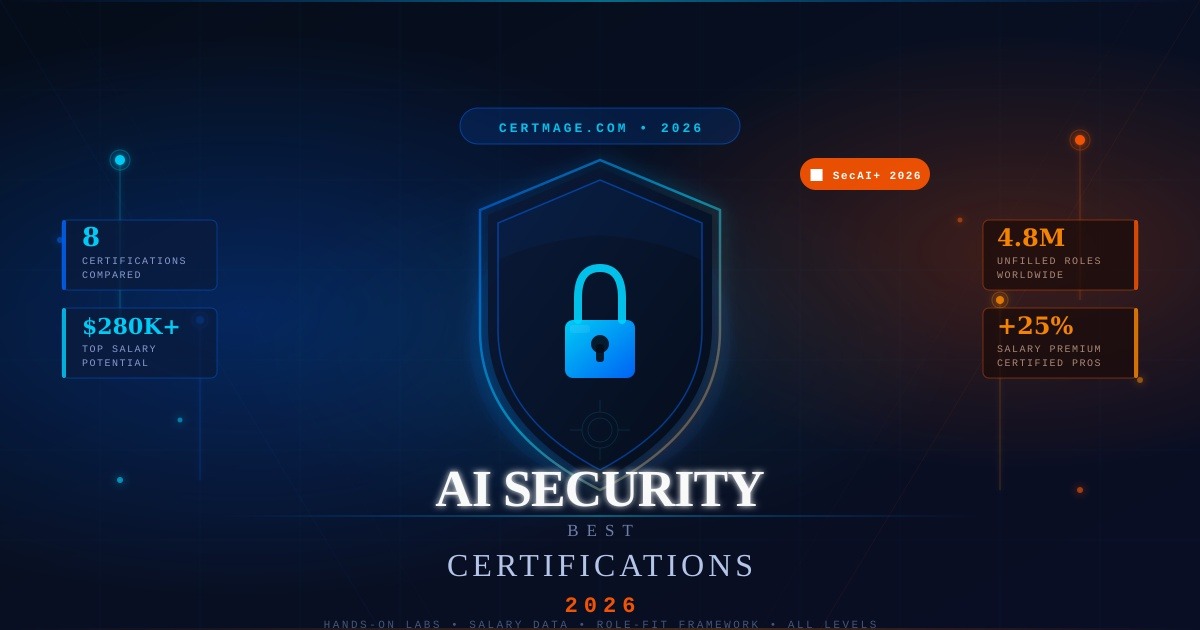
The numbers are stark. The global cybersecurity talent shortfall sits at an estimated 4.8 million unfilled roles, with AI and cloud security topping the list of hardest-to-fill specializations. According to the 2026 ISC2 Cybersecurity Workforce Study, 95% of cybersecurity teams report at least one critical skills gap, and 59% describe those gaps as significant or critical.
AI security is the sharpest point of that crisis. Over 70% of organizations now deploy AI systems in production, yet fewer than 20% have dedicated AI security teams. Traditional frameworks like ISO 27001 and NIST CSF were not built to handle adversarial machine learning, prompt injection, or model poisoning. The professionals who bridge that gap command a 20% to 30% salary premium over peers holding only traditional security credentials.
Key Market Statistics (2026):
- 4.8 million unfilled cybersecurity roles globally (ISC2 2026 Workforce Study)
- 95% of security teams report at least one critical skills gap
- 41% of hiring managers cite AI as their most urgent skills need
- 20–30% salary premium for AI-specialized security professionals
- 49% of security leaders fear AI will increase cyberattack sophistication (Fortinet)
- 97% of organizations are already using or planning AI-enabled security tools
The 8 Best AI Security Certifications in 2026
Ranked by hands-on value, industry recognition, career impact, and ROI.
1. Certified AI Security Professional (CAISP)
Provider: Practical DevSecOps | Cost: $999 | Format: Self-paced with 60-day browser lab access | Exam: Practical assessment
Best For: Security engineers, DevSecOps professionals, penetration testers, AppSec specialists, AI/ML Security Engineers, Red Teamers
CAISP stands out from the rest of this list for one fundamental reason: it is built around doing, not memorizing. While every other certification on this list uses multiple-choice exams as their primary assessment method, CAISP uses a practical exam format. You are tested on your ability to actually secure AI systems — not recall definitions from a study guide.
The curriculum is structured around two industry-standard frameworks: the OWASP Top 10 for Large Language Models and MITRE ATLAS. These are not theoretical abstractions — they are the exact references that security teams and red teamers use when auditing real AI deployments.
What You Actually Learn:
- Prompt injection attacks — how they work, how to execute them, and how to engineer defenses
- Model poisoning — introducing malicious data during training to corrupt model behavior
- AI supply chain security — auditing dependencies, third-party models, and datasets for risk
- AI threat modeling — applying the STRIDE methodology specifically to AI system architectures
- Securing MLOps pipelines — integrating security controls into CI/CD workflows for AI
- Adversarial machine learning — crafting evasion attacks and building defenses against them
- Data exfiltration and privacy attacks — preventing models from leaking sensitive training data
Lab Environment:
The 60-day browser-based lab environment is CAISP’s strongest feature. You work with real vulnerable AI systems — not simulations or toy examples. Labs cover building and breaking LLMs, implementing guardrails, auditing AI supply chains, and deploying secure AI pipelines in containerized environments. No local setup required.
Cost Breakdown:
At $999, CAISP includes 30+ hands-on exercises, 60-day lab access, 3 years of course material access, 36 CPE points, dedicated instructor support via Mattermost, and one exam attempt. Professionals who earn CAISP report an average salary increase of 18% within the first year.
Who Should NOT Choose CAISP:
CAISP is not designed for governance or compliance roles. If your primary responsibilities are writing AI policy, managing vendor risk, or conducting IT audits, AAISM or AIGP will be a better fit.
2. CompTIA SecAI+ (Launched February 17, 2026)
Provider: CompTIA | Cost: ~$349 | Format: Self-paced | Exam: MCQ + Performance-based (60 questions, 60 minutes)
Best For: Mid-level security professionals building on Security+, CySA+, or PenTest+ foundations
Exclusive Coverage: CompTIA SecAI+ launched on February 17, 2026. This is one of the only AI security certification guides currently covering it. If you already hold a CompTIA certification, this is likely the smartest next step you can take right now.
CompTIA SecAI+ is the first certification in CompTIA’s new Expansion Series — a credential family designed to extend existing job-role certifications with specialized expertise. It was developed by over 400 industry subject matter experts worldwide and is fully vendor-neutral, applying across all cloud platforms, AI frameworks, and deployment environments.
The certification addresses what CompTIA calls the “AI security trifecta”: securing AI platforms themselves, using AI to improve security operations, and governing AI adoption through compliance frameworks.
What You Actually Learn:
- Core AI principles — machine learning, deep learning, NLP, and automation terminology
- AI-driven threat detection — using AI tools to identify anomalies and accelerate incident response
- Securing AI deployment environments — across on-premises, cloud, and hybrid infrastructure
- Defending against AI-driven threats — adversarial attacks, polymorphic malware, and generative AI misuse
- Integrating AI into DevSecOps pipelines and enterprise security strategies
- Navigating global GRC frameworks — EU AI Act, GDPR, CCPA, and NIST AI RMF compliance
How It Compares to CAISP:
SecAI+ is broader in scope but less technically deep than CAISP. Where CAISP focuses intensely on hands-on offensive and defensive skills for AI systems, SecAI+ is designed as a well-rounded mid-career credential that adds AI security coverage to an existing foundation. If you hold Security+ and want to specialize, SecAI+ is the natural next step. If you want deep hands-on practitioner skills, CAISP delivers more.
Who Should Choose CompTIA SecAI+:
Professionals who already hold CompTIA foundational credentials and want AI security specialization without committing to a $999 course. Also excellent for career changers from IT roles who need a recognized bridge credential into AI security.
3. GIAC AI Security Professional (GAISP)
Provider: SANS Institute / GIAC | Cost: $2,499+ (exam only; training is additional) | Exam: Multiple choice
Best For: Enterprise security architects, senior analysts, highly regulated industries (finance, government, defense)
GIAC certifications carry significant brand weight in enterprise and government environments. GAISP provides broad coverage of AI security from an enterprise risk perspective: AI system architecture, regulatory compliance (GDPR, CCPA, EU AI Act), risk assessment frameworks, incident response for AI breaches, and AI governance and policy.
The significant limitation is cost. By the time you factor in the required SANS training course, total spend easily exceeds $8,000 to $9,000. The exam itself is multiple-choice, testing knowledge recall rather than hands-on ability. For that price point, the lack of extended lab access is a meaningful weakness.
Best choice if: You work in a government-adjacent role, a heavily regulated industry, or need the GIAC brand name to open doors in enterprise security leadership. Not the right choice if your goal is hands-on technical skill development.
4. Certified Ethical Hacker – AI Edition (CEH-AI)
Provider: EC-Council | Cost: ~$2,049 (exam + training) | Exam: Multiple choice
Best For: Penetration testers, ethical hackers, red team operators wanting AI-specific offensive techniques
The CEH-AI extends the established Certified Ethical Hacker framework with AI-specific modules: adversarial inputs, model reverse-engineering, AI-powered phishing, deepfakes, and synthetic media manipulation. If you already hold a CEH and want to add AI offensive techniques, this is a logical next step.
The main limitation: despite covering offensive AI techniques, CEH-AI uses a multiple-choice exam. At $2,049, you are paying more than CAISP for a less practical credential. For pure offensive AI red teaming with demonstrable skills, CAISP’s practical exam and deeper labs deliver stronger results.
5. ISACA Advanced in AI Security Management (AAISM)
Provider: ISACA | Cost: $599 (exam) + $799–$2,500 training | Exam: Multiple choice | Prerequisite: Active CISM or CISSP required
Best For: CISOs, Security Directors, Security Managers building enterprise AI security programs
AAISM is a management certification, not a technical one. It does not teach you how to execute a prompt injection attack. It teaches you how to build an organizational program that prevents one. For security leaders responsible for AI risk at scale, that is exactly the right focus.
Key areas include AI governance frameworks, risk assessment for AI deployments, third-party AI vendor risk management, and communicating AI risk to boards and executives. The CISM or CISSP prerequisite makes this a genuinely senior credential, and that selectivity is part of its value.
6. Certified AI Governance Professional (AIGP)
Provider: IAPP | Cost: $799+ (training fees additional) | Exam: Multiple choice
Best For: Privacy Officers, Legal Counsel, GRC Leads, Data Protection Officers
AIGP sits at the intersection of AI technology and law. With the EU AI Act now fully in force and AI-related regulatory enforcement accelerating globally, organizations need professionals who can navigate these frameworks. AIGP is the premier credential for that work.
Coverage includes GDPR and CCPA as applied to AI, EU AI Act requirements and prohibited use cases, algorithmic bias and fairness obligations, transparency and explainability mandates, and building governance structures that satisfy both legal and ethical requirements. This is not a technical security certification — it is a legal and governance credential focused on AI.
7. ISACA Advanced Certificate in AI Audit (AAIA)
Provider: ISACA | Cost: $599 (exam) + training | Exam: Multiple choice
Best For: IT Auditors, Internal Audit Professionals, Compliance Officers
As AI systems face increasing regulatory scrutiny, organizations need auditors who understand how to assess AI controls, evaluate algorithmic fairness, and report on AI compliance posture. AAIA covers AI system audit methodologies, evaluating AI controls and governance effectiveness, auditing for bias and transparency, assessing model explainability, and conducting regulatory compliance audits against the EU AI Act and similar frameworks.
8. Microsoft Certified: AI Security Specialist
Provider: Microsoft | Cost: $165 | Exam: MCQ + Scenario-based
Best For: Azure-focused security engineers securing Microsoft AI workloads
At $165, this is the most affordable certification on the list — and the most narrowly scoped. It covers securing Azure AI services, Azure Machine Learning workspaces, IAM for AI services, and compliance governance within Azure. Strong if your organization is Azure-committed; limited value if you work in multi-cloud or on-premises environments. Treat it as a platform credential, not a career-defining specialization.
Side-by-Side Comparison: All 8 Certifications
| Certification | Provider | Cost | Hands-On Labs | Exam Type | Best For |
| CAISP | Practical DevSecOps | $999 | Extensive (60 days) | Practical | Engineers, Red Teamers, DevSecOps |
| CompTIA SecAI+ | CompTIA | ~$349 | Performance-based | MCQ + Performance | Mid-level security pros |
| GAISP | GIAC / SANS | $2,499+ | Minimal | MCQ | Enterprise architects |
| CEH-AI | EC-Council | $2,049 | Moderate | MCQ | Ethical hackers |
| AAISM | ISACA | $599+ | None | MCQ | CISOs, Security Managers |
| AIGP | IAPP | $799+ | None | MCQ | Privacy, Legal Counsel |
| AAIA | ISACA | $599+ | None | MCQ | IT Auditors |
| MS AI Security | Microsoft | $165 | None | MCQ + Scenario | Azure engineers only |
2026 AI Security Salary Guide
| Role | 2026 Salary Range (USD) | Relevant Certifications |
| AI Security Engineer | $150,000 – $210,000 | CAISP, CompTIA SecAI+ |
| Lead AI Security Architect | $200,000 – $280,000+ | CAISP, GAISP |
| LLM Red Team Specialist | $160,000 – $230,000 | CAISP, CEH-AI |
| DevSecOps Engineer (AI) | $150,000 – $210,000 | CAISP, CompTIA SecAI+ |
| Adversarial ML Engineer | $160,000 – $225,000 | CAISP |
| AI Governance Lead | $160,000 – $240,000 | AAISM, AIGP |
| AI Threat Intelligence Analyst | $140,000 – $195,000 | CAISP, CompTIA SecAI+ |
| AI Ethics & Compliance Officer | $130,000 – $190,000 | AIGP, AAIA |
| AI SOC Orchestrator | $140,000 – $195,000 | CAISP, CompTIA SecAI+ |
| Quantum-AI Security Specialist | $175,000 – $260,000+ | CAISP + specialized training |
Source: Aggregated from ZipRecruiter, Glassdoor, Robert Walters, and specialized AI security recruitment data, adjusted for 2026 conditions.
💡 Salary Insight: Professionals with specialized AI security skills earn 20–30% more than peers in similar roles without those skills (Robert Walters). A CISSP gets you the interview. An AI security certification like CAISP gets you the offer at the number you want.
How to Choose: A Decision Framework for Every Career Path
| Your Goal | Your Background | Best Certification |
| Hands-on technical skills | Security engineer / AppSec | CAISP |
| Expand existing CompTIA credentials | Security+ / CySA+ holder | CompTIA SecAI+ |
| AI red teaming & offensive skills | Penetration tester | CAISP or CEH-AI |
| Build enterprise AI security programs | CISO / Security Manager | AAISM |
| Compliance, audit & governance | IT Auditor / GRC | AAIA or AIGP |
| Legal & privacy perspective on AI | Privacy Officer / Legal Counsel | AIGP |
| Secure Azure AI workloads specifically | Azure security engineer | MS AI Security Specialist |
| Transition into AI security from IT | Career changer | CompTIA SecAI+ → CAISP |
Common Mistakes to Avoid
Choosing based on price alone. The $165 Microsoft credential is not a deal if Azure is not your platform. A $999 certification that leads to an 18% salary increase has far better ROI. Calculate return, not just cost.
Ignoring whether there are real hands-on labs. Multiple-choice exams test what you remember. Practical exams test what you can do. Before choosing any certification, ask: will I actually work with real AI systems, or am I memorizing concepts?
Pursuing certifications that do not match your role. A penetration tester does not need AIGP. A privacy officer does not need CAISP. Match the credential to your actual job responsibilities and target roles.
Overlooking prerequisites. AAISM requires an active CISM or CISSP. Check prerequisites before planning your path, especially for ISACA credentials.
Waiting for the “perfect” certification. CompTIA SecAI+ did not exist last week. New credentials will continue to emerge. Choose the best available option for your current goals, earn it, and reassess from a stronger position.
Frequently Asked Questions
Is AI security a good career in 2026?
It is one of the highest-paying and fastest-growing specializations in cybersecurity. With 4.8 million unfilled cybersecurity roles globally and AI security representing the sharpest point of the skills gap, qualified professionals have significant leverage in salary negotiations.
Do I need to know machine learning to work in AI security?
You need to understand how AI systems are built, trained, and deployed at a conceptual level. You do not need to be a data scientist. Hands-on certifications like CAISP and CompTIA SecAI+ build that AI literacy as part of their curriculum, not as a prerequisite.
What is the difference between AI security and AI safety?
AI security focuses on external threats — preventing attackers from manipulating models, stealing training data, or injecting malicious prompts. AI safety focuses on ensuring AI systems behave as intended and do not cause unintended harm. Security is about adversaries. Safety is about system behavior.
Which certification is best for someone transitioning into AI security?
CompTIA SecAI+ is the best entry point if you already hold foundational security credentials (Security+, CySA+). For those with stronger existing security backgrounds wanting immediate hands-on impact, CAISP delivers the technical depth to be effective faster.
Is CompTIA SecAI+ worth getting in 2026?
It is a brand-new certification launched February 17, 2026, so long-term employer recognition data does not yet exist. However, CompTIA’s track record and the credential’s vendor-neutral positioning make it a strong bet for mid-level professionals — particularly compelling if you already hold other CompTIA credentials.
How long does it take to earn these certifications?
CAISP typically takes 4 to 8 weeks of focused study and lab time. CompTIA SecAI+ is similar for those with existing security backgrounds. AAISM and AIGP can be completed in 2 to 4 weeks of study with relevant experience. GAISP and CEH-AI typically require 3 to 6 weeks.
The Bottom Line
AI security is not a trend. It is a permanent expansion of the cybersecurity profession, driven by the irreversible integration of AI into every industry. The professionals who build real expertise in securing these systems — not just the ones who collect certificates — will be among the highest-paid in the field through 2026 and beyond.
The simplest summary: if you want hands-on engineering depth, choose CAISP. If you want a bridge credential building on CompTIA foundations, choose the newly launched SecAI+. If you manage AI security programs at an organizational level, AAISM is the benchmark. If you navigate legal and regulatory AI obligations, AIGP is essential. If you audit AI systems, AAIA is purpose-built for you.
Certifications open the door. Competence keeps you in the room.
© 2026 Certmage.com — For exam preparation resources, practice questions, and study guides for AI security certifications, visit Certmage.com.