On October 26, 2026, at Security Congress in Denver, ISC2 announced the next addition to its portfolio: a professional certification for securing AI and machine learning systems. It is described as ISC2’s tenth certification, it has no name yet, and the first people to sit the exam will do so as volunteers in a free, in-person pilot this winter.
That combination, a major vendor, a brand-new credential and a volunteer window that closes in days, is exactly when people start searching and when a lot of guesswork gets published. This guide sticks to what ISC2 has actually said, marks what is still undecided, explains what each detail means for you, and tells you what to do before the volunteer form closes on November 4, 2026.
What is the ISC2 AI security certification?
It is a professional certification ISC2 is developing to cover the knowledge, skills and abilities needed to secure AI systems, manage AI threats and mitigate AI risk. ISC2, the nonprofit behind the CISSP, announced the project on July 15, 2026, and released the pilot exam outline on October 26, 2026. It is intended for experienced professionals who secure the design, deployment and maintenance of AI and machine learning systems across their lifecycle.
The credential does not have a name yet. ISC2’s CEO, Scott Beale, said as much, which means “ISC2 AI Security Certification” is a working label and not an official title. He also described it as “being built by cybersecurity professionals, for cybersecurity professionals.” The development drew on Job Task Analysis surveys from roughly 9,000 to 10,000 volunteers, depending on which ISC2 page you read.
ISC2 also says it is not chasing speed to market. It describes the process as rigorous and built for long-term value. That is a useful signal about what to expect: the finished credential is likely to be a serious, experience-based professional certification, not a quick course badge.
When will the certification launch?
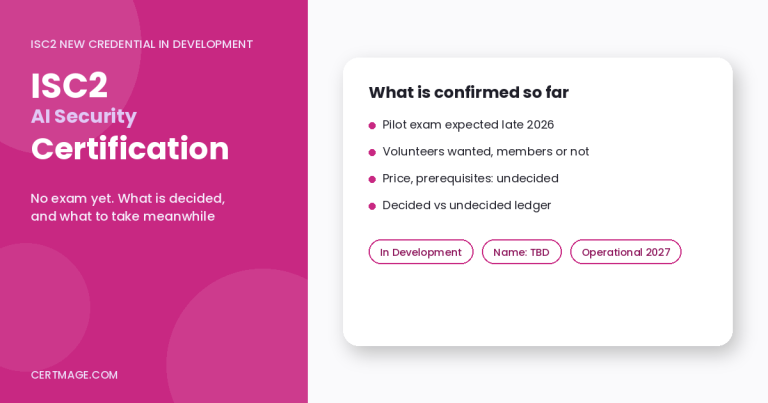
ISC2 says the certification is not expected to be operational until 2027. Its CEO told Infosecurity Magazine it could be available from the first quarter of 2027, possibly as early as January, if the pilot succeeds. Everything before that is the pilot phase.
The timeline runs like this. The volunteer interest form closes on November 4, 2026. Selected candidates register for the pilot in mid-November. The pilot exam itself begins in mid-December 2026, with appointments available until about January 24, 2027, although ISC2 says that window may be shortened or extended. Pilot results arrive 8 to 12 weeks after the pilot period ends. After that, the ISC2 Board has to approve the scheme before the operational certification and any training options appear.
ISC2’s COO, Casey Marks, explained what the pilot is for: it provides evidence on whether the exam measures AI security competence reliably, fairly and defensibly. In other words, the pilot is a test of the test, and the final credential depends on what it shows.
What are the six domains?
ISC2’s outline lists six domains. No percentage weights have been published, and the detailed topics sit in the outline itself, so check ISC2’s page for the full list. The domains are AI Concepts and Security Fundamentals, AI Governance, Ethics, Risk and Compliance, AI Data Management, Privacy and Model Security, Secure AI Architecture, Engineering and Identity and Access Management, Secure AI Operations and Incident Response, and AI Threats, Testing and Lifecycle Management.
Reading the titles tells you the shape of the credential. Two domains are about running AI safely over time, namely operations and incident response, and threats, testing and lifecycle. Two are about building it securely, namely data and model security, and architecture and identity. Two set the foundation and the rules, namely concepts, and governance, ethics, risk and compliance. That is a broad span from policy through engineering to incident response, and it explains why ISC2 lists such a mixed set of target roles.
Who is the certification for?
ISC2 describes the audience as experienced professionals including security architects, engineers, operations leads, risk managers and strategists. The example job titles on its page are AI Security Engineer, AI Risk and Governance Analyst, ML Security Specialist, Chief AI Officer, SOC Analyst and Forensics Analyst.
That list is deliberately mixed. This is not only for people who build models. A SOC analyst or forensics analyst who has to investigate attacks on AI systems appears on the same list as an engineer who designs them, and a risk and governance analyst appears alongside both. If your work touches how AI systems are secured, governed or defended, you are in the intended audience even if you have never trained a model.
What is the pilot exam like?
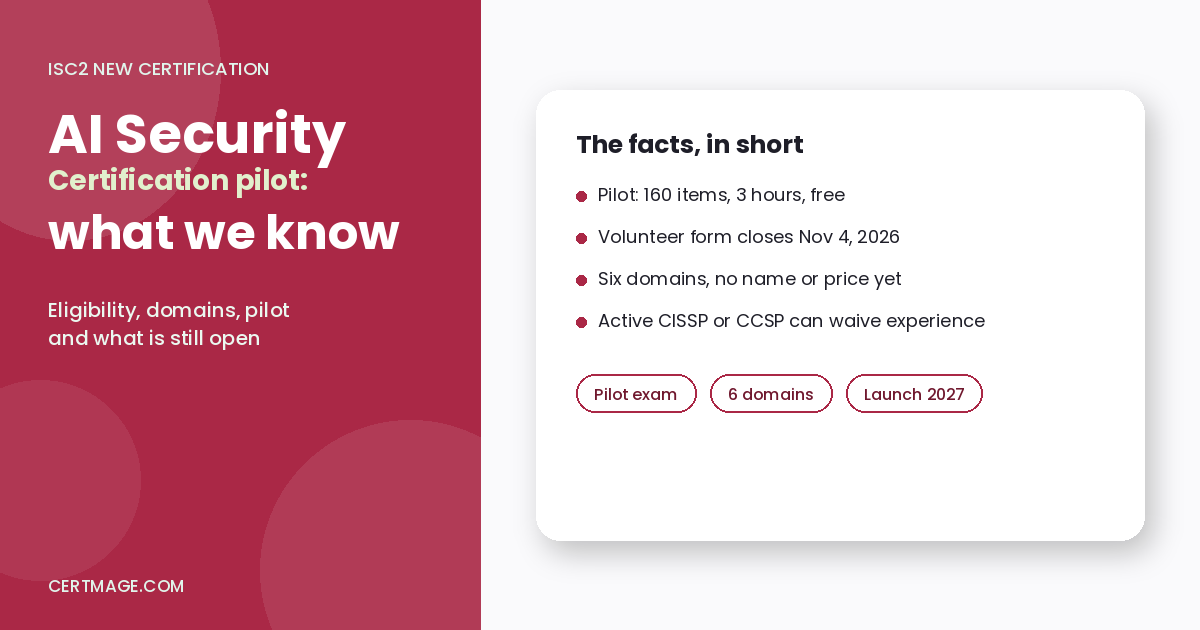
The pilot has 160 items in a standard linear format with a 3-hour maximum that includes breaks and information screens, and it is free. It is in person only, at ISC2-authorised Pearson Professional Centers, not online and not at Pearson Authorized Test Centers. It is available in English only, and ISC2 says special accommodations cannot be offered for the pilot.
Two rules deserve extra attention. You cannot skip an item and return to it later, so you need to pace yourself and commit to answers in order. And you receive only a pass or fail on your ISC2 dashboard, with no score and no domain-level feedback, so the pilot will not tell you where you were weak. ISC2 says there is no pilot course or education. Candidates are directed to the exam outline and suggested references, and unused pilot authorisations do not convert to the regular program.
If the in-person, English-only or no-accommodations rules rule you out of the pilot, the sensible plan is to wait for the operational exam in 2027 and watch for announcements on languages and delivery.
How do you volunteer for the pilot, and what is the deadline?
You must complete ISC2’s Volunteer Interest Form before November 4, 2026. The pilot is not open to the public. Only candidates selected from the volunteer list can sit it, and ISC2 is limiting it to about 3,000 people. Selection is based on relevant knowledge and experience, so describe your real AI security work clearly on the form.
ISC2 membership is not required, and non-certified professionals are encouraged to apply. If you are selected, you need a valid ISC2 account to receive your exam authorisation and schedule your appointment. Volunteers can earn CPE credits for participating in development, and ISC2 encourages employers to let their teams take part. Passing the pilot also does not end the process on its own: those who pass, meet the experience requirements and complete the endorsement process will be among the first to hold the credential, if the pilot becomes the operational scheme.
What experience will you need?
ISC2’s proposed experience requirement is four years of cumulative, paid, full-time experience in cybersecurity or AI-related fields. Two of those years must be in cybersecurity, and one year must be in two or more of the exam’s domains. Part-time work and internships may count. A bachelor’s or master’s degree in computer science, IT, STEM or a related field may satisfy up to one year, and only one year can be waived.
The most important detail is the shortcut for existing ISC2 holders. An active CISSP, ISSAP, ISSEP, ISSMP, CCSP or CSSLP can replace the entire experience requirement. That makes the new credential a natural next step for people who already hold one of those, and it also means someone with an active CISSP does not need to prove four more years of AI-related work. ISC2 also says candidates are not required to hold any ISC2 certification, so experienced professionals without one can still qualify through the experience route.
These requirements are described as proposed, so ISC2 may adjust them before launch. If you are weighing the credentials that could replace the experience requirement, our guides to CISSP vs CISM and CCSP vs AWS Security Specialty can help.
What is still not decided?
Several important details are open, and nothing here should be read as a prediction. ISC2 has not announced the certification’s name, the exam price, the passing score or the domain weights. It lists the annual maintenance fee, the continuing professional education requirements, the training options and any languages beyond English as undetermined. On maintenance fees, ISC2 says it expects them to be in line with its portfolio, which is USD 135 per year. Training options will be offered only after the ISC2 Board approves the scheme.
ISC2 does describe the program as a formal credential that requires ongoing continuing education and renewal, so expect maintenance requirements even though the details are open. Be wary of any website that states a price, a passing score or a final name, because none of those has been announced.
How is it different from the ISC2 AI Security Certificate?
ISC2 already offers an AI security certificate, which it announced in July 2025. The new credential is a different thing, and the names are close enough to cause confusion. According to ISC2, the certificate is a one-time demonstration of learning, while the new certification is an exam-based professional credential with experience requirements, ongoing continuing education and renewal.
ISC2 also says AI concepts already appear across more than 50 exam domains in its existing portfolio, and its CEO said AI questions are being incorporated across all of its current certifications. The new certification is meant for emerging, specialised AI security roles and does not replace the AI content already in CISSP and other certifications. If you see search results that mix the certificate and the certification, check which one the page is about.
How does it compare with ISACA’s AAISM?
The closest existing credential is ISACA’s Advanced in AI Security Management, or AAISM. The biggest difference is the entry rule. ISACA’s page says you must hold an active CISM or CISSP and pass the AAISM exam, then pay a USD 50 application fee after your scores are released and apply within five years of passing. The exam fee was not listed on the page I read.
ISC2’s proposed credential works the other way round. It does not require any ISC2 certification, and experience can qualify you instead, with an active CISSP, CCSP or similar credential available as a shortcut. AAISM is also already available, while ISC2’s credential is in pilot and will not be operational until 2027. In plain terms, AAISM is open only to people who already hold CISM or CISSP, while ISC2’s new credential is being designed so that experienced professionals without an ISC2 certification can also earn it. For a fuller look at AAISM, see our AAISM vs AIGP comparison, our AI security certifications guide and the AAISM exam page.
Should you volunteer for the pilot?
You are a good candidate if you have worked in cybersecurity for at least two years and have four years in cybersecurity or AI-related work overall, and if you handle AI or machine learning systems in your job, whether that is securing pipelines, reviewing models, governing AI use or responding to AI-related incidents. You also need to be able to travel to an ISC2-authorised Pearson Professional Center between mid-December and late January, be comfortable with a three-hour English exam in which you cannot go back, and not need accommodations.
If you already hold an active CISSP or CCSP, the experience requirement is waived in full, so the pilot is mainly about getting a head start on the credential. The cost of volunteering is only your time, since the pilot is free. The main risk is not being selected, which is why it is worth submitting before the deadline instead of waiting to see what other people do.
How should you prepare?
ISC2 says there is no pilot course, so preparation is self-directed. Start by reading the pilot exam outline and the suggested references on ISC2’s page, then map each of the six domains to your own work and note the ones you rarely touch. Strengthen the foundations that sit under AI security, which are identity and access management, incident response, data protection and secure architecture. If you hold or are studying CISSP or CCSP, those domains transfer well, and our CISSP practice test and CCSP exam page can help with the foundations. Because the pilot does not let you skip and return, practise answering in order and committing to an answer. Do not pay for a “pilot prep” course, since ISC2 says none exists.
The mistakes to avoid are treating blog guesses as fact, waiting until after November 4 to apply, assuming the pilot is open to everyone, confusing the certificate with the certification, and counting on the CISSP shortcut to cover the exam itself. An active CISSP or CCSP can replace the experience requirement, but ISC2 has not said it replaces the exam.
What will the certification mean for pay and careers?
No salary data can exist for a credential that has not launched, and borrowing figures from other AI security certifications would be misleading. ISC2’s example job titles, AI Security Engineer, AI Risk and Governance Analyst, ML Security Specialist and Chief AI Officer, are the best indication of the roles it targets. For pay in those roles, check current job postings in your own market.
FAQS
What is the ISC2 AI security certification?
It is a professional certification ISC2 is developing to cover the knowledge, skills and abilities needed to secure AI systems, manage AI threats and mitigate AI risk. It was announced on October 26, 2026 and is described as ISC2’s tenth certification.
When will the ISC2 AI security certification launch?
ISC2 says it is not expected to be operational until 2027. Its CEO told Infosecurity Magazine that it could be available from Q1 2027, possibly as early as January, if the pilot succeeds.
What is the name of the ISC2 AI security certification?
There is no official name yet. ISC2’s CEO said it “doesn’t even have a name yet”, so “ISC2 AI Security Certification” is a working label.
How much will the ISC2 AI security certification cost?
ISC2 has not announced the exam price. It says annual maintenance fees are not yet determined but are expected to be in line with its portfolio, which is USD 135 per year.
What are the domains on the ISC2 AI security exam?
Six: AI Concepts and Security Fundamentals; AI Governance, Ethics, Risk and Compliance; AI Data Management, Privacy and Model Security; Secure AI Architecture, Engineering and IAM; Secure AI Operations and Incident Response; and AI Threats, Testing and Lifecycle Management. Weights have not been published.
How do I join the ISC2 AI security pilot exam?
Complete ISC2’s Volunteer Interest Form before November 4, 2026. About 3,000 qualified volunteers will be selected. ISC2 membership is not required, and non-certified professionals are encouraged to apply.
What is the format of the pilot exam?
160 items, linear format, 3 hours maximum including breaks and information screens. It is in person only at ISC2-authorised Pearson Professional Centers, in English only, and free. You cannot skip an item and return to it.
When is the pilot exam?
It begins in mid-December 2026, with appointments available until about January 24, 2027. ISC2 says the window may be shortened or extended, and pilot results arrive 8 to 12 weeks after the pilot period ends.
What experience do I need for the ISC2 AI security certification?
ISC2’s proposed requirement is four years of paid, full-time experience in cybersecurity or AI-related fields, with two years in cybersecurity and one year in two or more domains. A degree in a related field can satisfy one year. These are proposed and may change.
Do I need CISSP to get the ISC2 AI security certification?
No. ISC2 says candidates are not required to hold an ISC2 certification. An active CISSP, ISSAP, ISSEP, ISSMP, CCSP or CSSLP can replace the entire experience requirement, though.
Is the ISC2 AI security certification different from the ISC2 AI Security Certificate?
Yes. The certificate is a one-time demonstration of learning. The new certification is an exam-based professional credential with experience requirements and ongoing continuing education and renewal.
How is it different from ISACA’s AAISM?
AAISM requires an active CISM or CISSP, according to ISACA. ISC2’s new credential does not require any ISC2 certification, and experience can qualify you instead.
Is it worth getting?
It is too early to say, because there is no name, price or passing score yet. If you work in AI security, volunteering for the pilot costs nothing but time, and the first holders will have a head start once it launches.
The bottom line
ISC2’s AI security certification is real, but it is still in pilot and several key details are open. If you work in security and handle AI systems, put the November 4 deadline in your calendar, read the exam outline and decide whether you can travel for an in-person exam this winter. Everything else can wait until ISC2 publishes the name, price and passing score. Read ISC2’s own page on the new AI security certification for the latest, and check our best cybersecurity certifications guide and ISC2 CC exam update while you plan your next step. We will update this guide when ISC2 publishes the final details.