
Cisco certification practice
Free 300-730 Practice Test
10 free 300-730 exam-style questions for Implementing Secure Solutions with Virtual Private Networks (SVPN 300-730), with answers, explanations and source references.
Full set: 175 questionsThe 300-730 SVPN exam, Implementing Secure Solutions with Virtual Private Networks, is a 90-minute Cisco exam associated with CCNP Security. It is for network and security engineers who deploy and troubleshoot VPNs on Cisco routers and firewalls. Cisco has retired it: the retired-exams page lists August 27, 2026 as the last test date, and VPN topics now sit within SCOR and SNCF.
Cisco's v1.1 exam topics give troubleshooting using ASDM and CLI the largest weight at 35%, followed by secure communications architectures at 30%, remote access VPNs at 20% and site-to-site VPNs on routers and firewalls at 15%. Troubleshooting means reading command output and spotting a mismatched proposal, a missing route or a failed authentication step, so practise reading that output closely.
Use the free practice questions to review this material, whether you are refreshing VPN skills for SCOR or SNCF or closing out your own notes. Check each answer and read every explanation, paying attention to why a configuration or command fails. Track which of the four domains produces most of your mistakes and go back to it, giving troubleshooting extra time given its weight.
A network engineer must design a clientless VPN solution for a company. VPN users must be able to access several internal web servers. When reachability to those web servers was tested, it was found that one website is not being rewritten correctly by the ASA. Remote users must be able to access an internal webserver via the URL example.com. Which two steps accomplish this task? (Choose two.)
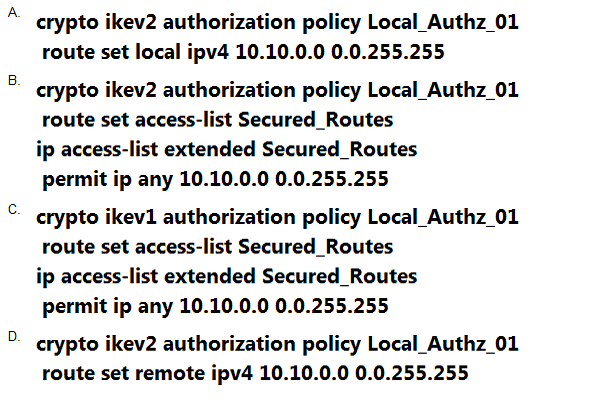
Refer to the exhibit. 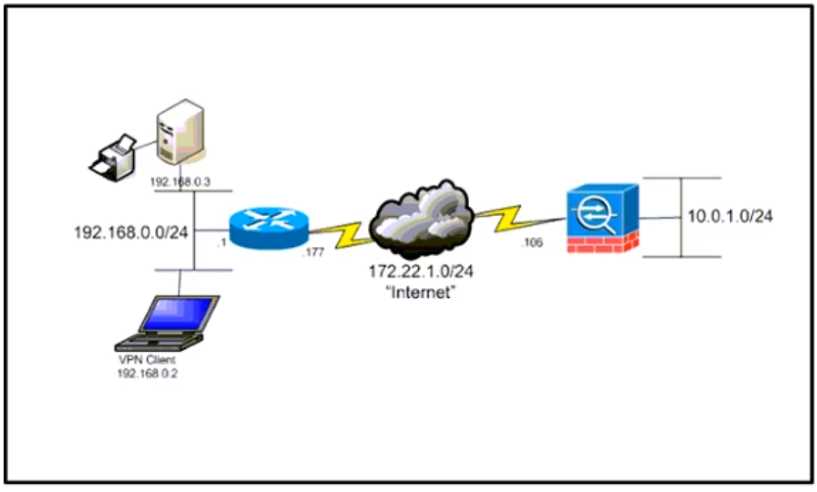 The network administrator must allow the Cisco AnyConnect Secure Mobility Client to securely access the corporate resources via IKEv2 and print locally. Traffic that is destined for the Internet must still be tunneled to the Cisco ASA. Which configuration does the administrator use to accomplish this goal?
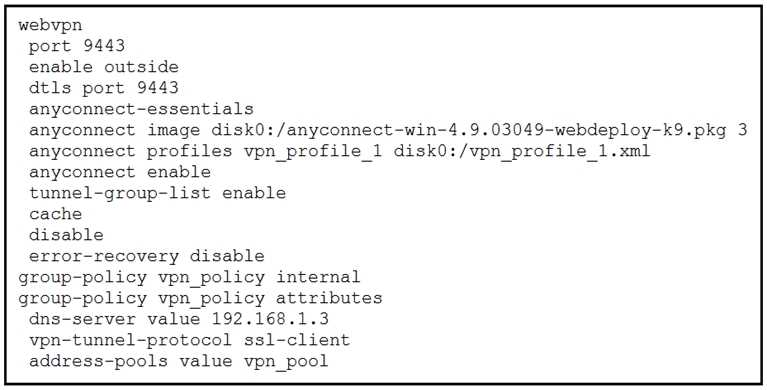 A network engineer is reconfiguring clientless SSLVPN during a maintenance window, and after
testing the new configuration, is unable to establish the connection. What must be done to
remediate this problem?
About the exam
300-730 exam at a glance
Key facts for the Implementing Secure Solutions with Virtual Private Networks (SVPN 300-730) exam, taken from the official exam page.
| Exam code | V1.1 |
|---|---|
| Time allowed | 90 minutes |
| Version status | Retired. Cisco's retired-exams page lists August 27, 2026 as the last day to test for 300-730 SVPN, while Cisco's Learning blog says August 26, 2026. There is no direct replacement concentration exam; VPN topics moved into SCOR (core) and SNCF (firewall concentration). |
Source: official 300-730 exam page. Verified . Prices and policies can change, so confirm with the provider before booking.
Exam objectives
What the 300-730 exam covers
The 300-730 exam is organized into 4 official domains. Weight shows the share of the exam each domain represents, so spend your study time in proportion.
- Site-to-Site Virtual Private Networks on Routers and Firewalls 15%
- Remote Access VPNs 20%
- Troubleshooting Using ASDM and CLI 35%
- Secure Communications Architectures 30%
Domains and weights from the official 300-730 exam outline.
Quick answers
300-730 exam FAQ
How many questions are on the 300-730 exam?
The 300-730 exam gives you 90 minutes to finish.
Source context
How this practice set is maintained
Maintained by the CertMage content team, this page loads questions from the exam dataset connected to its preparation resource. When an answer includes a supporting reference, it is shown with that answer so you can review the underlying vendor documentation.
Certification objectives, interfaces, and vendor services can change. Verify important details against the provider's current exam guide and documentation before your exam.
Reviewed by Ryan Nakamura CCNP, CCNA 200-301, VCP-DCV, LPIC-3, OCA