
Cisco certification practice
Free 300-815 Practice Test
10 free 300-815 exam-style questions for Implementing Cisco Advanced Call Control On-Premises (CLACC 300-815), with answers, explanations and source references.
Full set: 221 questionsThe 300-815 exam, Implementing Cisco Advanced Call Control On-Premises (CLACC) v2.0, is for engineers who deploy and manage call control in Cisco on-premises collaboration environments. It checks that you can implement session border controllers, voice gateways, advanced call routing and supplemental features. The exam runs for 90 minutes and is offered in English. Cisco previously titled this exam Implementing Cisco Advanced Call Control and Mobility Services (CLACCM v1.2).
The v2.0 blueprint has five domains. Session Border Controller and Voice Gateway Technologies carries the largest share at 30%, followed by Advanced Call Control at 25% and Supplemental Features and Security at 20%. Remote Connectivity and Business to Business Solutions accounts for 15%, and Signaling and Media Protocols for 10%. Give the gateway and border controller topics the most study time, but keep the protocol fundamentals in view, since the other domains build on them.
Work through the free practice questions one at a time and check each answer before moving on. Read the explanation for every question, including the ones you got right, so you understand why the correct option fits the scenario. Note which domains produce the most wrong answers, review Cisco's exam topics for those areas, and then come back to the questions to confirm your progress.
The administrator of ABC company is troubleshooting a one-way audio issue for a call that uses H.323 protocol (slow-start mode). The administrator requests that you provide the IP and port information of the Real- Time Transport Protocol traffic that had the one-way audio call. You gather the H.225 and H.245 messages for one of the one-way audio calls. Where can you find the RTP IP and port information for both sides? (Note: This call flow has not invoked any media resources like MTP or transcoders).
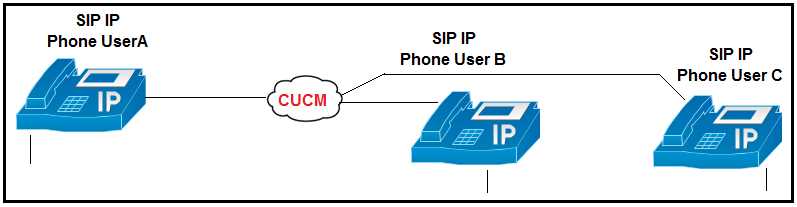 In an active SIP call between phone user A and phone user B, phone A initiates a call transfer to
phone user C. Which two scenarios are correct? (Choose two.)
Refer to the exhibit. 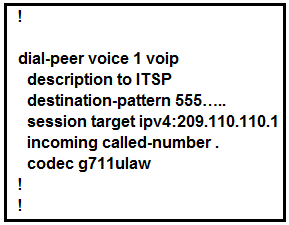 An engineer configures Cisco Unified Border Element to connect the enterprise VoIP network with a SIP telephony provider. Calls are not working in either direction. What must be configured in the dial peer 1 to fix the issue?
About the exam
300-815 exam at a glance
Key facts for the Implementing Cisco Advanced Call Control On-Premises (CLACC 300-815) exam, taken from the official exam page.
| Exam code | V2.0 |
|---|---|
| Time allowed | 90 minutes |
| Exam price | USD 300 (or Cisco Learning Credits) |
| Languages | English |
| Version status | Exam 300-815 was previously titled 'Implementing Cisco Advanced Call Control and Mobility Services' (CLACCM v1.2). The current v2.0 blueprint renames it 'Implementing Cisco Advanced Call Control On-Premises' (CLACC). Cisco does not state a changeover date on the pages checked. |
Source: official 300-815 exam page. Verified . Prices and policies can change, so confirm with the provider before booking.
Exam objectives
What the 300-815 exam covers
The 300-815 exam is organized into 5 official domains. Weight shows the share of the exam each domain represents, so spend your study time in proportion.
- Signaling and Media Protocols 10%
- Session Border Controller and Voice Gateway Technologies 30%
- Advanced Call Control 25%
- Supplemental Features and Security 20%
- Remote Connectivity and Business to Business Solutions 15%
Domains and weights from the official 300-815 exam outline.
Quick answers
300-815 exam FAQ
How many questions are on the 300-815 exam?
The 300-815 exam gives you 90 minutes to finish.
How much does the 300-815 exam cost?
The 300-815 exam costs USD 300 (or Cisco Learning Credits). Check the official exam page for the price in your country.
Source context
How this practice set is maintained
Maintained by the CertMage content team, this page loads questions from the exam dataset connected to its preparation resource. When an answer includes a supporting reference, it is shown with that answer so you can review the underlying vendor documentation.
Certification objectives, interfaces, and vendor services can change. Verify important details against the provider's current exam guide and documentation before your exam.
Reviewed by Ryan Nakamura CCNP, CCNA 200-301, VCP-DCV, LPIC-3, OCA