
The Open Group certification practice
Free OGEA-103 Practice Test
10 free OGEA-103 exam-style questions for TOGAF Enterprise Architecture Combined Part 1 and Part 2, with answers, explanations and source references.
Full set: 199 questionsThe Open Group's OGEA-103 exam combines TOGAF Enterprise Architecture Part 1 and Part 2 into a single sitting, based on the TOGAF Standard, 10th Edition. It suits architects and practitioners who want the TOGAF Enterprise Architecture Practitioner credential in one step. There are no prerequisites, and the certification does not expire.
The two sections differ in pace and format, so prepare for each one separately. Part 1 is closed book, with 40 multiple-choice questions in 60 minutes, and you cannot return to it once you move on. Part 2 is open book but gives you 8 scenario questions in 90 minutes, with gradient scoring that rewards the best answer and gives partial credit to weaker ones. You must reach 60% in each section, so a strong Part 2 cannot make up for a weak Part 1.
Use these free OGEA-103 practice questions to test both skills. Check each answer, and read every explanation to see how TOGAF concepts apply in context. When a scenario catches you out, go back to the relevant part of the standard and practise again until you can justify the best option.
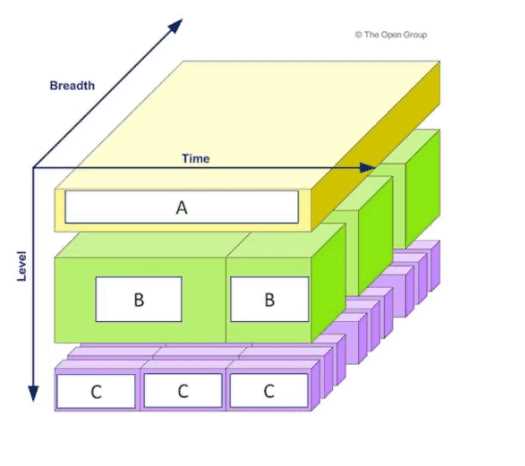 What are the items labelled A, B and C?
About the exam
OGEA-103 exam at a glance
Key facts for the TOGAF Enterprise Architecture Combined Part 1 and Part 2 exam, taken from the official exam page.
| Exam code | OGEA-103 (English); OGEA-C103 (Simplified Chinese); based on the TOGAF Standard, 10th Edition |
|---|---|
| Number of questions | 48 |
| Time allowed | 150 minutes |
| Passing score | 60% in each section (24 of 40 points for Part 1 and 24 of 40 points for Part 2); both sections must be passed |
| Question types | Section 1: 40 simple multiple choice (closed book); Section 2: 8 scenario-based, complex multiple choice with gradient scoring (open book) |
| Exam price | USD 610 exam booking fee via Pearson VUE (USD 640 retail voucher); fees applicable from February 1, 2026; additional taxes may apply |
| Delivery | Authorized Examination Provider test centers and remotely via Pearson VUE OnVUE |
| Languages | English, Simplified Chinese |
| Prerequisites | None |
| Validity and renewal | Does not expire; no re-certification or renewal requirements |
Source: official OGEA-103 exam page. Verified . Prices and policies can change, so confirm with the provider before booking.
Exam objectives
What the OGEA-103 exam covers
The OGEA-103 exam is organized into 2 official domains. Weight shows the share of the exam each domain represents, so spend your study time in proportion.
- TOGAF Enterprise Architecture Part 1 40 questions, 60 minutes
- TOGAF Enterprise Architecture Part 2 8 questions, 90 minutes
Domains and weights from the official OGEA-103 exam outline.
Quick answers
OGEA-103 exam FAQ
How many questions are on the OGEA-103 exam?
The OGEA-103 exam has 48 questions and gives you 150 minutes to finish. Question types include section 1: 40 simple multiple choice (closed book); Section 2: 8 scenario-based, complex multiple choice with gradient scoring (open book).
What is the passing score for OGEA-103?
You need 60% in each section (24 of 40 points for Part 1 and 24 of 40 points for Part 2); both sections must be passed to pass the TOGAF Enterprise Architecture Combined Part 1 and Part 2 exam.
How much does the OGEA-103 exam cost?
The OGEA-103 exam costs USD 610 exam booking fee via Pearson VUE (USD 640 retail voucher); fees applicable from February 1, 2026; additional taxes may apply. Check the official exam page for the price in your country.
How long is the OGEA-103 certification valid?
Does not expire; no re-certification or renewal requirements.
Source context
How this practice set is maintained
Maintained by the CertMage content team, this page loads questions from the exam dataset connected to its preparation resource. When an answer includes a supporting reference, it is shown with that answer so you can review the underlying vendor documentation.
Certification objectives, interfaces, and vendor services can change. Verify important details against the provider's current exam guide and documentation before your exam.
Reviewed by Priya Kapoor ITIL v4 Expert, PMP, Salesforce Certified Administrator, SAP CAA