A Consolidated Gaps, Solutions and Dependencies Matrix is a technique that can be used to create
work packages for an incremental rollout of the architecture. A work package is a set of actions or
tasks that are required to implement a specific part of the architecture. A work package can be
associated with one or more Architecture Building Blocks (ABBs) or Solution Building Blocks (SBBs),
which are reusable components of business, IT, or architectural capability. A work package can also
be associated with one or more Capability Increments, which are defined, discrete portions of the
overall capability that deliver business value. A Capability Increment can be realized by one or more
Transition Architectures, which are intermediate states of the architecture that enable the transition
from the Baseline Architecture to the Target Architecture123
The steps for creating work packages using this technique are:
For each gap between the Baseline Architecture and the Target Architecture, identify a proposed
solution and classify it as new development, purchased solution, or based on an existing product. A
gap is a difference or deficiency in the current state of the architecture that needs to be addressed by
the future state of the architecture. A solution is a way of resolving a gap by implementing one or
more ABBs or SBBs.
Group similar solutions together to define the work packages. Similar solutions are those that have
common characteristics, such as functionality, technology, vendor, or location.
Identify dependencies between work packages, such as logical, temporal, or resource dependencies.
Dependencies indicate the order or priority of the work packages, and the constraints or risks that
may affect their implementation.
Regroup the work packages into a set of Capability Increments to transition to the Target
Architecture. Capability Increments should be defined based on the business value, effort, and risk
associated with each work package, and the schedule and objectives of the clinical trials. Capability
Increments should also be aligned with the Architecture Vision and the Architecture Principles.
Document the work packages and the Capability Increments in an Architecture Definition Increments
Table, which shows the mapping between the work packages, the ABBs, the SBBs, and the Capability
Increments. The table also shows the dependencies, assumptions, and issues related to each work
package and Capability Increment.
Therefore, the best answer is B, because it describes the approach to identify the work packages for
an incremental rollout meeting the requirements, using the Consolidated Gaps, Solutions and
Dependencies Matrix as a planning tool.
Reference: 1: The TOGAF Standard, Version 9.2, Part III: ADM Guidelines and Techniques, Chapter 30:
Gap Analysis 2: The TOGAF Standard, Version 9.2, Part IV: Architecture Content Framework, Chapter
36: Building Blocks 3: The TOGAF Standard, Version 9.2, Part III: ADM Guidelines and Techniques,
Chapter 31: Architecture Change Management : The TOGAF Standard, Version 9.2, Part II:
Architecture Development Method (ADM), Chapter 23: Phase E: Opportunities and Solutions : The
TOGAF Standard, Version 9.2, Part II: Architecture Development Method (ADM), Chapter 21: Phase F:
Migration Planning : The TOGAF Standard, Version 9.2, Part II: Architecture Development Method
(ADM), Chapter 18: Phase A: Architecture Vision : The TOGAF Standard, Version 9.2, Part III: ADM
Guidelines and Techniques, Chapter 23: Architecture Principles

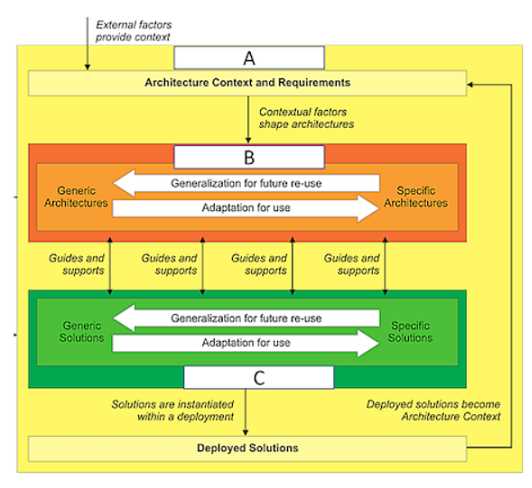 What are the items labelled A, B and C?
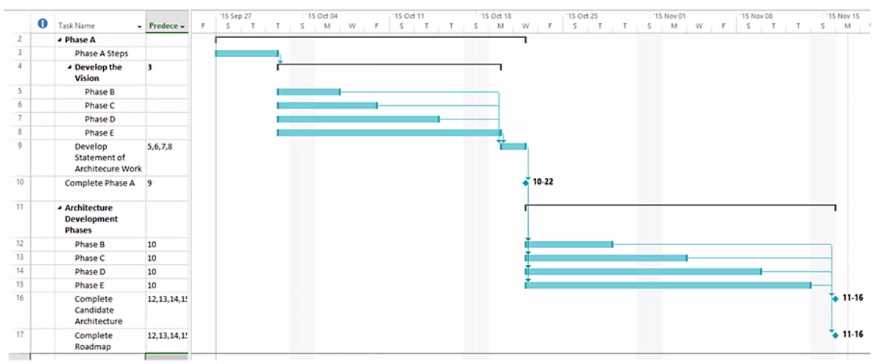 Which important concept for Enterprise Architecture Practitioners does it illustrate?