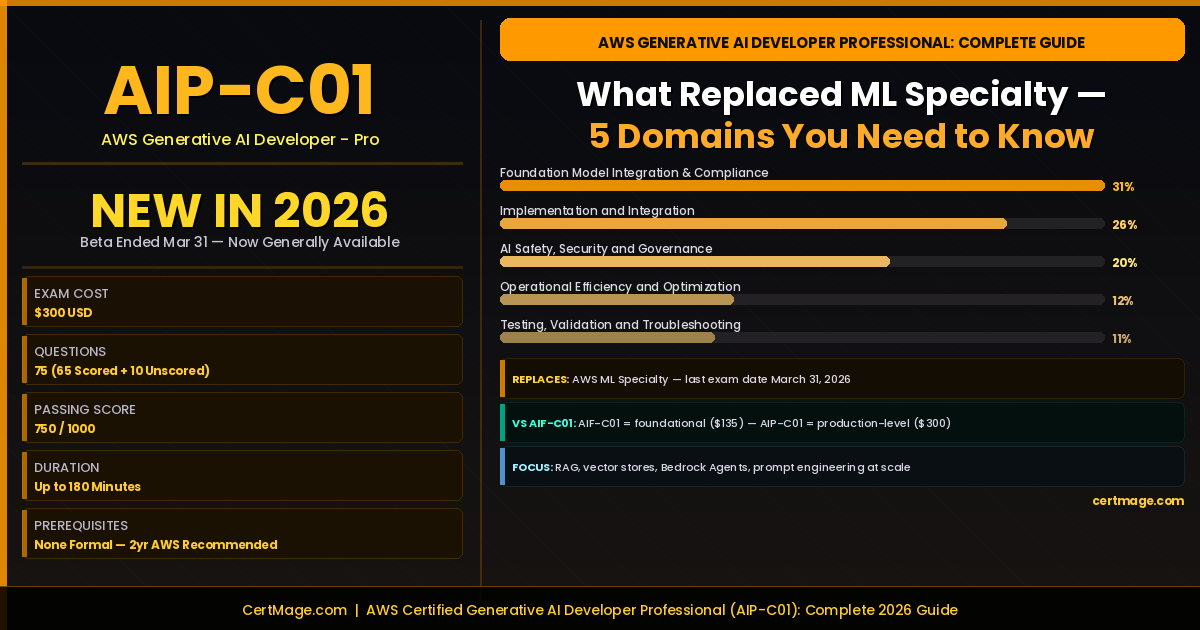
The AWS Certified Generative AI Developer Professional (AIP-C01) is AWS’s newest professional-level certification, validating the ability to design, implement, and optimize production-ready generative AI solutions using AWS services. The exam covers five domains weighted toward Foundation Model Integration, Data Management, and Compliance at 31 percent and Implementation and Integration at 26 percent, together representing 57 percent of the exam. It costs $300, requires a score of 750 out of 1000 to pass, and has no formal prerequisites, though AWS recommends 2 or more years of AWS experience and at least 1 year of hands-on generative AI development. The beta period ended March 31, 2026, and the exam is now generally available.
This guide covers everything confirmed about AIP-C01 so far: what it tests, how it compares to AIF-C01 and the retired ML Specialty, and how to prepare.
AIP-C01 Quick Reference
| Detail | Information |
| Exam code | AIP-C01 |
| Full name | AWS Certified Generative AI Developer – Professional |
| Level | Professional |
| Cost | $300 USD |
| Question count | 75 (65 scored, 10 unscored) |
| Exam duration | 170 to 180 minutes |
| Passing score | 750 out of 1000 |
| Question types | Multiple choice, multiple response, ordering, matching |
| Prerequisites | None formal |
| Recommended experience | 2+ years AWS experience, 1+ year hands-on generative AI development |
| Validity | 3 years |
| Delivery | Pearson VUE / PSI testing centers, online proctored |
| Beta period | Ended March 31, 2026 |
| Current status | Generally available |
AIP-C01 Exam Domains and Weights
| Domain | Weight | What It Covers |
| Domain 1: Foundation Model Integration, Data Management, and Compliance | 31% | Selecting and configuring foundation models, designing flexible architectures for dynamic model selection, implementing resilient systems with fallback mechanisms, data pipeline management, compliance and governance standards |
| Domain 2: Implementation and Integration | 26% | Building solutions using vector stores, Retrieval Augmented Generation (RAG), knowledge bases, Bedrock Agents, and other generative AI architectures |
| Domain 3: AI Safety, Security, and Governance | 20% | Responsible AI practices, security controls for generative AI workloads, governance frameworks for AI systems in production |
| Domain 4: Operational Efficiency and Optimization for Generative AI Applications | 12% | Cost optimization, performance tuning, and operational efficiency of generative AI workloads at scale |
| Domain 5: Testing, Validation, and Troubleshooting | 11% | Testing methodologies, validation approaches, and troubleshooting techniques for generative AI models and applications |
Domains 1 and 2 together represent 57 percent of the exam. Mastering Bedrock model selection, RAG implementation with Bedrock Knowledge Bases, prompt engineering, and Bedrock Agents covers more than half the exam content. Candidates who treat these two domains as their primary preparation focus, while still studying the remaining three domains, are aligning their study time with the exam’s actual weighting.
The domains are interrelated. AWS’s own guidance notes that proficiency in one domain often supports understanding of another, and that studying domains in isolation can leave knowledge gaps. Foundation model selection decisions in Domain 1 directly affect the implementation choices tested in Domain 2, which in turn affect the security and governance considerations in Domain 3.
What AIP-C01 Replaced: The AWS Certified Machine Learning Specialty Retirement
AIP-C01 did not appear in isolation. AWS announced its introduction alongside the retirement of the AWS Certified Machine Learning – Specialty certification, with March 31, 2026 as the last date to take that exam.
| Aspect | AWS Certified Machine Learning – Specialty (Retired) | AIP-C01 (New) |
| Status | Last exam date March 31, 2026 | Now generally available |
| Focus | Traditional ML model building, training, tuning, deployment | Generative AI, foundation models, RAG, prompt engineering, AI agents |
| Existing certifications | Remain active through original expiration date | New credential, 3-year validity from passing |
| Target audience | Data scientists and ML engineers building custom models | Developers integrating foundation models into applications |
If you already hold ML Specialty, your certification remains valid through its original expiration date. AWS has stated that current ML Specialty holders can continue their AI/ML journey through the expanded portfolio, which includes AWS Certified AI Practitioner (AIF-C01), AWS Certified Machine Learning Engineer – Associate (MLA-C01), AWS Certified Data Engineer – Associate, and now AIP-C01.
The shift in emphasis is significant. ML Specialty tested deep machine learning theory: algorithm selection, hyperparameter tuning, model training pipelines, and traditional ML frameworks. AIP-C01 tests how to integrate already-trained foundation models (like those available through Amazon Bedrock) into production applications, with heavy emphasis on RAG architectures, prompt engineering, and AI agent design. This reflects the broader industry shift from building custom ML models from scratch toward building applications on top of foundation models.
AIP-C01 vs AIF-C01: How They Differ
AWS now has two generative AI-focused certifications, and understanding the difference is essential before choosing where to start.
| Factor | AIF-C01 (AI Practitioner) | AIP-C01 (GenAI Developer Professional) |
| Level | Foundational | Professional |
| Cost | $135 | $300 |
| Questions | 65 | 75 (65 scored + 10 unscored) |
| Duration | 90 minutes | 170 to 180 minutes |
| Passing score | 700 out of 1000 | 750 out of 1000 |
| Prerequisites | None | None formal, but 2+ years AWS and 1+ year GenAI experience recommended |
| Audience | Analysts, cloud engineers, anyone with basic AI/ML exposure | Developers building production generative AI applications |
| Depth | Conceptual understanding of AI, ML, generative AI, and AWS AI services | Hands-on implementation: RAG, vector stores, Bedrock Agents, foundation model integration at scale |
| Position in portfolio | Entry point, above Cloud Practitioner, below ML Specialty track | Professional-level, parallel to other AWS Professional certifications |
AIF-C01 is the correct starting point if you are new to AI/ML on AWS. It establishes foundational vocabulary: AI versus ML versus generative AI, foundation model basics, prompt engineering fundamentals, and responsible AI principles. For complete preparation materials covering AIF-C01, CertMage’s AIF-C01 exam dumps cover all five domains of the foundational exam.
AIP-C01 is the correct next step if you are already building generative AI applications on AWS. It assumes the foundational knowledge AIF-C01 validates and tests your ability to architect, implement, secure, and optimize production-grade systems. The 2+ years AWS experience and 1+ year hands-on generative AI development recommendation reflects this gap.
AIP-C01 vs MLA-C01: Generative AI vs Traditional ML Engineering
A second comparison worth understanding is between AIP-C01 and the AWS Certified Machine Learning Engineer – Associate (MLA-C01), since both sit in AWS’s expanded AI/ML portfolio following the ML Specialty retirement.
| Factor | MLA-C01 (ML Engineer Associate) | AIP-C01 (GenAI Developer Professional) |
| Level | Associate | Professional |
| Focus | Building, tuning, deploying, and monitoring traditional ML pipelines on AWS, including SageMaker | Integrating foundation models into production applications via RAG, prompt engineering, and AI agents |
| Typical background | Hands-on experience with real ML deployments, feature engineering, model tuning | Application development experience plus hands-on generative AI implementation |
| Core AWS services | SageMaker, feature stores, ML pipelines | Amazon Bedrock, vector stores, Bedrock Knowledge Bases, Bedrock Agents |
These two certifications are not competing for the same role. MLA-C01 validates skills for engineers who build and operate ML pipelines and models from the ground up. AIP-C01 validates skills for developers who build applications on top of existing foundation models. An organization might employ professionals with either certification, or both, depending on whether their AI strategy centers on custom model development or foundation model integration. For complete preparation covering the associate-level ML engineering path, CertMage’s MLA-C01 exam dumps cover the practical SageMaker-focused content this certification tests.
The Related AWS Security Specialty Update: SCS-C03
AWS’s announcement that introduced AIP-C01 and retired ML Specialty also included an update to the AWS Certified Security – Specialty exam, moving from SCS-C02 to SCS-C03 with expanded coverage of emerging technologies and a dedicated focus on generative AI security.
| Aspect | SCS-C02 (Previous) | SCS-C03 (Updated) |
| Generative AI security coverage | Not a dedicated focus | Expanded coverage added |
| Overall structure | Established security domains | Established security domains plus emerging technology focus |
| Relevance to AIP-C01 | Limited overlap | Domain 3 (AI Safety, Security, and Governance) of AIP-C01 overlaps conceptually with SCS-C03’s new generative AI security content |
Why this matters if you are planning both certifications: AIP-C01’s Domain 3 (AI Safety, Security, and Governance) at 20 percent weight and SCS-C03’s new generative AI security coverage address overlapping concerns from different angles. AIP-C01 approaches AI security from a developer’s implementation perspective. SCS-C03 approaches it from a dedicated security specialist’s perspective. Professionals pursuing both certifications will find their preparation reinforces concepts across both exams, particularly around securing foundation model access, data protection in RAG pipelines, and governance frameworks for AI systems. For current Security Specialty preparation materials, CertMage’s SCS-C02 exam dumps remain relevant for the established security domains, with SCS-C03’s generative AI security content representing the primary area requiring additional focus.
Who Should Take AIP-C01?
You Are a Strong Candidate If:
You have 2 or more years of experience building applications on AWS, and at least 1 year of hands-on experience implementing generative AI solutions specifically. You are comfortable with AWS compute, storage, networking, and security services including IAM, KMS, and VPC. You have worked with infrastructure as code tools like CDK or CloudFormation. You understand observability through CloudWatch. You have practical experience with Amazon Bedrock, including model selection, RAG implementation, and prompt engineering, not just conceptual familiarity.
You Should Start Elsewhere If:
You are new to AWS entirely. Start with AWS Certified Cloud Practitioner, then build toward AIF-C01 for AI/ML fundamentals before attempting AIP-C01. You understand AI/ML concepts but have not yet built production generative AI applications on AWS. AIF-C01 validates conceptual knowledge; AIP-C01 validates production implementation experience. Without the hands-on background, the gap between AIF-C01 and AIP-C01 is substantial.
How to Prepare for AIP-C01
Step 1: Confirm Your Foundation with AIF-C01-Level Knowledge
Even though AIF-C01 is not a formal prerequisite, the conceptual foundation it covers (AI versus ML versus generative AI, foundation model basics, prompt engineering fundamentals, responsible AI) underlies everything AIP-C01 tests at a deeper level. If any of these concepts feel unfamiliar, build this foundation first.
Step 2: Prioritize Domains 1 and 2 (57% of the Exam)
Foundation Model Integration, Data Management, and Compliance, combined with Implementation and Integration, represent more than half the exam. Focus hands-on practice specifically on Amazon Bedrock model selection and configuration, building RAG architectures with Bedrock Knowledge Bases, vector store implementation, prompt engineering techniques for production use cases, and Bedrock Agents design and implementation.
Step 3: Build Hands-On Experience, Not Just Theory
AIP-C01 is explicitly described as testing practical, production-oriented skills rather than theoretical understanding. AWS recommends candidates have actually built generative AI applications, not just studied how to build them. If you have not implemented a RAG pipeline or configured a Bedrock Agent hands-on, prioritize building a small project before your exam, since question scenarios are designed around real implementation decisions and tradeoffs.
Step 4: Study Domains 3 Through 5 for Completeness
AI Safety, Security, and Governance at 20 percent, Operational Efficiency and Optimization at 12 percent, and Testing, Validation, and Troubleshooting at 11 percent together represent 43 percent of the exam. While individually smaller than Domains 1 and 2, these three domains combined are nearly as significant and should not be neglected. Security and governance considerations for generative AI, cost-optimization strategies for foundation-model usage at scale, and systematic approaches to testing and troubleshooting generative AI applications all require dedicated study time.
Step 5: Practice with Realistic Question Formats
AIP-C01 uses multiple choice, multiple response, ordering, and matching question types across 75 questions (65 scored, 10 unscored) in up to 180 minutes. Practicing with the full range of question formats, not just multiple choice, builds familiarity with how AWS structures professional-level exam questions.
AIP-C01 Career Context: Why This Certification Exists Now
The introduction of AIP-C01 reflects a broader shift in how organizations are building AI capabilities. Rather than every organization training custom machine learning models from scratch (the world ML Specialty was built for), most organizations are now building applications that integrate pre-trained foundation models, customized through RAG, prompt engineering, and fine-tuning, into existing business workflows.
This shift created a skills gap that neither traditional ML certifications nor foundational AI certifications fully addressed. AIF-C01 validates that you understand generative AI concepts. ML Specialty (and its successor MLA-C01) validates that you can build and operate ML pipelines. Neither validated the specific skill set of taking AWS’s generative AI services, Amazon Bedrock chief among them, and building secure, scalable, cost-efficient production applications on top of them. AIP-C01 fills this gap directly, and its professional-level positioning and $300 cost reflect AWS’s assessment that this skill set commands the same recognition as other AWS Professional certifications like Solutions Architect Professional and DevOps Engineer Professional.
FAQS
What is the AWS Certified Generative AI Developer Professional (AIP-C01)?
AIP-C01 is AWS’s newest professional-level certification, validating the ability to design, implement, and optimize production-ready generative AI solutions on AWS. It covers five domains: Foundation Model Integration and Compliance (31%), Implementation and Integration (26%), AI Safety, Security, and Governance (20%), Operational Efficiency (12%), and Testing and Troubleshooting (11%).
How much does the AIP-C01 exam cost?
AIP-C01 costs $300 USD, consistent with other AWS Professional-level certifications. Pricing may vary slightly by country.
What replaced the AWS Certified Machine Learning Specialty?
AWS retired the Machine Learning – Specialty certification, with March 31, 2026 as the last exam date. AWS’s expanded AI/ML portfolio now includes AWS Certified AI Practitioner (AIF-C01), AWS Certified Machine Learning Engineer – Associate (MLA-C01), AWS Certified Data Engineer – Associate, and the new AIP-C01. Existing ML Specialty certifications remain valid through their original expiration dates.
Are there prerequisites for AIP-C01?
No formal prerequisites exist. AWS recommends 2 or more years of AWS experience and at least 1 year of hands-on generative AI development experience, along with familiarity with AWS compute, storage, networking, security (IAM, KMS, VPC), infrastructure as code (CDK or CloudFormation), and observability (CloudWatch).
What is the difference between AIF-C01 and AIP-C01?
AIF-C01 is a foundational-level certification ($135, 65 questions, 90 minutes) validating conceptual understanding of AI, ML, and generative AI. AIP-C01 is a professional-level certification ($300, 75 questions, up to 180 minutes) validating hands-on implementation skills for production generative AI applications, including RAG, vector stores, and Bedrock Agents.
What is the passing score for AIP-C01?
750 out of 1000. The exam has 75 questions total, with 65 scored and 10 unscored, delivered in up to 180 minutes.
How does AIP-C01 relate to the AWS Security Specialty update (SCS-C03)?
AWS updated the Security Specialty exam from SCS-C02 to SCS-C03 in the same announcement that introduced AIP-C01, adding expanded coverage of generative AI security. AIP-C01’s Domain 3 (AI Safety, Security, and Governance) and SCS-C03’s new generative AI security content cover related concerns from a developer’s versus a security specialist’s perspective respectively.
Is AIP-C01 in beta?
No. The beta period ended March 31, 2026, and AIP-C01 is now generally available for registration and testing through Pearson VUE and PSI testing centers, as well as online proctored options.
How long is the AIP-C01 certification valid?
3 years from the date you pass the exam, consistent with other AWS certifications.
Should I take AIF-C01 before AIP-C01?
While not required, it is strongly recommended for most candidates. AIF-C01 establishes the conceptual foundation (AI/ML/generative AI distinctions, foundation model basics, prompt engineering, responsible AI) that AIP-C01 builds upon at a much deeper, implementation-focused level. Candidates without this foundation, even with strong AWS experience, may find the conceptual gap significant.