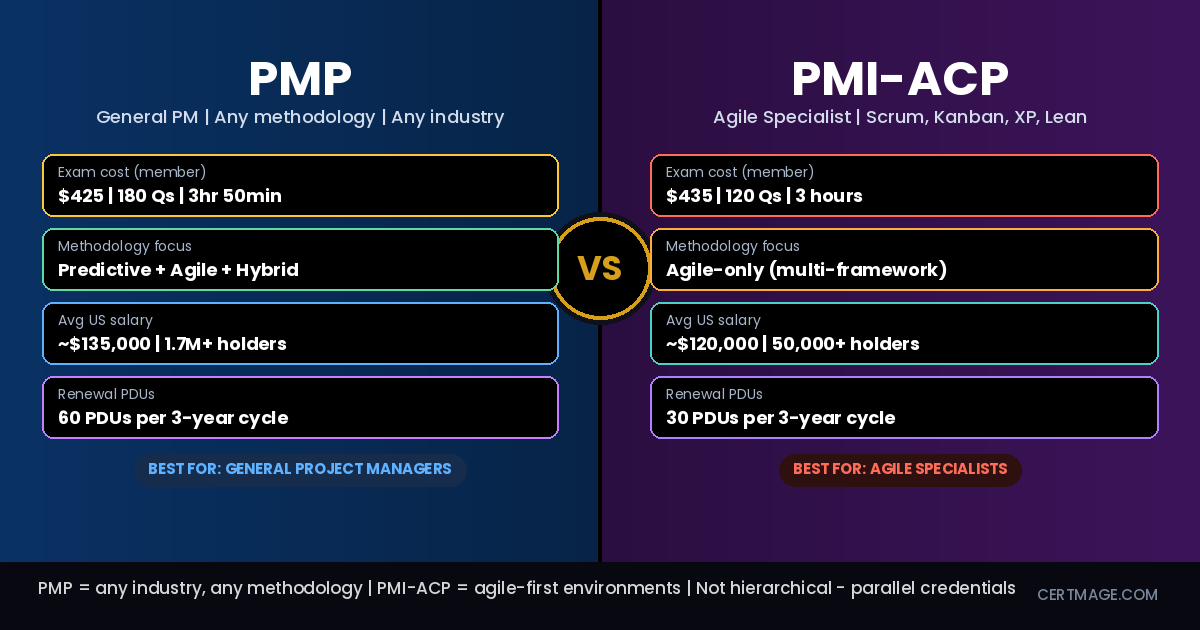
PMP (Project Management Professional) pays more on average, with US median salaries around $135,000 versus PMI-ACP’s $120,000, but PMI-ACP is not a step below PMP. It is a parallel credential for a different type of project work. PMP is the right choice for professionals managing projects across any methodology in any industry. PMI-ACP is the right choice for professionals whose work is primarily agile and who want to deepen their agile specialization rather than broaden their general project management credentials.
Quick Comparison Table
| Factor | PMP | PMI-ACP |
| Full name | Project Management Professional | Agile Certified Practitioner |
| Level | Professional | Professional (parallel, not advanced) |
| Global holders | 1.7 million+ | 50,000+ |
| Experience required | 36 months (degree) or 60 months (no degree) | 12 months general PM + 8 months agile (or active PMP) |
| Education required | Any degree + 35 contact hours | High school + 28 contact hours of agile training |
| Methodology focus | Predictive, agile, hybrid | Agile-specific (Scrum, Kanban, XP, Lean, SAFe) |
| Exam questions | 180 | 120 |
| Exam duration | 3 hours 50 minutes | 3 hours |
| Exam cost (member) | $425 | $435 |
| Exam cost (non-member) | $675 | $495 |
| Avg US salary | $135,000 | $120,000 |
| Validity | 3 years | 3 years |
| PDUs to renew | 60 | 30 |
| DoD 8570 recognized | No direct mapping | No direct mapping |
The Most Common Misconception: PMI-ACP Is Not “PMP Lite”
Many candidates assume PMI-ACP sits below PMP in the same career ladder, like an intermediate step before PMP. This framing is wrong and leads candidates to make poor sequencing decisions.
PMI-ACP and PMP sit at the same professional level. They are parallel credentials for different types of project environments. PMP certifies your ability to lead projects using any methodology, including agile. PMI-ACP certifies your depth and specialization in agile-specific frameworks. A PMI-ACP holder is not on the way to PMP. They are on a distinct agile specialist track.
| Credential | What it signals | Who it is for |
| PMP | You can lead any type of project, in any industry, using the right methodology | General project managers, program managers, PMO leads |
| PMI-ACP | You are a specialist in agile delivery and can lead agile teams across multiple frameworks | Scrum Masters, Agile Coaches, Product Owners, agile PMs |
| Both together | You can architect project systems and lead both traditional and agile delivery | Senior PMs, transformation leads, consulting PMs |
What PMP Tests in 2026
PMP is the broadest project management certification in the world. It tests your ability to lead projects across all three delivery approaches: predictive (waterfall), agile, and hybrid.
| Domain | Weight | What it covers |
| People | ~42% | Team leadership, conflict resolution, stakeholder engagement |
| Process | ~50% | Project delivery across predictive, agile, and hybrid |
| Business Environment | ~8% | Organizational alignment, benefits, compliance |
The July 2026 exam update added PMBOK Guide 8th Edition content including AI in project management, sustainability, and value delivery frameworks. The exam is currently approximately 50% predictive and 50% agile or hybrid, which means PMP holders must demonstrate competency in both worlds. This breadth is PMP’s key differentiator.
What PMI-ACP Tests in 2026
PMI-ACP tests depth in agile, not breadth across methodologies. The 120-question exam covers seven agile-specific domains and spans multiple frameworks rather than any single one.
| Domain | What it covers |
| Agile Principles and Mindset | Agile Manifesto, servant leadership, agile values |
| Value-Driven Delivery | Backlog management, MVP, iteration planning |
| Stakeholder Engagement | Agile communication, collaboration, feedback loops |
| Team Performance | Self-organizing teams, agile team dynamics |
| Adaptive Planning | Rolling wave planning, release planning, story pointing |
| Problem Detection and Resolution | Retrospectives, impediment removal, quality practices |
| Continuous Improvement | Kaizen, velocity, metrics, process improvement |
PMI-ACP deliberately covers multiple frameworks: Scrum, Kanban, XP, Lean, DSDM, Crystal, and SAFe. This breadth within the agile world is what distinguishes PMI-ACP from single-framework credentials like Certified ScrumMaster, which only covers Scrum. PMI-ACP signals that you understand agile as a philosophy across frameworks, not just one team methodology.
Experience Requirements Compared
This is the most important structural difference for candidates currently planning their path.
| Requirement | PMP | PMI-ACP |
| General PM experience | 36 months (with degree) / 60 months (no degree) | 12 months general PM (within past 5 years) |
| Agile-specific experience | Not required separately | 8 months of agile project experience (within past 3 years) |
| Active PMP shortcut | N/A | PMP holders skip the 12-month general PM requirement |
| Training hours | 35 contact hours of PM education | 28 contact hours of agile training |
| Experience window | Must fall within past 10 years | General PM: 5 years; Agile: 3 years |
PMI-ACP is more accessible by experience hours. However, the specific requirement for 8 months of agile project experience means that traditional project managers who have never worked in an agile environment cannot shortcut their way in with years of waterfall PM experience alone.
One important shortcut: if you already hold an active PMP, PMI waives PMI-ACP’s 12-month general project management experience requirement. You still need the 28 contact hours of agile training and 8 months of agile experience, but the PMP status removes one significant eligibility hurdle.
Salary and Career Paths
| Certification | Typical role | US salary range |
| PMP | Project Manager | $100,000-$130,000 |
| PMP | Senior Project Manager | $120,000-$155,000 |
| PMP | Program Manager | $130,000-$165,000 |
| PMI-ACP | Scrum Master | $110,000-$130,000 |
| PMI-ACP | Agile Coach | $125,000-$163,000 |
| PMI-ACP | Product Owner | $110,000-$130,000 |
| PMI-ACP | Agile Project Manager | $115,000-$140,000 |
| Both | Transformation Lead / Senior PM | $140,000-$175,000 |
PMP commands a higher average salary across most job titles. PMI’s Earning Power Survey documents a 24 percent salary premium for PMP holders in the US. PMI-ACP holders average approximately $120,000 with variations based on specific agile roles. Agile Coaches tend to earn the most from the PMI-ACP track ($127,000 average), while Scrum Masters and Product Owners with PMI-ACP typically fall in the $115,000 to $125,000 range.
One important nuance: PMI-ACP holders in technology-focused industries often earn salaries comparable to or above PMP holders in the same market, because demand for agile specialists in software and product companies is high and the supply of PMI-ACP holders is much smaller than the PMP pool.
Which Industries Favor Each Certification
| Industry | PMP demand | PMI-ACP demand |
| Construction | Very high | Low |
| Healthcare | High | Moderate |
| Government and defense | Very high | Low |
| Financial services | High | Growing |
| Technology and software | High | Very high |
| Consulting | Very high | High |
| Manufacturing | High | Moderate |
| Product development | Moderate | Very high |
PMP is the more universally required credential. Government contractors, construction firms, healthcare systems, and large enterprises list PMP as a standard requirement for senior PM roles. PMI-ACP is most valuable in technology-heavy environments where agile delivery is the norm rather than an option.
Should You Take PMP or PMI-ACP First?
| Your situation | Right first cert |
| You lead traditional or hybrid projects | PMP |
| You are a Scrum Master or Agile Coach | PMI-ACP |
| You work in government, construction, or healthcare | PMP |
| You work in software, product, or tech startups | PMI-ACP or PMP (both are valued) |
| You want the highest salary ceiling | PMP |
| You want the fastest path to an agile specialist credential | PMI-ACP |
| You already hold PMP and work in agile environments | Add PMI-ACP |
| You do not yet meet PMP experience requirements | Consider CAPM first; see our PMP vs CAPM guide |
The Case for Holding Both
Holding both PMP and PMI-ACP is an increasingly common profile among senior project professionals. The combination signals two things simultaneously: you can manage complex projects in any environment (PMP), and you have genuine depth in agile delivery (PMI-ACP). Transformation leads and senior consulting PMs who work across multiple clients and environments consistently report the dual credential as a meaningful differentiator for rate negotiation and hiring decisions.
The practical path is PMP first, then PMI-ACP. PMP is harder to earn (more experience required) and has broader market recognition. Adding PMI-ACP afterward builds agile depth on top of general PM credibility. PMI-ACP also becomes easier to obtain after PMP, since PMP status waives the 12-month general PM experience requirement for PMI-ACP eligibility.
FAQs
Is PMI-ACP harder than PMP?
No. PMP is generally considered harder due to its broader scope, longer exam, higher experience requirements, and scenario complexity. PMI-ACP is challenging but more focused. Candidates with real agile experience typically find it more manageable than PMP, while those with only waterfall backgrounds find the agile framework breadth difficult.
Which pays more, PMP or PMI-ACP?
PMP pays more on average. US median salary for PMP holders is approximately $135,000 versus $120,000 for PMI-ACP holders. However, Agile Coaches with PMI-ACP in high-demand tech environments can earn comparably or more than general PMP holders, so industry and role matter as much as the credential itself.
Can I take PMI-ACP without PMP?
Yes. PMI-ACP has its own experience pathway. You need a secondary degree, 12 months of general project experience in the past 5 years, 8 months of agile project experience in the past 3 years, and 28 contact hours of agile training. Holding a PMP waives the 12-month general PM experience requirement.
Does PMP cover agile?
Yes. PMP now covers predictive, agile, and hybrid methodologies across its three domains. The current exam is approximately 50% predictive and 50% agile or hybrid. However, PMP’s agile coverage is broader and more introductory than PMI-ACP’s deep agile framework specialization.
Is PMI-ACP recognized globally?
Yes, but with fewer job postings than PMP globally. PMP has 1.7 million holders worldwide and is recognized in virtually every industry and country where PMI operates. PMI-ACP has approximately 50,000 holders, giving it meaningful market recognition but less volume than PMP.
How long does it take to prepare for PMI-ACP versus PMP?
Most PMI-ACP candidates need 4 to 6 weeks of focused preparation. PMP requires 8 to 12 weeks for most experienced professionals. Both require hands-on experience with the content area; pure book study is less effective for either exam.
Does PMI-ACP expire?
Yes, after three years. Renewal requires 30 PDUs (versus 60 for PMP), with at least 18 of those PDUs focused on agile topics. The renewal fee is $60 for members and $150 for non-members, identical to PMP renewal.
Is PMI-ACP better than CSM (Certified ScrumMaster)?
They serve different purposes. CSM validates Scrum-specific knowledge through a training-and-assessment model. PMI-ACP validates agile knowledge across multiple frameworks through a proctored examination with experience requirements. PMI-ACP is generally considered more rigorous and broadly applicable, while CSM is faster to obtain and more recognized in pure Scrum environments.
What comes after PMI-ACP?
For professionals on the agile specialist track, natural next steps include SAFe Program Consultant (SPC) for scaling agile, ICP-ACC (Agile Coaching) through ICAgile, or leadership credentials like PgMP. For professionals who held PMI-ACP and want to add breadth, PMP is the natural complement.
Should I get PMP or PMI-ACP if I only have time and budget for one?
PMP, for most candidates. It has broader industry recognition, higher documented salary premium, and more job postings requiring it. PMI-ACP is more valuable than PMP only in specific scenarios: pure-agile technology organizations, Scrum Master or Agile Coach roles specifically, and professionals who already hold PMP and want to deepen agile specialization.