Here’s the sentence that ends most people’s Epic certification research the moment they find it: you cannot get certified on your own. Epic requires sponsorship from a customer organization, meaning a hospital, health system, or Epic-affiliated consulting firm has to bring you into their training pipeline before you can even access the coursework, let alone sit the certification exam. If you’re researching this from outside healthcare entirely, that single requirement changes everything about how you should approach this career path.
Why Epic Works This Way
Epic Systems doesn’t sell training or certification directly to individuals the way a vendor like AWS or Microsoft does. Certification is tied to a specific customer organization’s Epic build, and access to Epic UserWeb, the training portal, documentation, and certification tracking system, requires credentials issued by your sponsoring organization. Hospitals generally will not grant production-environment access without it, and consulting firms will not staff a project without it either, meaning certification functions as a hard gate at every stage of this career, not just at the point of hire. This isn’t a paywall you can get around with enough money. Even the “self-funded, independent prep” path that some guides mention, running $2,000 to $5,000, is described consistently as rare, precisely because Epic requires sponsorship to access the training in the first place. You’re not paying to skip the sponsorship requirement, you’re paying for prep materials while you pursue sponsorship through legitimate channels.
Interestingly, the sponsorship process is formalized enough within organizations that “Epic Certification Sponsor” exists as an actual internal job function, averaging $45.34 an hour, with responsibilities including coordinating the application process, ensuring candidates meet prerequisites, and managing training schedules against operational needs. Knowing this role exists is useful context: it confirms that sponsorship isn’t an informal favor a manager does for you, it’s a structured process with a named owner inside sponsoring organizations.
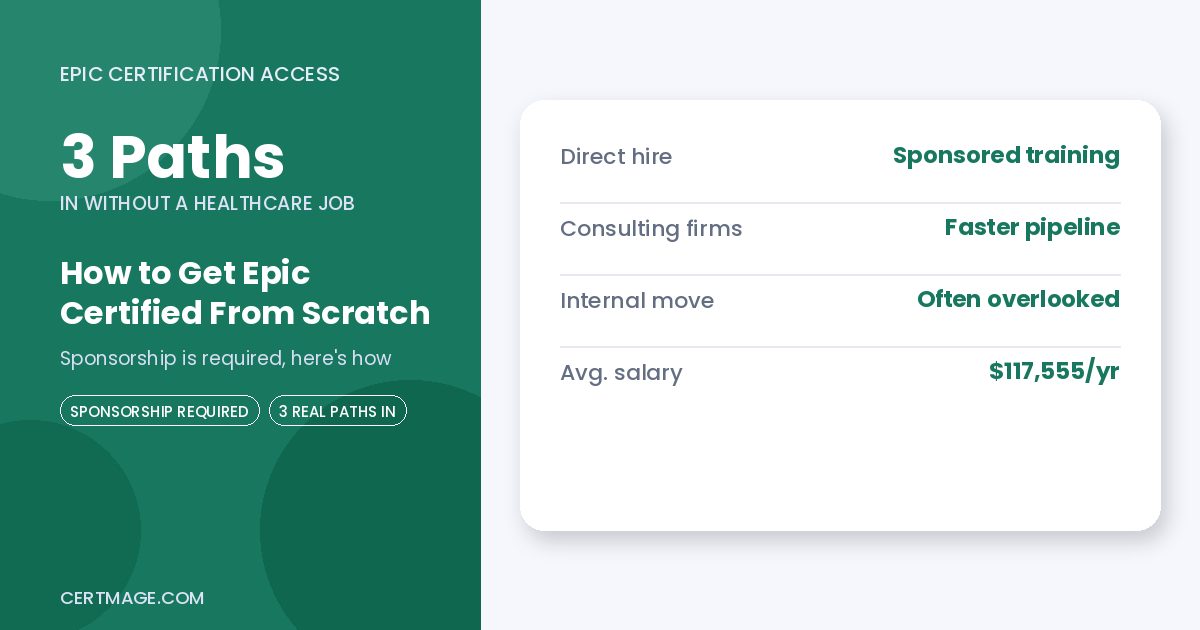
The 3 Real Paths In
Get hired directly by a healthcare organization that uses Epic, in a role that includes Epic training. This is the most common path. Major health systems actively hiring Epic-certified analysts in 2026 include Kaiser Permanente, Cleveland Clinic, Mayo Clinic, Mass General Brigham, and regional systems like Mercy and Providence, alongside hundreds of smaller hospitals and health systems running Epic. Entry-level IT roles, help desk positions, and clinical informatics roles at these organizations frequently include certification training as part of onboarding or an internal growth path, even if the job posting doesn’t lead with “Epic certification” as a requirement.
Join an Epic-affiliated consulting or staffing firm. This path splits into 2 tiers worth understanding separately. Healthcare IT-focused staffing firms, including Medix Technology, Healthcare IT Leaders, CereCore, and HCTec, place Epic-certified consultants on client projects and regularly sponsor promising candidates through certification as part of building their bench. Larger global consulting and implementation partners, including Accenture and the HCI Group, run similar pipelines at greater scale. Smaller, boutique firms are worth watching too: Prominence Advisors, a healthcare IT consultancy recognized as a top 10 Best Small Firm to Work For by Consulting magazine, actively posts remote Epic analyst roles and has built its reputation specifically around developing Epic talent. Firms at this tier often move faster than a direct hospital hire, since their business model depends on having certified consultants ready to place on client engagements.
Transition internally if you already work at a healthcare organization that uses Epic, even in a non-technical role. This is the most overlooked path, and it has a well-documented pattern: clinical support staff, including CNAs and medical assistants, have used this exact route to move from patient-facing roles into IT and informatics positions at their own employer. If you’re already employed by a hospital or health system running Epic, in scheduling, registration, billing, or clinical support, ask about internal mobility into IT before looking externally. Many organizations prefer promoting existing staff who already understand clinical workflows over hiring external candidates who don’t.
What You Can Actually Do Before You Have Sponsorship
You can’t touch Epic UserWeb or sit a certification exam without sponsorship, but you can build the background that makes you a stronger candidate once you’re in the door.
| What to Build | Why It Helps |
| General healthcare IT literacy, HIPAA basics, EHR concepts, clinical workflow understanding | Interviewers for Epic-track roles screen for baseline healthcare context, not just general IT skill |
| SQL and basic data analysis skills | Epic’s backend involves significant data work, and analysts with existing SQL comfort ramp up faster once certified |
| Any healthcare-adjacent work experience, even administrative or clinical support roles | Direct patient-facing or clinical operations experience signals you understand the workflows Epic is built around |
| A researched list of target organizations | A directory of healthcare IT companies and Epic customer organizations exists specifically to help candidates identify realistic sponsorship targets rather than applying blind |
| Networking with people who work in Epic-using organizations | Referrals matter significantly in this hiring pipeline, and informational interviews can reveal openings before they’re posted publicly |
Note: A general IT background alone, without any healthcare context, is a weaker starting position than it might seem. Organizations sponsoring Epic training are investing $3,000 to $15,000 per person in that training, and they want reasonable confidence the candidate will actually thrive in a healthcare-specific role, not just a technically competent one. Real consulting firm postings back this up directly, one recent Epic Grand Central and Prelude Consultant listing specifically noted that “multiple Epic certifications are highly desirable,” a preference for candidates who’ve already proven they can complete this process, which is exactly why your first certification matters more than it might seem for opening doors to the second and third.
What Happens Once You’re Sponsored
Once an organization sponsors you, the path runs through a few clear stages. Your organization assigns you a specific Epic module based on your role, you complete any required prerequisite learning through Epic UserWeb, then travel to Epic’s Verona, Wisconsin headquarters, or in some cases join virtually, for instructor-led training running 1 to 6 weeks depending on the module. After training, you sit the certification exam, most commonly at Epic’s campus, though some exams can now be completed remotely. Training is module-specific from the start, so your sponsoring organization will typically have already decided which module, Ambulatory, ClinDoc, Cadence, or another, matches the role they’re bringing you in for. For the full breakdown of how 2 of the most common tracks compare, see our Epic Ambulatory vs Inpatient (ClinDoc) Certification guide.
The Realistic Timeline
Getting from “no healthcare background” to “Epic certified” is rarely fast. Landing a sponsoring role can take anywhere from a few months to over a year depending on the local job market and how directly your existing background maps to healthcare IT. Once hired into a sponsoring role, training and certification itself typically adds another 1 to 3 months on top. Candidates who already have some healthcare or clinical experience generally move through this pipeline faster than candidates coming from a purely general IT background with no healthcare exposure at all.
What This Actually Pays Once You Get There
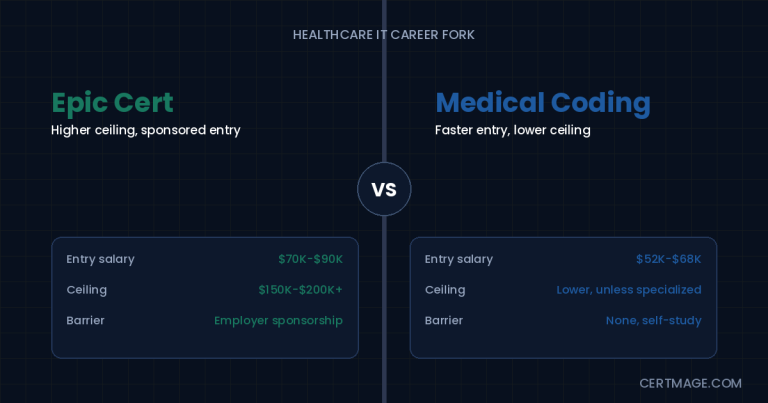
The investment is real, but so is the payoff, and the specifics are worth knowing before you commit years to this path. Entry-level Epic analysts typically earn $70,000 to $90,000, with the field overall ranging from $70,000 up to $200,000-plus for senior consultants and project managers. Salary.com’s state-level data from August 2026 shows most states landing close to a $100,000 to $103,000 national midpoint for Epic analysts broadly, but geography matters more than most candidates expect: San Francisco averages $138,005 a year, roughly 15 to 27 percent above the national average, and San Jose runs close behind at roughly $137,280 annualized, both cities benefiting from a dense concentration of large hospital systems and Epic consulting firms headquartered in the Bay Area specifically.
Remote work is genuinely common in this field, job boards typically list over 1,000 live remote Epic postings at any given time, but remote pay runs about 10 to 15 percent below comparable on-site roles, a real tradeoff worth factoring into your job search strategy depending on whether flexibility or maximum pay matters more to you.
Decision Checklist
- Don’t apply exclusively to roles that explicitly say “Epic certified required.” Look instead for entry-level healthcare IT, clinical informatics, or help desk roles at hospitals and health systems that mention Epic as part of their environment, since these are often the actual entry point.
- Research named healthcare IT staffing firms specifically, Medix Technology, Healthcare IT Leaders, CereCore, and HCTec among them, alongside larger consulting partners like Accenture and the HCI Group, and smaller, well-regarded boutique firms like Prominence Advisors, since these organizations sponsor certification as a core part of their business model.
- Build SQL and basic healthcare IT literacy before you’re in the sponsorship pipeline, not after, since it makes you a more competitive candidate at the hiring stage.
- If you’re already working at any healthcare organization, even in a non-technical or clinical support role, ask directly about internal mobility into IT or informatics before looking externally, since this path has a well-documented track record for staff moving from clinical roles into Epic-facing IT positions.
- Once you hold one certification, actively pursue a second where your role supports it. Consulting firm postings genuinely favor candidates who already hold multiple certifications, since it signals proven ability to complete the process.
- Be skeptical of any course, bootcamp, or program claiming to offer independent Epic certification prep that bypasses employer sponsorship entirely. Legitimate self-funded prep exists but remains rare and doesn’t remove the sponsorship requirement for the exam itself.
For the complete overview of Epic certification cost, structure, and career paths once you’re in, see our Epic Certification guide. If you’re weighing Epic against other major EHR platforms while you plan this path, see our Epic vs Meditech Certification guide and our Epic vs Cerner (Oracle Health) Certification comparison.
FAQS
Can I pay for Epic certification independently without an employer?
Not for the certification exam itself. Epic requires sponsorship from a customer organization to access training and sit the exam. Independent, self-funded prep exists but is rare and doesn’t bypass the sponsorship requirement.
What’s the fastest way into Epic certification with no healthcare background?
Joining a healthcare IT-focused staffing firm, such as Medix Technology, Healthcare IT Leaders, CereCore, or HCTec, or a boutique consultancy like Prominence Advisors, is often faster than a direct hospital hire, since these firms actively need a pipeline of newly certified consultants for client projects.
Do I need a healthcare degree to get sponsored for Epic training?
No, but healthcare-adjacent experience, even administrative or clinical support work, or demonstrated healthcare IT literacy, makes you a stronger candidate for sponsorship than a purely general IT background.
How long does it take to go from no healthcare background to Epic certified?
Realistically, several months to over a year to land a sponsoring role, plus another 1 to 3 months for training and certification itself once hired.
Is internal mobility a real path to Epic certification?
Yes, and it’s often underused. There’s a well-documented pattern of clinical support staff, including CNAs and medical assistants, moving from patient-facing roles into Epic-facing IT positions at their own employer.
What is an “Epic Certification Sponsor”?
An internal role within sponsoring organizations, averaging $45.34 an hour, responsible for coordinating the certification application process, ensuring candidates meet prerequisites, and managing training logistics. Its existence confirms how formalized the sponsorship process actually is.
Which major health systems are actively hiring Epic-certified analysts right now?
Kaiser Permanente, Cleveland Clinic, Mayo Clinic, Mass General Brigham, and regional systems like Mercy and Providence are among the larger organizations actively hiring in 2026, alongside many smaller hospitals and health systems.
Does holding multiple Epic certifications actually help my job search?
Yes. Real consulting firm postings specifically list multiple Epic certifications as highly desirable, since it demonstrates proven ability to complete the sponsorship and training process more than once.
Is remote work realistic in Epic-certified roles?
Yes, job boards typically list over 1,000 live remote Epic postings at any given time, though remote roles tend to pay about 10 to 15 percent below comparable on-site positions.