CCS-P and CPC were built to solve the same basic problem, validating physician-based and outpatient coding skill, but from 2 different credentialing bodies, AHIMA and AAPC respectively. For years, this looked like a genuine head-to-head choice. It increasingly isn’t. Multiple current industry analyses describe CPC as having largely eclipsed CCS-P in market demand, and understanding exactly why, down to the real exam formats, real costs, and real hiring patterns behind that shift, matters more than a generic feature comparison of the 2 exams.
What Each Credential Was Built to Do
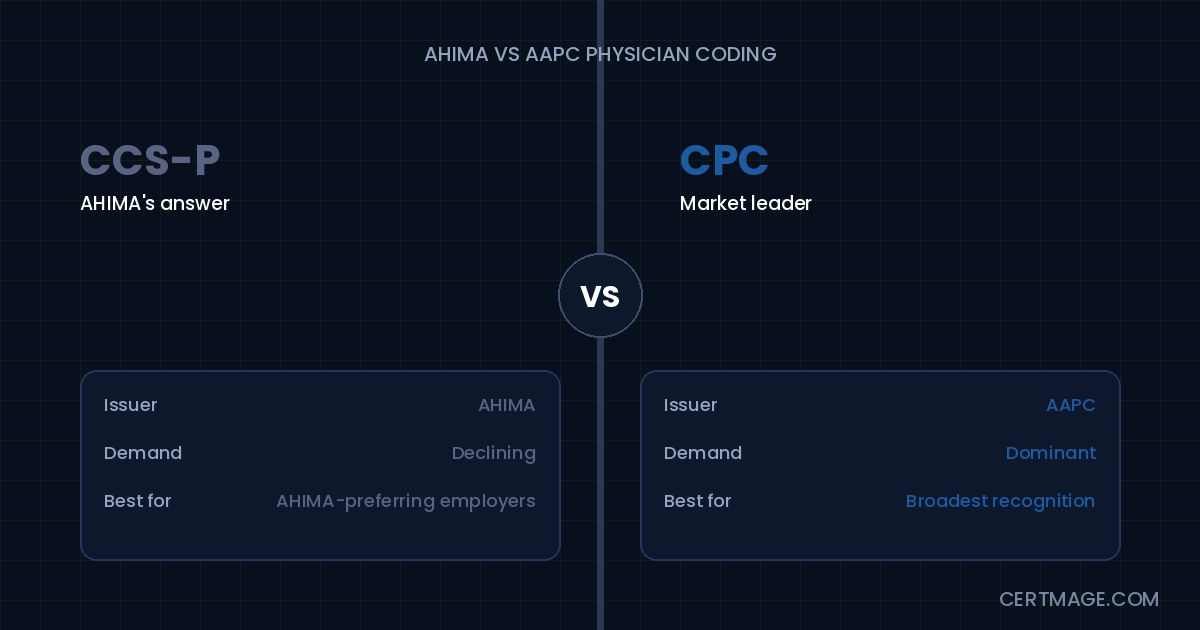
CCS-P, Certified Coding Specialist, Physician-based, is AHIMA’s credential for physician office, outpatient clinic, and ambulatory surgery center coding. It was designed as AHIMA’s answer to a genuine market need: a physician-focused counterpart to AHIMA’s more hospital-inpatient-oriented CCS credential.
CPC, Certified Professional Coder, is AAPC’s flagship physician-based coding credential, covering the same fundamental territory, CPT, ICD-10-CM, and HCPCS Level II coding for physician and professional-fee services. It’s become, by a wide margin, the most widely held medical coding certification in the United States.
Exam Format, Side by Side
| Detail | CCS-P | CPC |
| Issuing body | AHIMA | AAPC |
| Format | 4-hour exam, administered in 2 parts | 100 multiple-choice questions, 4-hour time limit, open codebook |
| Passing score | Not published with the same specificity as CPC’s | 70 percent |
| Membership required | AHIMA membership, $165/year, needed for member-rate pricing | AAPC membership, $229/year, required to sit the exam and maintain the credential |
| Exam fee, member rate | $320 | $425 for one attempt |
| Exam fee, non-member rate | $405 | $499 for 2 attempts |
| Prior experience recommended | CCA or RHIT experience commonly cited as helpful preparation | None formally required, though candidates without documented experience receive the CPC-A designation |
| Typical prep time | Comparable to other physician-based coding credentials, generally 4 to 6 months | 4 to 6 months |
Important: Notice that CCS-P’s exam is split into 2 parts within its 4-hour window, a structural difference from CPC’s single continuous 100-question sitting. Candidates used to CPC’s format, or researching this pairing based only on generic “both are 4-hour exams” comparisons, sometimes miss this real structural difference in how the testing experience actually unfolds.
Why CPC Has Largely Eclipsed CCS-P
This isn’t a subtle trend. Recent comparative analyses of the AAPC-versus-AHIMA coding landscape state it directly: CPC has largely eclipsed CCS-P in market demand, even though CCS-P remains a technically valid, AHIMA-recognized credential. Several structural reasons explain why, and they go beyond simple brand recognition.
AAPC has built an extensive 6-credential core ecosystem, spanning outpatient coding, facility coding, risk adjustment, inpatient coding, medical auditing, and billing, all administered under one consistent membership and exam pricing structure, currently $425 to $499 per core exam with a single $229 annual membership covering access to all of them. This gives employers a consistent, easily understood credentialing ladder to screen candidates against, and it gives coders a clear, low-friction path to stack additional specialty credentials once they hold CPC. CCS-P exists more as one option within AHIMA’s broader catalog rather than the center of a similarly developed specialty ecosystem built specifically around physician-based coding.
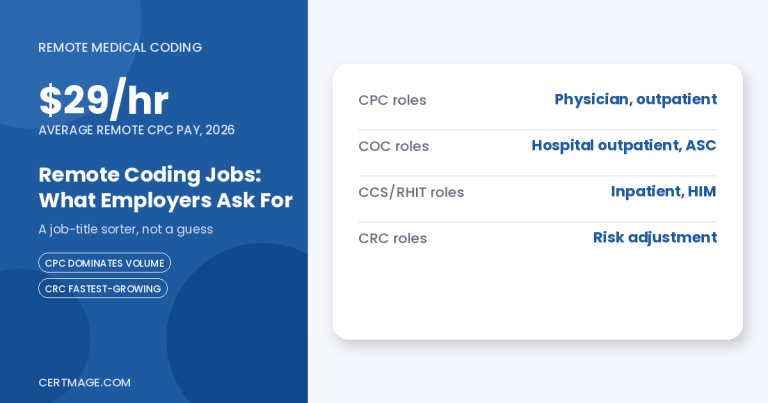
Remote hiring patterns reinforce this further. More than 70 percent of AAPC-credentialed coders now work fully or partially remote, according to recent AAPC survey data, and large national employers with permanent remote production-coder roles, including Optum, R1 RCM, and Conifer Health, along with major hospital systems, consistently name CPC by title in their job postings. This kind of large-scale, brand-name remote hiring infrastructure built specifically around CPC gives it a market visibility CCS-P doesn’t currently match.
The honest verdict, drawn from current market analysis: CCS-P remains a viable choice specifically if your employer or target organization has an established preference for AHIMA credentials, common at some hospital systems and larger health information management departments, but for most coders entering physician-based or outpatient coding without that specific employer context, CPC is the more broadly useful choice today.
The CPC-A Detail Most Comparisons Skip
Here’s a nuance worth knowing before you assume CPC is simply the easier or safer choice by default: candidates who pass the CPC exam without documented coding experience receive a modified designation, CPC-A, the Apprentice credential, rather than the full CPC. CPC-A holders typically start in the $40,000 to $48,000 range, meaningfully below the general CPC salary range, and the apprentice designation typically requires accumulating a set amount of real coding experience or completing additional coursework before it converts to the full, unrestricted CPC. This is exactly the kind of practical detail that gets lost in a pure feature-by-feature comparison but matters enormously for anyone entering coding with no prior on-the-job experience.
Salary Reality Check
CPC holders generally see a salary range of roughly $55,000 to $75,000, with a median around $58,895 according to AAPC’s own 2025 data. AHIMA’s closely related CCS credential, the hospital-inpatient sibling to CCS-P, shows a somewhat higher range of $57,500 to $85,000, reflecting the added complexity of inpatient DRG-based coding work specifically. CCS-P doesn’t have an equally clean, independently published salary breakdown separate from its AHIMA siblings, but given its physician-based focus overlaps closely with CPC’s scope, expect it to track closer to CPC’s range than to CCS’s higher, inpatient-driven figures. Certification broadly matters regardless of which specific credential you hold: certified coders average $66,979 a year compared to $55,721 for uncertified coders doing similar work, and that gap widens further with each additional stacked credential.
When CCS-P Still Makes Sense
This doesn’t mean CCS-P is worthless, it means its value is now more conditional than it once was. If you already hold AHIMA credentials, a CCA or RHIT specifically, CCS-P builds naturally on that foundation and keeps you within a single credentialing ecosystem rather than starting fresh with AAPC’s membership and exam structure. If your target employer is a large hospital system or health information management department with a documented preference for AHIMA credentials specifically, matching that preference has real value regardless of broader market trends. And if your long-term path includes AHIMA’s more advanced credentials built on physician-based coding experience, starting with CCS-P keeps that progression consistent.
| Your Situation | Better Fit |
| No existing credential, no specific employer preference | CPC |
| Already hold CCA or RHIT from AHIMA | CCS-P, building on your existing credentialing path |
| Target employer specifically values AHIMA credentials | CCS-P |
| Want the broadest possible job market recognition and remote opportunities | CPC |
| Planning to stack multiple physician-coding specialty credentials over time | CPC, given AAPC’s more developed 6-credential specialty ecosystem |
| Entering coding with zero documented experience and want to avoid the apprentice-tier pay gap | Either path works, but budget for the reality that CPC without experience means CPC-A status and lower starting pay |
Can You Hold Both?
Yes, and you don’t need to choose one organization permanently. AHIMA and AAPC credentials can be held simultaneously, and coders do this specifically when their career path benefits from both organizations’ recognition, an AHIMA credential for hospital-system credibility alongside a CPC for the broader outpatient job market’s default expectation.
Decision Checklist
- Check your target employers’ actual job postings before assuming either credential is universally preferred. Some organizations, particularly larger hospital systems, do specify AHIMA credentials.
- If you have no existing AHIMA credentials and no specific employer preference pulling you toward CCS-P, default to CPC given its broader current market demand and larger remote job pipeline.
- If you already hold CCA or RHIT, weigh the value of staying within AHIMA’s ecosystem against CPC’s broader general market recognition before switching credentialing bodies.
- Budget realistically: CCS-P runs $320 to $405 in exam fees plus $165 annual AHIMA membership, while CPC runs $425 to $499 in exam fees plus $229 annual AAPC membership, a real cost difference worth factoring in alongside market demand.
- If you’re entering coding without documented prior experience, plan around the CPC-A apprentice designation and its lower $40,000 to $48,000 starting range rather than assuming full CPC-level pay immediately.
- Don’t assume CCS-P is technically inferior to CPC. The eclipse described in current market analysis reflects demand and ecosystem breadth, not a quality gap between the 2 credentials’ content.
For the foundational comparison between AAPC and AHIMA’s entry-level credentials more broadly, see our CPC vs CCA guide. If you’re specifically deciding between outpatient facility coding and physician coding within AAPC’s own catalog, see our COC vs CPC comparison, and if you’re weighing a further specialty path beyond either of these foundational credentials, see our CIRCC vs CPMA guide.
FAQS
Is CCS-P still worth pursuing in 2026?
It remains viable specifically if you already hold AHIMA credentials or your target employer specifically values AHIMA certification. For most other candidates, current market analysis shows CPC has largely eclipsed it in general demand.
What is the exact format of the CCS-P exam?
A 4-hour exam administered in 2 parts, costing $320 for AHIMA members or $405 for non-members, with AHIMA membership itself running $165 a year.
What is the exact format of the CPC exam?
100 multiple-choice questions over a 4-hour time limit, open codebook, requiring a 70 percent passing score, costing $425 for one attempt or $499 for 2 attempts, with mandatory AAPC membership at $229 a year.
Which is easier to get hired with, CCS-P or CPC?
CPC generally offers broader job market recognition today, including a large, established remote hiring pipeline with named employers like Optum, R1 RCM, and Conifer Health. CCS-P can still be the stronger choice at specific employers, particularly larger hospital systems with established AHIMA preferences.
Do CCS-P and CPC test the same content?
They cover overlapping territory, physician-based and outpatient coding, but through each organization’s own exam structure and coding logic, so credentials don’t transfer directly between them.
What is CPC-A, and how does it affect pay?
CPC-A is the Apprentice designation given to candidates who pass the CPC exam without documented coding experience. CPC-A holders typically start in the $40,000 to $48,000 range, below the general CPC salary range, until they accumulate enough experience to convert to full CPC status.
Should I switch from CCS-P to CPC if I already hold CCS-P?
Not necessarily. If CCS-P already serves your current employer and career path well, switching isn’t automatically necessary. The eclipse in market demand matters most for candidates choosing a credential from scratch.
Can I hold both CCS-P and CPC at the same time?
Yes. Neither organization requires you to choose exclusively, and coders sometimes hold credentials from both AHIMA and AAPC to maximize recognition across different employer types.
Why has CPC overtaken CCS-P in demand?
Largely due to AAPC’s broader 6-credential specialty ecosystem built around CPC specifically, a large and growing remote hiring pipeline with major named employers, and a simpler, more consistent membership and pricing structure across its entire credential catalog.