“Remote medical coding jobs” is one of the most searched phrases in this entire field, and most of what comes up answers the wrong question. The real question isn’t whether remote coding jobs exist, they do, in large numbers, it’s which specific certification actually shows up in the postings you’d apply to. This guide sorts real job titles and current postings by which credential they actually name, rather than repeating the generic claim that “certification helps you go remote.”
The Baseline Numbers
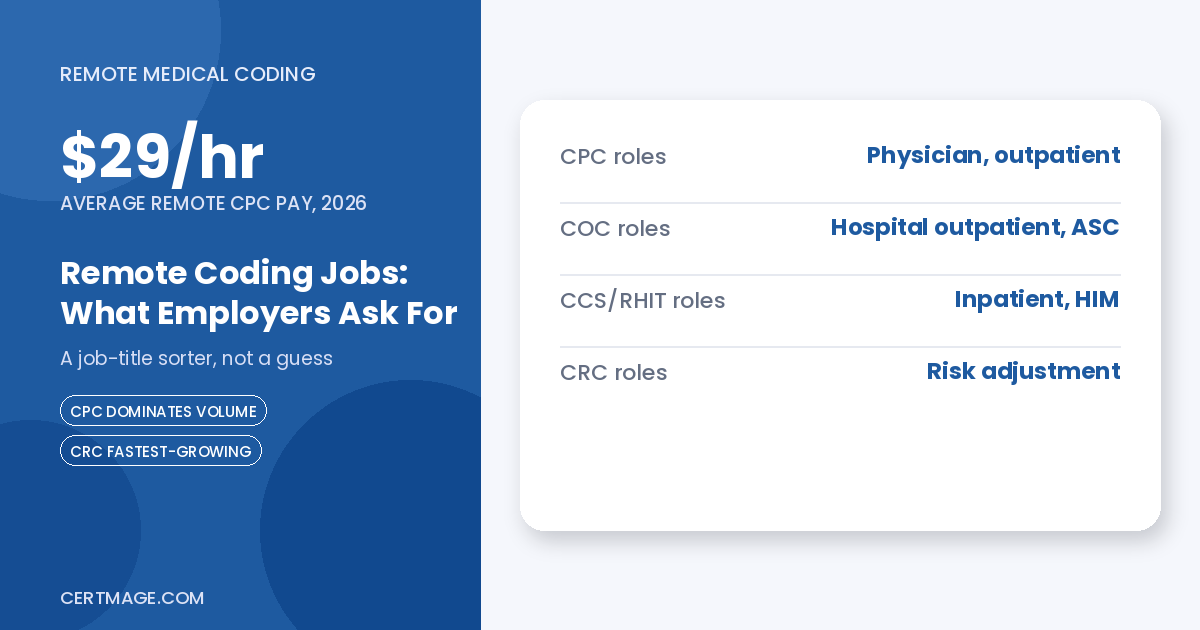
The Bureau of Labor Statistics tracks medical coders under Medical Records Specialists, SOC code 29-2072, and its most recent data, from May 2025, counts 194,720 workers nationally with a median hourly wage of $24.59 and a mean annual wage of $56,790, putting the median annual figure around $51,140. That’s the broad national floor before certification, specialty, and remote-specific premiums enter the picture. Remote CPC-certified coders specifically average $29.29 an hour, roughly $61,000 a year, according to ZipRecruiter’s aggregated 2026 data, already meaningfully above the BLS-wide baseline.
Job Title Sorter: What Employers Actually Ask For, With Real Pay
Risk Adjustment Coder, extremely high remote availability, almost always remote. This is the single most remote-friendly coding specialty in the field, since it’s entirely documentation-driven and doesn’t require any clinic-side interaction. Typical pay runs $55,000 to $80,000 a year, or $26 to $38 an hour, and postings consistently name CRC, CPC, or CCS as acceptable credentials, sometimes listing all 3 interchangeably. Real current postings back this up precisely: a Risk Adjustment Coding Auditor II role pays $53,000 to $86,000 remotely across the US, a Risk Adjustment Coder role at Blue Cross and Blue Shield of Rhode Island pays $65,600 to $98,400, and general HCC and risk-adjustment coder postings commonly run $25 to $27 an hour. Insurance companies, managed care organizations, and specialized revenue cycle management vendors are the primary employers here.
Coding Auditor, high remote availability. Auditors review other coders’ work for accuracy and compliance rather than producing new codes, and this role pays $60,000 to $90,000 a year, requiring CPMA, CPC, or CCS. A real current example, Oscar Health’s SIU Coding Auditor role, pays $96,000 a year, works remotely across 18 or more states, and focuses specifically on detecting fraud, waste, and abuse trends using deep coding knowledge.
Inpatient Coder, increasingly remote after initial onsite training. Many hospital systems now allow experienced inpatient coders to work fully remote once they’ve completed an initial onsite training period, with a median wage of $27.41 an hour and senior-level positions at large health systems reaching significantly higher. This role consistently favors CCS or CIC specifically, since it centers on ICD-10-PCS and DRG-based reimbursement logic that CPC alone doesn’t cover.
Outpatient Facility Coder. COC supports this work specifically, coding hospital outpatient departments, ambulatory surgery centers, and emergency department encounters using APC-based reimbursement logic distinct from both physician-fee and inpatient coding.
Coding Supervisor and Lead roles. Many postings at this level list multiple acceptable credentials rather than requiring one specifically, a pattern seen directly in real listings requiring “Current CCS, CCS-P, CPC, CPC-H, CPMA, or CRC credential,” treating several credentials as satisfying the same minimum bar.
Real Companies Hiring Remote Coders Right Now
Beyond generic advice to “apply to remote coding jobs,” a handful of specific employers show up consistently in current listings. Optum and GeBBS both run structured bridge programs specifically designed to help new CPC-A apprentice coders accumulate the experience needed to remove the apprentice designation and convert to full CPC status. LexiCode specializes in remote facility and inpatient coding services specifically. IKS Health focuses on coders working in quality and clinical documentation improvement. AAPC’s own job board, which tracks live risk-adjustment-adjacent postings by credential, shows CPC named far more often than any other single credential, followed by CRC, with CIC, COC, CCS, CPMA, CIRCC, RHIA, and CCS-P all appearing in smaller but real numbers, confirming that while CPC dominates in raw volume, the other credentials each maintain a genuine, specific presence in the market rather than being purely theoretical alternatives.
Why Remote Roles Sometimes Require More, Not Less
A common assumption is that remote work has lower barriers to entry than on-site coding roles. The opposite is often true. Remote-only positions frequently compete nationally rather than locally, meaning employers can be more selective about credentials precisely because they’re drawing from a much larger applicant pool. A local hospital hiring an on-site coder might accept a broader range of experience levels out of practical necessity. A national remote employer receiving hundreds of applications for the same posting can afford to require a specific named credential and years of directly relevant experience.
A Real Career Risk Specific to Remote Risk Adjustment Work
Risk adjustment coding’s heavy remote availability makes it an attractive specialty, but it carries a specific, documented career risk worth knowing before you specialize too narrowly. Coders who spend years working almost exclusively with ICD-10-CM in risk adjustment can genuinely lose broader CPT coding flexibility over time, since the work doesn’t exercise those procedural coding muscles. Coders who’ve made this move successfully recommend deliberately maintaining CPT knowledge, Medicare resource familiarity, and general billing fundamentals alongside risk adjustment specialization specifically, to protect long-term career mobility rather than becoming narrowly employable in one niche.
What Certification Stacking Actually Does to Pay
The data on this is specific and consistent: coders holding 3 or more AAPC certifications, a common combination being CPC plus COC plus CPMA, average $81,000 or more a year, nearly 45 percent above non-certified peers doing comparable work. This isn’t a vague directional claim, it’s a documented pattern across current job market data, and it’s exactly why the “which single certification should I get” framing undersells how this field’s compensation actually scales for coders willing to stack credentials strategically over time.
What This Actually Costs to Get Started
A realistic total cost for entering remote medical coding through the CPC path runs $2,500 to $4,000, covering a training course, AAPC membership, and the certification exam itself, with many employers offering tuition reimbursement once you’re hired, reducing your effective upfront investment further if you can secure employment during or shortly after training.
Decision Checklist
- Before assuming any single certification is your ticket to remote work, search actual current remote postings in your target specialty and note which specific credential appears most often, since this varies meaningfully by coding niche.
- If you’re targeting inpatient or hospital-system remote roles specifically, prioritize CCS or CIC over CPC alone, since these postings consistently favor credentials built around ICD-10-PCS and DRG logic.
- If risk adjustment coding interests you specifically for its remote flexibility, deliberately maintain your CPT and general coding skills alongside it, so you don’t narrow your future options.
- Research named employers with structured entry pathways, Optum and GeBBS specifically run bridge programs for CPC-A apprentices, a genuinely useful detail if you’re entering coding without documented experience yet.
- Consider stacking a specialty credential, COC, CRC, or CPMA, on top of a foundational CPC or CCA if you’re serious about competing in a national remote applicant pool, given the documented $81,000-plus average for coders holding 3 or more credentials.
- Don’t assume remote automatically means less competitive. National remote postings often see far more applicants than local on-site roles, and employers respond by tightening credential requirements rather than loosening them.
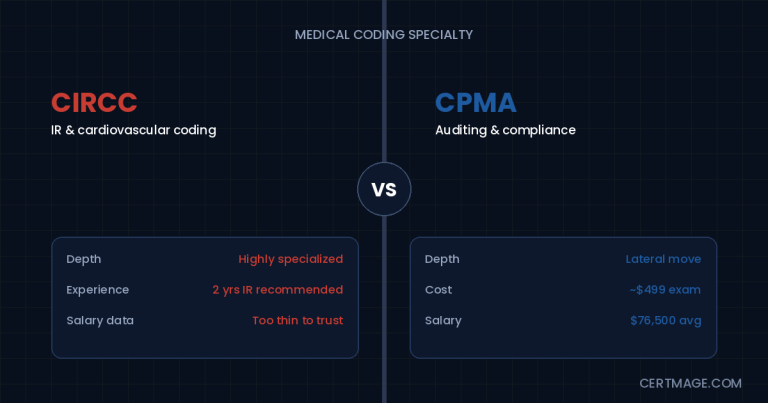
For the foundational entry-level comparison most coders start from, see our CPC vs CCA guide. If risk adjustment coding is a specialty direction you’re considering given its strong remote demand, see our CRC certification guide, for the outpatient facility-coding fork specifically, see our COC vs CPC comparison, and if auditing interests you as a specialty path, see our CIRCC vs CPMA guide.
FAQS
What is the most commonly required certification for remote medical coding jobs?
CPC, by a wide margin in pure volume, given its dominance in physician-office and outpatient coding, the largest single category of remote coding work, though CRC shows the strongest remote-specific demand as a specialty credential.
What is the national baseline salary for medical coders before certification premiums?
The Bureau of Labor Statistics reports a median hourly wage of $24.59 and median annual wage around $51,140 for Medical Records Specialists as of May 2025, the broadest available government baseline.
Which remote coding specialty is considered the most remote-friendly?
Risk adjustment coding, described as “almost always remote” given its entirely documentation-driven nature, with typical pay of $55,000 to $80,000 a year.
Do any real companies have structured programs for coders without experience?
Yes. Optum and GeBBS both run bridge programs specifically designed to help CPC-A apprentice coders gain the experience needed to convert to full CPC status.
How much more do coders with multiple certifications earn?
Coders holding 3 or more AAPC certifications average $81,000 or more a year, nearly 45 percent above non-certified peers, according to current job market data.
What is the real cost of getting started in remote medical coding?
Roughly $2,500 to $4,000 for a complete CPC path, including training, AAPC membership, and the exam itself, with many employers offering tuition reimbursement after hire.
Is there a career risk to specializing only in risk adjustment coding?
Yes. Coders who work almost exclusively in ICD-10-CM risk adjustment for years can lose broader CPT coding flexibility, making it worth deliberately maintaining general coding skills alongside specialization.
Which certification is best for remote inpatient coding specifically?
CCS or CIC, AHIMA and AAPC’s respective inpatient-focused credentials, are the credentials most consistently favored in remote hospital-system and inpatient coding postings, given their ICD-10-PCS and DRG focus.
Why do some remote coding jobs require more experience than local ones?
Remote-only postings often draw a much larger, national applicant pool, allowing employers to be more selective about specific credentials and experience level than a local employer hiring on-site might need to be.