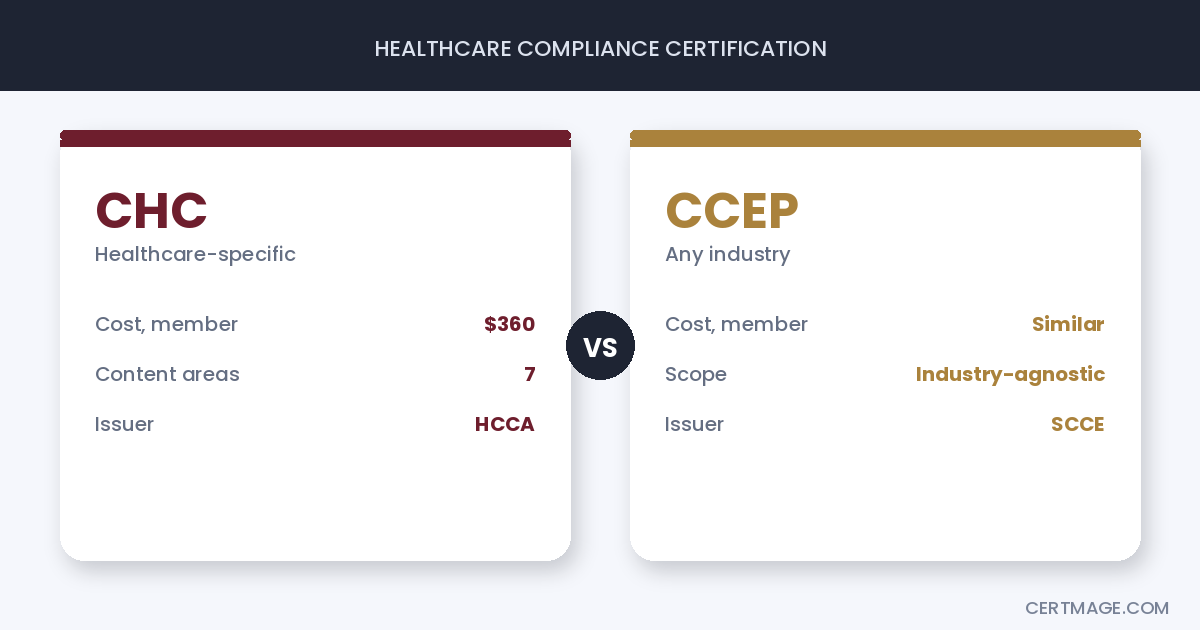
CHC validates healthcare-specific compliance expertise while CCEP validates broad, industry-agnostic compliance and ethics program management, and the choice comes down to whether your career is anchored specifically in healthcare or spans compliance work across any industry.
The direct answer: Choose CHC, Certified in Healthcare Compliance, if you work exclusively in healthcare compliance, hospital systems, physician practices, health plans, or healthcare vendors, since it tests healthcare-specific regulatory knowledge directly. Choose CCEP, Certified Compliance and Ethics Professional, if your compliance career spans multiple industries or you want broader recognition outside healthcare specifically, since it validates general compliance program management applicable anywhere. Both are administered by the Compliance Certification Board, the credentialing arm connected to HCCA and SCCE. Full official details live on HCCA’s certification page and SCCE’s CCEP certification page.
CHC vs CCEP at a Glance
| Detail | CHC | CCEP |
| Full name | Certified in Healthcare Compliance | Certified Compliance and Ethics Professional |
| Issuing body | Compliance Certification Board, via HCCA | Compliance Certification Board, via SCCE |
| Industry scope | Healthcare specifically | Any industry, general compliance |
| Exam format | 120 questions, 100 scored, 2 hours | Similar format and length, general compliance content |
| Cost, member | Approximately $360 | Similar fee structure to CHC |
| Cost, non-member | Approximately $595 | Similar fee structure to CHC |
| Content areas | 7 | Covers general compliance program elements, not healthcare-specific regulation |
| Renewal | Every 2 years, 40 CEUs, or included with active HCCA membership | Every 2 years, similar CEU structure through SCCE |
Important: CHC and CCEP share the same certifying infrastructure, the Compliance Certification Board, and CEUs earned toward one can often be applied toward eligibility for the other if still valid within the required window. This is why many senior compliance professionals hold both rather than treating them as a strict either-or choice.
What CHC Actually Tests
CHC is built specifically around the regulatory, operational, and ethical demands of healthcare compliance work.
| Content Area | Approximate Scored Questions |
| Standards, Policies, and Procedures | 11 |
| Compliance Program Administration | 19 |
| Screening and Evaluation of Employees, Physicians, Vendors, and Other Agents | 6 |
| Communication, Education, and Training on Compliance Issues | 14 |
| Monitoring, Auditing, and Internal Reporting Systems | 22 |
| Additional content areas covering investigations and remedial action, plus general compliance risk areas | Remaining scored questions |
Key point: Monitoring, Auditing, and Internal Reporting Systems carries the heaviest weight of any single content area at 22 scored questions, reflecting how much of real-world healthcare compliance work centers on ongoing detection and correction rather than one-time policy writing.
What CCEP Actually Tests
CCEP covers the same underlying compliance program management skill set as CHC, standards and procedures, program administration, training, monitoring and auditing, but without healthcare-specific regulatory content. Instead, CCEP draws on the U.S. Federal Sentencing Guidelines for organizations and general compliance principles applicable across any regulated industry, finance, manufacturing, technology, or otherwise.
Note: There is no official CCEP study guide the way some certifications provide one. The exam draws heavily on real compliance work experience rather than a fixed textbook curriculum, which is why candidates without hands-on compliance program experience typically find CCEP harder to prepare for than credentials built around a defined body of knowledge.
CHC and CCEP Cost Breakdown
Required Costs
| Item | CHC | CCEP |
| Exam fee, member | Approximately $360 | Similar, verify current fee on SCCE’s site |
| Exam fee, non-member | Approximately $595 | Similar, verify current fee on SCCE’s site |
| HCCA or SCCE membership, if joining first | $295 | Similar membership fee through SCCE |
Strongly Recommended Supplementary Costs
| Item | Amount | Notes |
| Study materials | $50 to $200 | CHC has more structured official materials than CCEP |
| Retake fee, if needed | Reduced from full fee, based on CEUs already on file | Contact the Compliance Certification Board directly to confirm your specific retake cost |
The membership math: Joining HCCA or SCCE before sitting your exam typically costs only about $60 more than paying the non-member exam fee directly, once you account for the membership fee against the member-rate discount, while also unlocking free CEU-eligible webinars that can cover your entire annual continuing education requirement at no additional cost.
Who Should Pursue CHC, and Who Should Pursue CCEP
Compliance professionals working exclusively within hospitals, health systems, or physician practices. CHC’s healthcare-specific regulatory depth, fraud and abuse laws, Stark Law, Anti-Kickback Statute, HIPAA, directly matches daily responsibilities in these settings.
Compliance professionals at healthcare vendors, health plans, or pharmaceutical and device companies. CHC remains the stronger fit even outside a hospital setting specifically, since these organizations still operate under healthcare-specific regulatory frameworks.
Compliance professionals whose career spans multiple industries, or who want portability beyond healthcare. CCEP’s broader, industry-agnostic framing signals compliance program management competence that transfers cleanly to a role outside healthcare, which CHC’s healthcare-specific content does not demonstrate as directly.
Senior compliance officers or those targeting Chief Compliance Officer roles. Holding both CHC and CCEP is common at this level, since it demonstrates both deep healthcare-specific expertise and broad, transferable compliance program management skill, useful if your career path might eventually move outside healthcare entirely.
For a closer look at how healthcare compliance credentials compare to the broader governance, risk, and audit certifications CertMage covers, see our Top IT Auditing Certifications guide and our CISA vs CRISC comparison if your compliance work overlaps with IT audit and risk functions specifically.
Common Mistakes When Choosing Between CHC and CCEP
Assuming CCEP is a lesser or entry-level version of CHC. It is not. CCEP tests a genuinely different scope, broad compliance program management rather than healthcare-specific regulation, and is not easier simply because it lacks healthcare-specific content.
Pursuing CCEP without real hands-on compliance program experience. Since no official study guide exists, candidates who lack practical compliance work experience often find CCEP significantly harder to prepare for than CHC, which has more structured materials available.
Ignoring the shared CEU pathway between the two credentials. Compliance professionals who plan to eventually hold both often waste effort by not tracking CEU eligibility windows carefully across both certifications.
Choosing CHC purely because it is more commonly discussed, without confirming your actual work is healthcare-specific. If your compliance role is not anchored in healthcare regulation specifically, CCEP’s broader positioning may serve your career better regardless of which credential is more frequently mentioned online.
Frequently Asked Questions
What is the difference between CHC and CCEP?
CHC validates healthcare-specific compliance expertise, covering regulations like HIPAA, Stark Law, and the Anti-Kickback Statute. CCEP validates broad, industry-agnostic compliance program management applicable to any regulated industry.
Can I hold both CHC and CCEP?
Yes, and many senior compliance professionals do, particularly those targeting Chief Compliance Officer roles where both healthcare-specific depth and broad compliance program management credibility matter.
How much does CHC cost?
Approximately $360 for HCCA members and $595 for non-members, based on current published pricing. Confirm the exact current fee directly with HCCA before applying.
Is CCEP harder than CHC?
Not inherently harder, but different. CCEP lacks an official study guide and draws heavily on real compliance work experience, which candidates without hands-on program management background often find more challenging to prepare for than CHC’s more structured content.
Do CHC and CCEP share continuing education requirements?
CEUs earned toward one can often be applied toward the other if still valid, since both certifications are administered through the same Compliance Certification Board infrastructure connected to HCCA and SCCE.
Which certification is better for a healthcare career specifically?
CHC, since its content is built directly around healthcare-specific compliance regulation rather than general compliance principles.
Which certification is better if I might leave healthcare eventually?
CCEP, since it validates compliance program management skill that transfers to any regulated industry, rather than healthcare-specific regulatory knowledge that has less direct application outside the sector.
Do I need to be an HCCA or SCCE member to sit for CHC or CCEP?
No, but membership typically costs only marginally more than the non-member exam fee difference while unlocking free continuing education resources, making it worthwhile for most candidates who plan to maintain the credential long-term.
How often do I need to renew CHC or CCEP?
Every 2 years, requiring continuing education credits, commonly around 40 CEUs, which can often be earned at no additional cost through free HCCA or SCCE member webinars.
Is CHC or CCEP better recognized by employers?
CHC carries stronger recognition specifically within healthcare organizations. CCEP carries broader recognition across industries generally. The better choice depends entirely on whether your target employers and roles are healthcare-specific or industry-agnostic.