CPHQ validates expertise in healthcare quality improvement, performance measurement, and patient outcomes, while CPHRM validates expertise in healthcare risk management, patient safety, and regulatory and financial risk, and the two certifications serve genuinely different departments within the same hospital rather than competing for the same role.
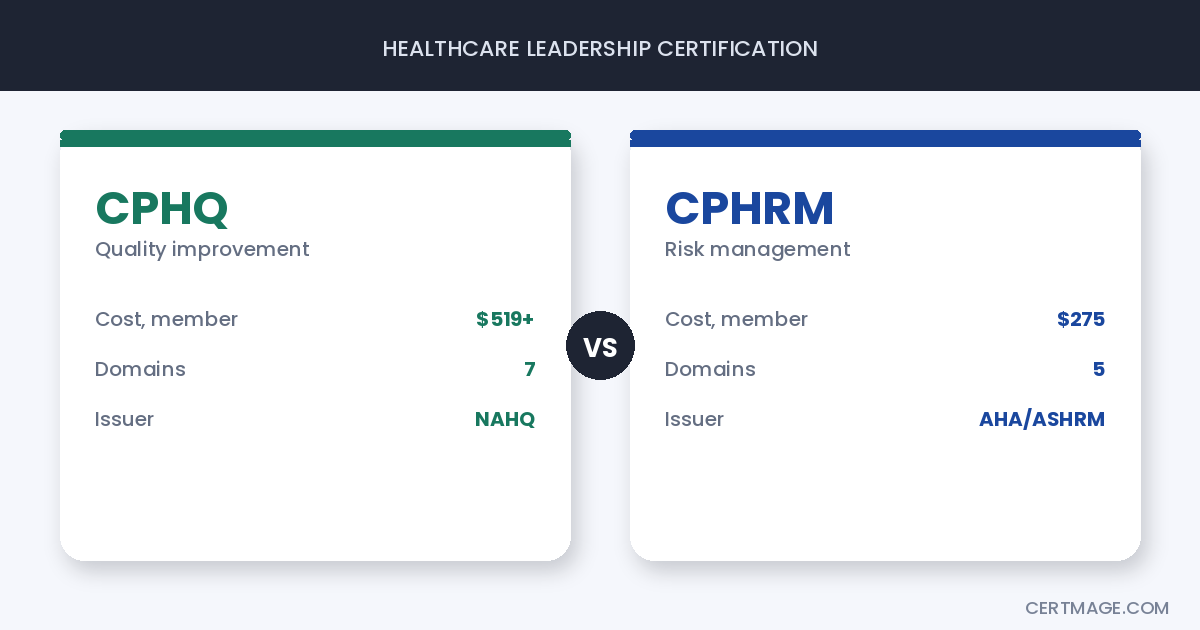
The direct answer: Choose CPHQ, Certified Professional in Healthcare Quality, if your work centers on quality improvement initiatives, accreditation readiness, and performance data. Choose CPHRM, Certified Professional in Healthcare Risk Management, if your work centers on patient safety incidents, liability exposure, and regulatory or financial risk. CPHQ costs $519 to $679 depending on NAHQ membership status. CPHRM costs $275 to $425 depending on ASHRM membership status, making it the less expensive of the two regardless of path. Full official details live on NAHQ’s CPHQ certification page and ASHRM’s CPHRM certification page.
CPHQ vs CPHRM at a Glance
| Detail | CPHQ | CPHRM |
| Full name | Certified Professional in Healthcare Quality | Certified Professional in Healthcare Risk Management |
| Issuing body | National Association for Healthcare Quality, NAHQ | American Hospital Association, via ASHRM |
| Focus | Quality improvement, performance measurement, patient outcomes | Patient safety, liability, regulatory and financial risk |
| Question count | 125 scored, 15 unscored | 100 scored, 10 unscored |
| Duration | 3 hours | 2 hours |
| Domains | 7 | 5 |
| Cost, member | $519 to $579 | $275 |
| Cost, non-member | $619 to $679 | $425 |
| First-time pass rate | 60 to 70 percent | Not consistently published, verify with ASHRM directly |
| Experience recommendation | 2 years in healthcare quality, not a hard requirement | Not formally specified as a hard prerequisite |
Important: CPHRM is meaningfully less expensive than CPHQ at every membership tier, roughly half the cost at both member and non-member rates. Cost alone should not drive your decision, since the two credentials validate different skill sets for different roles, but it is worth knowing upfront if budget is a real constraint.
What CPHQ Actually Tests
CPHQ is built around the full scope of healthcare quality management, from data analysis to leading organizational improvement initiatives.
| Domain Area | Focus |
| Quality leadership and integration | Building and leading quality programs across an organization |
| Health data analytics | Interpreting performance data to drive decisions |
| Patient safety | Overlaps with CPHRM’s territory but from a quality-improvement lens rather than a liability lens |
| Performance and process improvement | Applying methodologies to improve care delivery |
| Regulatory and accreditation | Preparing organizations for accreditation surveys and regulatory review |
Key point: CPHQ is explicitly not limited to clinical professionals. Administrators, analysts, and managers without a clinical background regularly hold CPHQ, since the credential validates data-driven quality management competence rather than clinical judgment specifically.
What CPHRM Actually Tests
CPHRM concentrates on identifying, assessing, and managing risk across a healthcare organization’s clinical, operational, and financial exposure.
| Domain Area | Focus |
| Risk identification | Recognizing sources of clinical, financial, and operational risk |
| Risk analysis | Assessing severity and likelihood of identified risks |
| Risk control | Implementing measures to reduce identified risk |
| Claims and litigation management | Managing incidents that escalate to liability exposure |
| Regulatory, accreditation, and legal issues | Navigating the legal and regulatory landscape specific to healthcare risk |
Note: CPHRM’s shorter format, 100 scored questions over 2 hours versus CPHQ’s 125 scored questions over 3 hours, reflects its narrower domain count, 5 versus CPHQ’s 7, rather than a difference in difficulty. Candidates report both exams as demanding real applied judgment rather than simple recall, regardless of length.
Cost Breakdown
Required Costs
| Item | CPHQ | CPHRM |
| Exam fee, member | $519 to $579 | $275 |
| Exam fee, non-member | $619 to $679 | $425 |
Strongly Recommended Supplementary Costs
| Item | CPHQ | CPHRM |
| Official study guide or prep course | $100 to $300 | $249 to $599 depending on format |
| Self-assessment or practice exam | Included in some prep packages | $100-question self-assessment available separately |
Realistic Total Budget
| Path | CPHQ | CPHRM |
| Exam fee only, minimal prep | $519 to $679 | $275 to $425 |
| Full preparation package | $1,000 to $2,500 | $500 to $1,000 |
The honest comparison: Even accounting for full preparation packages, CPHRM remains the less expensive path by a meaningful margin. If your role genuinely spans both quality and risk functions, which is common at smaller hospitals and health systems, budgeting for CPHRM first and CPHQ second is the more cost-efficient sequence for most candidates.
Who Should Pursue CPHQ, and Who Should Pursue CPHRM
Quality improvement directors, patient safety analysts focused on outcomes data, and accreditation readiness coordinators. CPHQ directly validates the data analysis and improvement methodology skills these roles require daily.
Risk managers, patient safety officers focused on incident and claims management, and compliance professionals handling liability exposure. CPHRM directly validates the risk identification and claims management competence these roles require.
Professionals at smaller healthcare organizations where quality and risk functions overlap. In smaller hospitals and health systems, one person often owns both functions. In this situation, the credential matching your primary responsibility, the one you spend more time on, should come first, with the second credential added once budget and time allow.
Administrators or analysts without a clinical background entering healthcare quality or risk work. Both credentials are explicitly open to non-clinical professionals, and neither requires a clinical license, making them accessible entry points into healthcare leadership tracks for professionals with a data, operations, or compliance background. For related healthcare career certification comparisons, see our Best Paying Healthcare Certifications guide.
Common Mistakes When Choosing Between CPHQ and CPHRM
Assuming the two credentials compete for the same roles. They generally do not. Quality departments and risk management departments are typically distinct functions within a healthcare organization, even when they collaborate closely on patient safety initiatives.
Choosing based on cost alone. CPHRM’s lower price point makes it tempting as a default choice, but if your actual role centers on quality improvement and performance data rather than risk and liability, CPHQ remains the better investment despite the higher cost.
Underestimating CPHRM’s claims and litigation management content. Candidates without direct exposure to healthcare liability and claims work often find this specific domain the hardest to prepare for, since it requires familiarity with legal and insurance concepts beyond general risk theory.
Assuming a clinical background is required for either credential. Neither CPHQ nor CPHRM requires a clinical license, and both are actively pursued by non-clinical administrators, analysts, and managers.
Ignoring the domain overlap in patient safety. Both exams touch patient safety content, but CPHQ approaches it through a quality-improvement lens while CPHRM approaches it through a liability and risk-control lens, and conflating the two perspectives during study leads to missed exam questions on either side.
FAQS
What is the difference between CPHQ and CPHRM?
CPHQ validates healthcare quality improvement and performance measurement expertise. CPHRM validates healthcare risk management, patient safety liability, and regulatory or financial risk expertise. They serve different departments within a healthcare organization.
Which certification pays more, CPHQ or CPHRM?
Compensation varies significantly by role, organization size, and region rather than by certification alone, since both credentials support leadership-track roles with comparable salary ranges in most healthcare settings.
Do I need a clinical background for CPHQ or CPHRM?
No. Both certifications are explicitly open to non-clinical professionals, including administrators, analysts, and managers, and neither requires a clinical license.
How much does CPHQ cost compared to CPHRM?
CPHQ costs $519 to $679 depending on NAHQ membership status. CPHRM costs $275 to $425 depending on ASHRM membership status, making CPHRM the less expensive credential at every tier.
Can I hold both CPHQ and CPHRM?
Yes, and professionals at smaller healthcare organizations where quality and risk functions overlap commonly hold both, since the two credentials complement rather than duplicate each other.
Which exam is harder, CPHQ or CPHRM?
Neither is consistently reported as harder overall. CPHQ is longer with more domains, 7 versus 5, while CPHRM’s claims and litigation management content is frequently cited as its most challenging section for candidates without direct liability work experience.
Is there a work experience requirement for CPHQ or CPHRM?
NAHQ recommends 2 years of healthcare quality experience for CPHQ, though this is guidance rather than a strict enforced prerequisite. CPHRM does not publish a formal hard experience requirement either.
What is a realistic total cost including study materials?
CPHQ typically totals $1,000 to $2,500 with full preparation materials. CPHRM typically totals $500 to $1,000 with full preparation materials, reflecting its lower base exam fee.
Which certification is better for someone new to healthcare leadership?
Neither is inherently better for beginners. The right choice depends on whether your actual role or target role centers on quality improvement, choose CPHQ, or risk and patient safety liability, choose CPHRM.
How often do CPHQ and CPHRM need to be renewed?
Both require periodic continuing education for renewal, though specific cycles and CEU requirements should be confirmed directly with NAHQ and ASHRM respectively, since renewal terms are set independently by each certifying body.