These 2 paths get compared constantly by career changers deciding how to break into healthcare without a clinical degree, and the honest answer is that they’re not really competing for the same job. Epic certification builds you toward EHR analyst, builder, and consultant roles, working with the software infrastructure hospitals run on. Medical coding certification builds you toward translating clinical documentation into billing codes. Both are legitimate, well-paying, non-degree paths into healthcare, but they require different skills, different entry routes, and once you look at the real numbers on both sides, they top out at genuinely different ceilings.
The Core Difference in One Sentence
Epic certification is about the systems healthcare runs on. Medical coding certification is about translating what happened during patient care into standardized codes for reimbursement. One is closer to IT and systems configuration, the other is closer to clinical documentation and health information management.
Real Numbers, Side by Side
| Detail | Epic Certification | Medical Coding Certification (CPC baseline) |
| What you actually do | Configure, build, and support Epic’s EHR modules | Assign CPT, ICD-10-CM, and HCPCS codes to patient encounters |
| Entry requirement | Employer sponsorship, cannot self-enroll | AAPC or AHIMA membership plus passing the exam, no employer sponsorship required |
| Cost to get certified | $0 to you directly, but $3,000 to $15,000 in training costs paid by your sponsoring employer | $2,500 to $4,000 out of pocket, covering training course, membership, and exam fee, often reimbursed after hire |
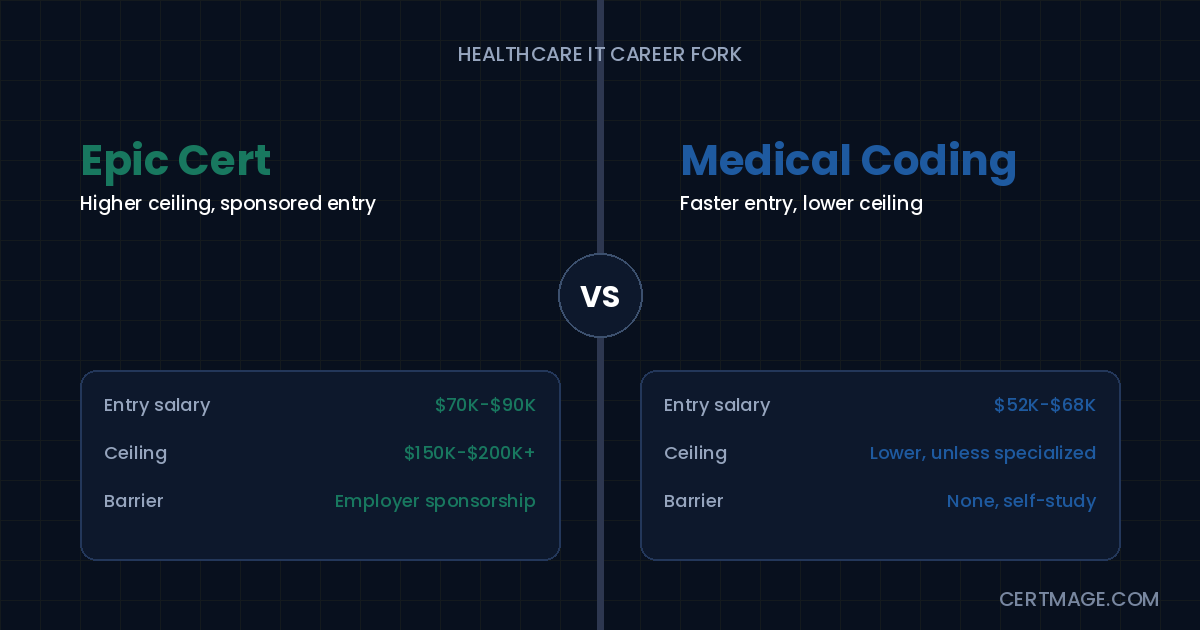
| Entry-level salary | $70,000 to $90,000 for sponsored analyst roles, or $108,276 national average specifically for Ambulatory Analysts | $40,000 to $48,000 if entering without documented experience as CPC-A, closer to $55,000 to $75,000 for full CPC status |
| Mid-career salary | $99,000 to $120,000 for Associate to Senior Analyst roles | $60,000 to $90,000 for specialty and auditing roles like risk adjustment or CPMA-credentialed auditing |
| Senior-career ceiling | $150,000 to $200,000-plus for principal consultants and project managers | $81,000-plus average for coders holding 3 or more stacked credentials, with coding directors and auditors exceeding $100,000 |
| Geographic premium | Real and significant: San Francisco averages $138,005, New York $118,458, both meaningfully above the $108,276 national Ambulatory average | Less geographically concentrated, though metro markets in California, New York, and Massachusetts still pay 18 to 25 percent above national averages |
| Remote availability | Common, over 1,000 live remote postings at any time, though remote roles typically pay 10 to 15 percent below on-site equivalents | Extremely high for specific specialties like risk adjustment, described as “almost always remote,” with less of a consistent remote pay penalty |
| Real named employers | Kaiser Permanente, Cleveland Clinic, Mayo Clinic, Mass General Brigham, plus staffing firms like Medix Technology, CereCore, and Prominence Advisors | Optum, R1 RCM, Conifer Health, LexiCode, with GeBBS and Optum specifically running apprentice-to-full-credential bridge programs |
Why Epic Pays More at the Ceiling, But Costs More to Enter
Epic’s higher salary ceiling reflects its structural barrier to entry. You cannot simply study for and pass an Epic certification exam the way you can with CPC or CCS. You need an employer or Epic-affiliated consulting firm to sponsor you, which means your first real obstacle isn’t the exam itself, it’s landing a role that includes training. Once you clear that bar, though, the investment pays off, and it pays off specifically because so few people can clear that same bar. Epic-certified Ambulatory Analysts average $108,276 nationally, and senior consultants and project managers routinely clear $150,000 to $200,000-plus, figures that reflect both genuine skill scarcity and the fact that Epic dominates EHR deployment at the largest, best-funded academic medical centers and health systems in the country.
Medical coding certification removes that structural barrier entirely. You can study independently, join AAPC or AHIMA, and sit the exam without needing anyone’s sponsorship first, typically for a total investment of $2,500 to $4,000. That accessibility is exactly why medical coding remains one of the most popular non-degree entry points into healthcare. But it also means the field is more broadly accessible and more competitive at entry, and the ceiling without specialization or credential stacking is correspondingly lower. The parallel to Epic’s sponsorship gate is worth noticing directly: coders without documented experience get the CPC-A apprentice designation and start at $40,000 to $48,000, a real entry-tier penalty that functions somewhat like Epic’s sponsorship requirement, a genuine early hurdle you have to clear before reaching standard pay.
The Path to the Top Looks Different on Each Side
On the Epic side, reaching the $150,000-plus ceiling is mostly a function of tenure, module breadth, and moving into consulting or project leadership. Analysts who hold certification across multiple modules, or who move from a health system’s internal IT team into a national consulting firm, see the clearest path upward. Geography matters too, real data shows meaningful premiums in San Francisco and New York specifically, tied to the concentration of large hospital systems and Epic consulting firms headquartered in those markets.
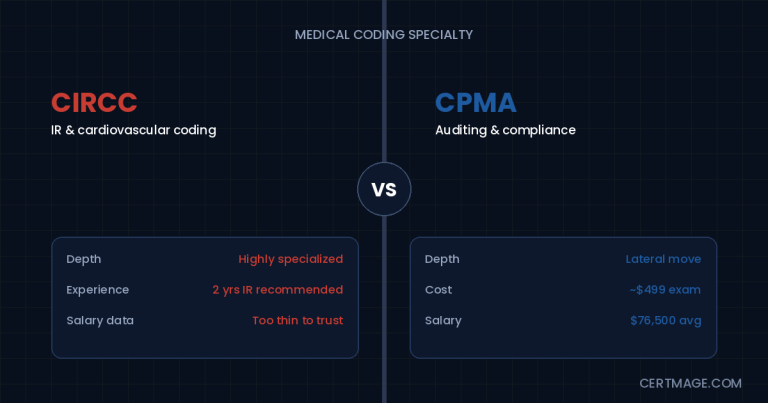
On the coding side, reaching a comparable ceiling is mostly a function of credential stacking rather than tenure alone. Coders holding 3 or more AAPC certifications, a common combination being CPC plus a specialty like COC or CRC plus CPMA, average $81,000 or more, nearly 45 percent above non-certified peers. Auditing and compliance work specifically opens a further ceiling, with CPMA-credentialed auditors regularly exceeding $100,000 and specialized roles like interventional radiology coding under CIRCC commanding a genuine, if less precisely documented, premium on top of that.
Who Should Choose Which Path
Career changers with a general IT or systems background, and access to a sponsoring employer. Epic certification is the higher-ceiling path, but only if you can actually clear the sponsorship hurdle. If you already work at any healthcare organization that uses Epic, even a non-technical role, this path is more accessible than it looks from outside, and named staffing firms like Medix Technology, CereCore, and Prominence Advisors specifically exist to sponsor candidates into this pipeline.
Career changers who want to start immediately without needing an employer’s permission first. Medical coding lets you begin studying and testing on your own timeline. You control the pace of entry in a way Epic’s sponsorship model doesn’t allow, and named employers like Optum and GeBBS specifically run structured programs to help apprentice-level coders advance quickly.
Detail-oriented people who prefer working with clinical documentation and classification systems over software configuration. Medical coding rewards precision with codes and documentation logic. Epic rewards comfort with software builds, workflow configuration, and systems troubleshooting. These are genuinely different daily skill sets, not just different entry points to similar work.
Anyone wanting the fastest realistic path to a first healthcare paycheck. Medical coding generally moves faster from a standing start, since there’s no sponsorship bottleneck. Epic can ultimately pay more, but only after you clear the harder initial hurdle of landing a sponsoring role, which can realistically take a few months to over a year.
Anyone specifically motivated by remote work flexibility. Both paths offer strong remote options, but they differ in structure. Epic remote roles are common but carry a real pay discount, roughly 10 to 15 percent below on-site equivalents. Certain coding specialties, risk adjustment specifically, are described as “almost always remote” without that same consistent pay penalty, making coding the stronger choice if remote flexibility matters more to you than maximizing pay.
Can You Combine Them?
Not really, and this is worth being direct about. These 2 paths don’t stack the way, for example, CPC and CRC do within medical coding, or the way Epic’s own modules can stack for a senior analyst. They represent genuinely different skill tracks. Some professionals do move from medical coding into Epic-adjacent roles, particularly Epic Resolute, which covers hospital and professional billing specifically and benefits from existing coding and revenue cycle knowledge, but this is a deliberate career pivot, not a natural stacking of credentials, and it would still require clearing Epic’s sponsorship requirement from scratch.
Decision Checklist
- If you already work at any healthcare organization, even in a non-clinical role, check whether that organization uses Epic before assuming you need to start your healthcare IT career completely from scratch elsewhere.
- If you have no current healthcare employer and want to start earning and building experience as quickly as possible, medical coding removes the sponsorship bottleneck that makes Epic certification slower to access, for a total cost of $2,500 to $4,000 versus months of job searching before Epic training even begins.
- If long-term earning ceiling matters more to you than speed of entry, and you can realistically land a sponsoring role, Epic’s ceiling is meaningfully higher, particularly if you can position yourself in a high-premium market like San Francisco or New York.
- If you choose medical coding, plan from day one to stack credentials over time, CPC plus a specialty like COC, CRC, or CPMA, rather than stopping at a single certification, since that stacking is what actually closes the ceiling gap with Epic over a career.
- Don’t assume you have to choose permanently at 22 years old. Coders with strong revenue cycle and billing knowledge sometimes pivot into Epic Resolute specifically, where that background transfers directly, once they clear Epic’s sponsorship requirement.
- Match the choice to your actual working style, systems configuration and IT-adjacent work for Epic, documentation and classification precision for coding, rather than picking based purely on salary numbers.
For the complete breakdown of how to actually get into Epic certification, including the sponsorship requirement and real named employers, see our Epic Certification guide and our guide on how to get Epic certified without already working in healthcare IT. For the track-level decision within Epic itself, see our Epic Ambulatory vs Inpatient (ClinDoc) Certification comparison, and for how Epic compares to other EHR platforms, see our Epic vs Meditech Certification guide.
For the foundational medical coding decision most career changers face first, see our CPC vs CCA comparison, and for the real remote job market by specialty, see our Remote Medical Coding Jobs guide.
FAQS
Which pays more, Epic certification or medical coding certification?
Epic has a meaningfully higher ceiling, senior consultants and project managers reaching $150,000 to $200,000-plus, compared to medical coding’s lower ceiling absent specialty stacking, though coders holding 3 or more credentials average $81,000-plus. Entry-level Epic roles also start higher, $70,000 to $90,000 versus $40,000 to $75,000 for new coders depending on documented experience.
Which is easier to break into with no healthcare background?
Medical coding, since it requires no employer sponsorship, just membership and passing the exam, for a total cost of roughly $2,500 to $4,000. Epic certification requires landing a sponsoring employer first, a genuine structural barrier medical coding doesn’t have.
Can I do both Epic and medical coding certification?
Not as a natural stacking combination, though coders with strong billing and revenue cycle knowledge sometimes pivot specifically into Epic Resolute, which covers hospital and professional billing.
Which career path is more remote-friendly?
Both offer strong remote options, but coding specialties like risk adjustment are described as “almost always remote” without a consistent pay penalty, while Epic remote roles are common but typically pay 10 to 15 percent below on-site equivalents.
Is medical coding a good stepping stone toward Epic certification?
Not directly, since they’re different skill tracks, but coding and revenue cycle experience specifically can transfer well into Epic’s Resolute billing module if you later pursue that specific certification path and clear the sponsorship requirement.
Which path has a faster timeline to a first paycheck?
Medical coding, generally, since there’s no sponsorship bottleneck to clear before you can even begin the certification process, while landing an Epic-sponsoring role can take months to over a year.
What’s the real cost difference between the 2 paths?
Epic certification itself is free to you, but requires an employer to invest $3,000 to $15,000 in your training. Medical coding certification costs you directly, $2,500 to $4,000, though many employers offer reimbursement after hire.