CPC certifies you to translate a patient encounter into standardized diagnosis and procedure codes, and CPB certifies you to take those codes and actually get the claim paid, and if you’ve been comparing coding certifications against each other without realizing billing is a separate AAPC credential entirely, this is the comparison you were missing.
TL;DR
- CPC (Certified Professional Coder) certifies medical coding: assigning ICD-10-CM and CPT codes to a patient encounter
- CPB (Certified Professional Biller) certifies medical billing: submitting claims, following up on denials, and managing the revenue cycle after coding is done
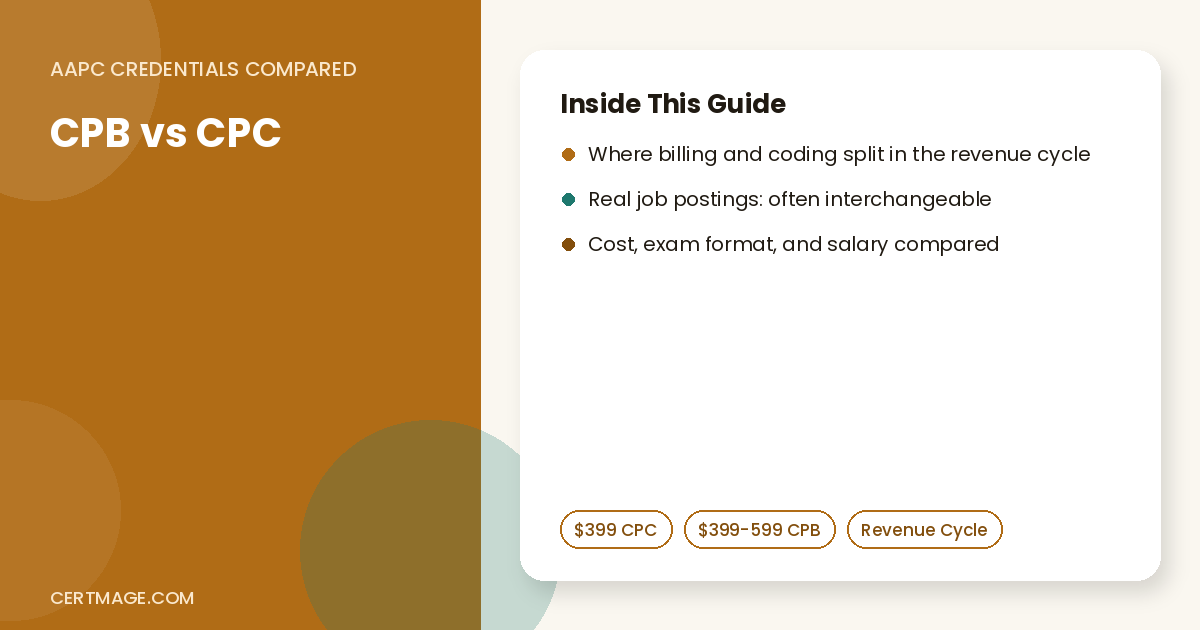
- Both require AAPC membership; CPC costs $399 with a $199/year membership, CPB costs $399 (members) or $599 (non-members) with a separate membership requirement
- CPC is a 100-question, 4-hour, open-book exam; CPB is a longer 200-question, 5-hour-40-minute exam, also open-book
- Real job postings show employers frequently accept either CPB or CPC interchangeably for billing-titled roles, even though the 2 certifications test genuinely different skills
- CPB-tagged compensation data runs slightly higher on average than CPC in some salary comparisons, but the gap is small enough that career fit should decide this, not a few thousand dollars
Where Each Role Sits in the Revenue Cycle
The clearest way to understand CPB vs CPC isn’t a feature-by-feature table, it’s picturing the actual sequence of events after a patient visit, since coding and billing are literally sequential steps in the same process, not competing approaches to the same job.
- Patient encounter happens. A physician documents the visit, diagnosis, and any procedures performed.
- A coder (CPC territory) translates that documentation into standardized codes. ICD-10-CM for diagnoses, CPT and HCPCS for procedures and services.
- A biller (CPB territory) takes those codes and builds the actual claim. This means verifying insurance eligibility, applying the correct billing regulations for that specific payer, and submitting the claim.
- The biller follows up. Tracking claim status, handling denials and appeals, posting payments, and managing patient billing for any remaining balance.
CPC certifies step 2. CPB certifies steps 3 and 4. A coder who never touches claim submission or denial management doesn’t need CPB. A biller who never assigns codes from scratch doesn’t need CPC. The confusion between the 2 exists mainly because smaller practices often have one person doing both jobs, which is exactly why some employers, shown in real postings below, list either certification as acceptable for the same role.
Quick Facts: CPB vs CPC
| Detail | CPC | CPB |
| Full name | Certified Professional Coder | Certified Professional Biller |
| Certifies | Diagnosis and procedure coding | Claims submission, follow-up, and revenue cycle management |
| Number of questions | 100 | 200 |
| Duration | 4 hours | 5 hours 40 minutes |
| Format | Open book (AMA CPT manual and ICD-10-CM permitted) | Open book |
| Passing score | Approximately 70% (not officially published) | 70% or higher |
| Exam fee | $399 | $399 (members) / $599 (non-members) |
| AAPC membership | Required, $199/year | Required, approximately $170/year |
| Initial credential status | CPC-A (Apprentice) until 2 years’ experience or 80 hours approved education | Full CPB upon passing |
| Renewal | 36 CPE credits per 2-year cycle, $55 renewal fee | CEU-based renewal through AAPC, similar structure |
Notice the apprentice-status difference. CPC holders without prior coding experience earn a CPC-A designation first, converting to full CPC only after documenting 2 years of coding work or completing 80 hours of approved education. CPB carries no equivalent apprentice tier, you earn full certification immediately upon passing, which is a meaningful practical difference for anyone choosing based on how quickly they need a complete, unqualified credential on their resume.
What Each Exam Actually Tests
CPC draws its content directly from CPT, ICD-10-CM, and HCPCS Level II code sets, testing your ability to read clinical documentation and assign the correct codes across the full range of medical specialties. It’s a coding-accuracy exam first and foremost.
CPB covers a genuinely different skill set: types of insurance plans (commercial, Medicare, Medicaid, workers’ compensation), payer-specific billing regulations, the full claims lifecycle from submission through denial management and appeals, and general revenue cycle management competency. Coding knowledge is assumed as background context, but the exam is testing whether you can get a correctly coded claim actually paid, not whether you can generate the code yourself.
Real Job Postings: Employers Often Don’t Distinguish Cleanly
This is the most practically useful finding in this comparison, and it contradicts how cleanly the 2 certifications are defined on paper.
- Valley Pediatric Associates (Ho Ho Kus, NJ), a Medical Billing Specialist posting paying $22 to $24/hour, lists “Certified Professional Biller (CPB) or Certified Professional Coder (CPC) is a strong plus,” treating the 2 as interchangeable qualifications for the same role
- Alaska Heart Institute (Anchorage, AK), a Medical Billing Specialist posting paying $23 to $33/hour plus a $3,000 sign-on bonus, requires “active CPB or CPC certification,” again accepting either
- County College of Morris (Randolph, NJ), a Medical Billing Workforce Development Instructor posting, specifically requires CPB along with a bachelor’s degree and 3+ years of healthcare experience, a case where the distinction does matter because the role is billing-instruction-specific
The pattern: smaller practices and general billing-titled roles frequently accept either credential, reflecting how often one person handles both coding and billing functions in a smaller office. Larger organizations and roles with “billing” specifically in a specialized or instructional capacity are more likely to require CPB by name. If you’re targeting a specific employer, checking their actual posting language matters more than assuming either certification’s on-paper definition determines what’s accepted.
Salary Comparison
| Career Stage | CPB Reported Range | CPC Reported Range |
| Entry-level | $42,000 to $54,000 | Comparable entry range for coding roles |
| Mid-career (3-5 years) | $58,000 to $72,000, averaging $65,200 | $52,000 to $72,000 |
| Experienced (5+ years) | $70,000 to $85,000+, averaging $76,800 | Varies by specialty coding focus |
| National average | $62,800 | Generally comparable, specialty-dependent |
A necessary caveat: the CPB-specific figures above come from certification-focused salary aggregators, and the gap they show over CPC (roughly $3,000 to $6,000 in favor of CPB in some comparisons) is small enough, and inconsistent enough across sources, that it shouldn’t be the deciding factor between the 2. Certification-specific salary premiums also compound with which real job title you hold, a “Revenue Cycle Coordinator” with CPB and a specialty coder with CPC in a high-demand specialty can easily out-earn each other in either direction depending on employer and location far more than the base certification does.
Can One Person Reasonably Hold Both?
Yes, and it’s common in smaller practices and for anyone building toward a revenue-cycle-management or practice-management career, where understanding the full patient-encounter-to-payment pipeline end to end is genuinely valuable. The order that makes the most practical sense is CPC first, since coding knowledge is assumed background context on the CPB exam, then CPB once you want to formally validate the billing and claims side too. For related medical coding specialty comparisons that build on a CPC foundation, see our guides on COC vs CPC for outpatient facility coding, CCS-P vs CPC for AHIMA’s physician-based coding alternative, and CPC vs CCA if you’re still deciding on your very first entry-level coding credential before adding billing later.
Study Approach for Each Exam
Because both exams are open-book, the skill being tested is speed and accuracy navigating your reference materials under time pressure, not memorization. That changes how you should actually prepare.
| CPC Prep Focus | CPB Prep Focus | |
| Core skill to build | Fast, accurate lookup across ICD-10-CM, CPT, and HCPCS Level II manuals | Familiarity with payer-specific billing rules across commercial, Medicare, Medicaid, and workers’ compensation |
| Practice format | Timed coding scenarios pulled from real clinical documentation | Timed claims scenarios covering submission, denial reasons, and appeals workflows |
| Common first-attempt weak spot | Running out of time on the back half of the exam due to slow manual lookups | Underestimating how much of the exam covers payer-specific regulation rather than pure billing mechanics |
| Where hands-on experience helps most | Any real coding practice across multiple specialties, since CPC draws from the full range rather than one focus area | Direct exposure to actual denial and appeals handling, which is hard to simulate from a study guide alone |
If you’re pursuing either credential through a structured program rather than self-study, our guide to medical billing and coding certification options online covers how to evaluate a training provider before committing to one.
Common Mistakes When Choosing Between Them
Assuming the certification name guarantees the job title. Real postings show employers frequently blur CPB and CPC for billing-titled roles, so checking your target employer’s actual language matters more than assuming either certification’s textbook definition determines eligibility.
Choosing based on the small reported salary gap alone. The $3,000 to $6,000 difference some sources report between CPB and CPC compensation is smaller and less consistent than the variation caused by specialty, employer, and geographic location. Career fit should decide this, not a marginal, inconsistently-reported number.
Underestimating CPC-A’s practical impact. Candidates without prior coding experience should plan around the CPC-A apprentice period realistically, since converting to full CPC status takes 2 years of documented experience or 80 hours of approved education, a real timeline that affects how quickly the credential becomes fully unqualified on a resume.
Treating CPB as “the easier version of CPC.” It isn’t easier, it’s different. CPB’s exam is longer and covers genuinely distinct content (payer regulations, claims lifecycle, revenue cycle management) rather than a lighter version of coding knowledge.
Not checking remote job market differences between the 2 paths. Billing and coding roles don’t have identical remote-work availability or requirements; our remote medical coding jobs guide breaks down what employers actually require for remote-eligible coding positions specifically, which is worth checking before assuming either credential opens the same remote opportunities.
Decision Checklist
- If your actual job involves reading clinical documentation and assigning diagnosis and procedure codes, CPC tests the skill you use daily
- If your actual job involves submitting claims, chasing down denials, and managing the revenue cycle after coding is finished, CPB tests the skill you use daily
- Before assuming you need one specifically, check real postings for your target employer, since many billing-titled roles at smaller practices accept either certification
- If you want the fastest path to a full, unqualified credential with no apprentice period, CPB has an advantage, since CPC-A status can take up to 2 years to convert without prior experience
- If you’re building toward a revenue-cycle-management career long-term, plan for both eventually, CPC first, since it provides the coding foundation CPB’s exam assumes
FAQS
What is the difference between CPB and CPC?
CPC certifies medical coding, translating clinical documentation into standardized diagnosis and procedure codes. CPB certifies medical billing, submitting claims built from those codes, managing denials, and handling the broader revenue cycle. They’re sequential skills in the same overall process, not competing versions of the same job.
Is CPB or CPC easier to pass?
Neither is definitively easier; they test different content. CPB’s exam is longer (200 questions over 5 hours 40 minutes versus CPC’s 100 questions over 4 hours), but both are open-book and both require approximately 70% to pass.
Can I get a billing job with only a CPC certification?
Often, yes. Real job postings, including from Valley Pediatric Associates and Alaska Heart Institute, list CPB or CPC as interchangeable qualifications for billing-titled roles, particularly at smaller practices where one person handles both functions.
Do I need CPC before I can get CPB?
No formal prerequisite connects them. You can take CPB without holding CPC, though coding knowledge is assumed as background context on the CPB exam, so candidates with zero coding exposure may find some content less intuitive.
Which pays more, CPB or CPC?
Reported figures show CPB running roughly $3,000 to $6,000 higher on average in some certification-specific salary comparisons, but the gap is inconsistent across sources and smaller than the variation caused by specialty, employer, and location. Don’t choose based on this gap alone.
What is CPC-A and does CPB have an equivalent?
CPC-A (Apprentice) is the initial designation for CPC holders without prior coding experience, converting to full CPC after 2 years of documented coding work or 80 hours of approved education. CPB has no equivalent apprentice tier; you receive full certification immediately upon passing the exam.
How much does AAPC membership cost for CPB versus CPC?
CPC requires AAPC membership at approximately $199/year. CPB’s membership requirement runs slightly lower at approximately $170/year in some reported figures, though both are mandatory ongoing costs separate from the one-time exam fee.
Is the CPB exam open book like CPC?
Yes. Both exams allow reference materials during testing, reflecting that both roles involve looking up specific codes, regulations, and payer rules on the job rather than memorizing them, the exams test application skill, not pure recall.
Should someone new to healthcare start with CPB or CPC?
CPC is the more common starting point, since coding is typically the earlier step in the revenue cycle and CPB’s content assumes some coding familiarity as background. That said, if your specific target role is billing-focused from the start, such as a claims or revenue cycle position, starting directly with CPB is reasonable.
Are CPB and CPC both AAPC credentials, or is one from a different organization?
Both are AAPC credentials, unlike some other medical coding comparisons where AAPC and AHIMA credentials get compared against each other. CPB and CPC share the same issuing body, membership structure, and general renewal process, which is part of why some employers treat them as more interchangeable than their distinct content would suggest.