TL;DR
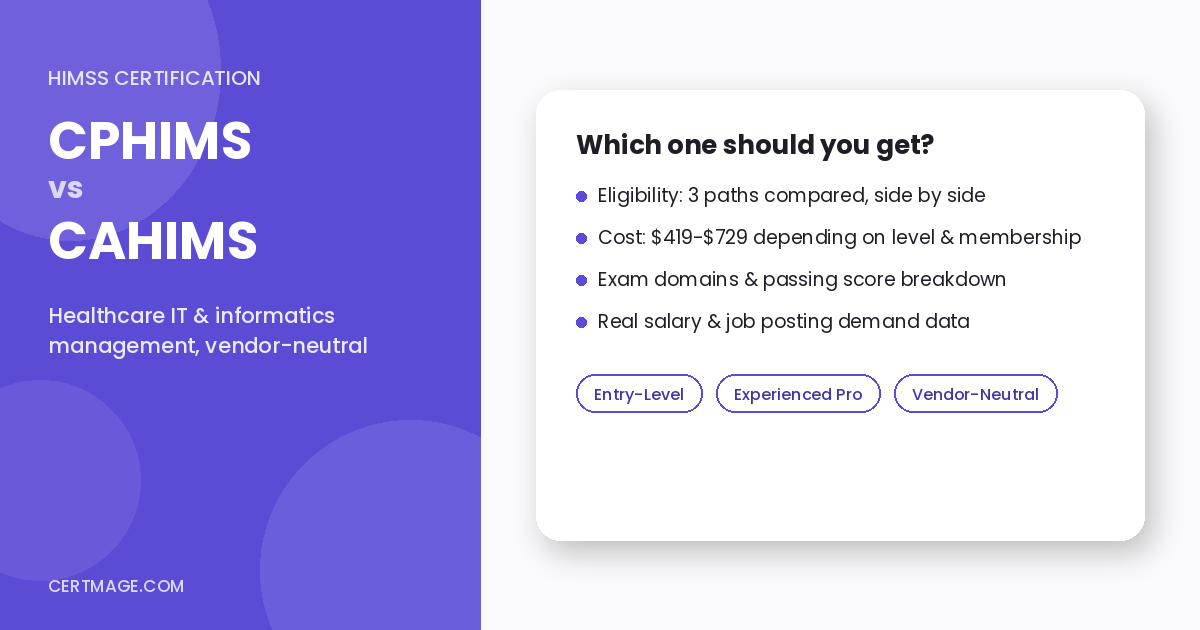
- CAHIMS (Certified Associate in Healthcare Information and Management Systems) is HIMSS’s entry-level credential. Cost: $419 (member) to $459 (non-member). 115 questions (100 scored), 2 hours, tests systems analysis, clinical informatics, and project management basics.
- CPHIMS (Certified Professional in Healthcare Information and Management Systems) is the experienced-professional credential. Cost: $609 (member) to $729 (non-member). Same 115 questions/100 scored/2-hour format, but requires real work experience to even sit the exam, and tests deeper systems management, leadership, and clinical informatics content.
- The real difference isn’t the exam itself, it’s eligibility. CAHIMS is open to students and career-changers with as little as 75 hours of relevant experience. CPHIMS requires a minimum of a bachelor’s degree plus 5 years of information/management systems experience (3 in healthcare), or equivalent paths up to 10 years of experience with no degree.
- Both are vendor-neutral, meaning they validate healthcare IT and informatics management knowledge broadly, unlike Epic, Cerner, or Meditech certifications, which certify you on one specific EHR platform.
- Passing score for CPHIMS is 70%. Both certifications are valid for 3 years and renew through retake or continuing education hours plus a fee.
- Live job board data shows roughly 900 CPHIMS-related listings on Indeed and CPHIMS ranked #1 among healthcare IT certifications tracked by one industry demand tracker, with salary ranges commonly cited between $87,000 and $142,000, while CAHIMS-specific job postings are far thinner, since it’s designed as a stepping stone rather than a standalone career credential.
Quick Facts: CAHIMS vs CPHIMS Side by Side
| CAHIMS | CPHIMS | |
| Full name | Certified Associate in Healthcare Information and Management Systems | Certified Professional in Healthcare Information and Management Systems |
| Level | Entry / Associate | Experienced Professional |
| Cost (member) | $419 | $609 |
| Cost (non-member) | $459 | $729 |
| Retake cost | $239 | $359 |
| Questions | 115 (100 scored) | 115 (100 scored) |
| Time limit | 2 hours | 2 hours |
| Passing score | Not officially published | 70% |
| Content areas | Systems analysis, clinical informatics, project management | Healthcare/tech environments, clinical informatics, systems management, leadership |
| Experience required | None to minimal (75-150 hours, or student status) | 3-10 years depending on education level |
| Validity | 3 years | 3 years |
| Renewal | Retake or CE hours + fee | Retake or CE hours + fee |
Source: HIMSS official CPHIMS certification page, HIMSS official CAHIMS certification page.
The Eligibility Maze: Figuring Out Which One You Actually Qualify For
This is the part most comparison articles gloss over, and it’s genuinely the most important thing to get right before you spend money registering for either exam. Both certifications gate on eligibility before you can even sit for them, and the paths are more layered than a simple “years of experience” cutoff.
CAHIMS has three eligibility paths:
- Current student: you’re in the final stages of an approved health informatics career and technical education program.
- High school diploma or equivalent, plus either 45+ hours of continuing education in healthcare IT, digital health, or informatics, or 150+ hours of relevant IT and healthcare work experience.
- Associate’s, bachelor’s, or advanced degree from an accredited institution, plus either 25+ hours of relevant continuing education, or 75+ hours of relevant work experience.
Notice how having a degree cuts the experience-hour requirement roughly in half compared to the high-school-diploma path. This is designed to be genuinely accessible: a recent graduate with a health informatics degree and minimal work history can qualify.
CPHIMS has three eligibility paths, and they’re all substantially heavier:
- Bachelor’s degree plus 5 years of information and management systems experience, with at least 3 of those years in a healthcare setting.
- Graduate degree or higher plus 3 years of relevant experience, with at least 2 in healthcare.
- No degree at all, but a minimum of 10 years of information and management systems experience, with at least 8 in healthcare settings.
The third path matters more than it might seem: CPHIMS doesn’t require a degree if you have the depth of hands-on healthcare IT experience to back it up, which makes it genuinely accessible to experienced practitioners who came up without a traditional academic credential.
The practical test: if you’re a student, a recent graduate, or early-career with under 3 years of relevant experience, CAHIMS is very likely your only current option, and that’s fine, it’s built for exactly that stage. If you already have several years of healthcare IT, informatics, or systems management experience under your belt, check your specific path against CPHIMS’s requirements before defaulting to CAHIMS just because it seems like the “safer” first step, since CPHIMS is the credential that actually matches your experience level and carries more weight with employers.
What Each Exam Actually Tests
Both exams share the same shell (115 questions, 100 scored, 2-hour time limit), but the content depth and emphasis differ meaningfully.
CAHIMS covers three content areas: systems analysis, clinical informatics, and project management, tested at a foundational level appropriate for someone early in a healthcare IT career or transitioning in from a different field.
CPHIMS covers four content areas with published weightings that tell you exactly where to focus preparation:
| CPHIMS Domain | Weight | What It Covers |
| Healthcare Information and Systems Management | 30% | Implementation methodologies, data governance, operational processes |
| Healthcare and Technology Environments | 25% | Industry landscape, regulatory context, technology infrastructure |
| Management and Leadership | 25% | Strategic planning, team leadership, organizational change |
| Clinical Informatics | 20% | Clinical workflows, decision support, health data standards |
Systems Management alone is nearly a third of your score, which tells you CPHIMS is testing whether you can actually run healthcare IT operations, not just describe them conceptually. CAHIMS, by contrast, doesn’t publish domain weightings with the same granularity, reflecting its role as a broader entry-level knowledge check rather than a deep operational credential.
How This Differs From Epic, Cerner, and AAPC/AHIMA Credentials
If you’ve researched healthcare IT certifications on this site before, you’ve likely come across Epic, Cerner (Oracle Health), and Meditech certifications, or AAPC and AHIMA medical coding credentials. CPHIMS and CAHIMS occupy a genuinely different lane from both.
Epic, Cerner, and Meditech certifications are vendor-specific: they prove you can configure, build, or support one particular EHR platform, and they’re typically earned through employer-sponsored training rather than open registration. See our Epic vs Cerner and Epic vs Meditech comparisons for that specific decision.
AAPC and AHIMA credentials like CPC, CCS-P, or RHIA certify medical coding and health information management, the administrative and billing side of healthcare data. See our CCS-P vs CPC and RHIA vs CCS guides for that comparison.
CPHIMS and CAHIMS sit in a third lane entirely: vendor-neutral healthcare informatics and IT management. They don’t certify you on a specific EHR platform, and they’re not about coding or billing. They’re about whether you understand how healthcare IT systems, projects, and teams should be managed and led, which makes them a natural fit for roles like health IT project manager, informatics analyst, or healthcare systems consultant that work across multiple platforms and vendors rather than specializing in one. For the broader landscape of where these fit among other credentials, see our Healthcare Certifications overview and Best-Paying Healthcare Certifications roundups.
Career Impact and Salary Data
Live job market data shows real, substantial demand specifically for CPHIMS: ZipRecruiter shows national salary figures commonly in the $87,000 to $142,000 range, with Chicago-area postings for CPHIMS-preferred roles reaching $89,000 to $210,000 depending on seniority, and Indeed listing roughly 900 active postings referencing the credential. One industry certification demand tracker ranks CPHIMS #1 among healthcare IT certifications it monitors, describing market demand as stable with 328 active U.S. positions specifically requiring or preferring it as of 2026 tracking.
CAHIMS-specific job postings are considerably thinner on job boards, which makes sense given its design purpose: it’s built as an accessible entry point and resume credential for students and early-career professionals, not a credential employers typically write into senior job requirements the way they do with CPHIMS.
The honest read: CAHIMS is valuable as a signal that you’re serious about a healthcare IT career and have foundational knowledge, useful for landing a first role or internship. CPHIMS is the credential that shows up as an actual hiring filter in job postings and correlates with real, above-average healthcare IT salaries, because its eligibility requirements already filter for genuine, multi-year experience before you can even sit the exam.
Which One Should You Take?
Take CAHIMS if:
- You’re a current student in a health informatics or related program.
- You’re transitioning into healthcare IT from another field and have under 3 years of directly relevant experience.
- You want a credential that validates foundational knowledge before you have the work history to qualify for CPHIMS.
Take CPHIMS if:
- You already meet one of its three eligibility paths (bachelor’s + 5 years, graduate degree + 3 years, or 10 years with no degree).
- You’re aiming for roles like healthcare IT project manager, informatics director, or systems management positions where employers specifically screen for it.
- You want the credential that shows up in real salary data and job posting volume as a meaningful hiring signal.
Start with CAHIMS and move to CPHIMS later if: you’re early career now but building toward the experience thresholds CPHIMS requires. There’s no rule against holding CAHIMS first and later earning CPHIMS once your experience catches up; many HIMSS-credentialed professionals do exactly that.
How to Prepare for Each
- Confirm your eligibility path before you register for either exam. Unlike many IT certifications, both CAHIMS and CPHIMS gate on real prerequisites, and registering without checking first risks a rejected application.
- For CPHIMS, weight your study time toward Systems Management (30%) first, since it’s the single heaviest domain, followed by Technology Environments and Leadership at 25% each.
- Use HIMSS’s own self-assessment exam ($129 to $139) before committing to the full CPHIMS registration fee, since it gives a realistic readiness check at a fraction of the cost.
- Don’t underestimate the Leadership and Management domain on CPHIMS. Candidates coming from purely technical backgrounds sometimes treat it as a soft-skills afterthought, but it’s a quarter of the exam.
- For CAHIMS, focus on breadth across all three content areas rather than depth in any one, since the exam is designed to check foundational literacy rather than deep specialization.
Common Mistakes People Make
- Assuming CAHIMS is simply “CPHIMS but easier.” They’re built for genuinely different career stages, and CPHIMS’s eligibility requirements alone disqualify most CAHIMS-level candidates regardless of how well they’d score on the content.
- Registering for CPHIMS without confirming which of the three eligibility paths you actually meet. The degree-plus-experience combinations are specific; assuming you qualify because you have “years of IT experience” without the healthcare-specific portion can lead to a rejected application.
- Treating these as replacements for Epic, Cerner, or AAPC/AHIMA credentials. They test a different skill set (vendor-neutral systems and IT management) and won’t substitute for a platform-specific or coding-specific credential a job posting explicitly requires.
- Skipping the HIMSS self-assessment exam to save money, then failing the full exam. The $129 to $139 self-assessment is inexpensive relative to a $359 to $729 retake.
FAQS
What does CPHIMS stand for?
Certified Professional in Healthcare Information and Management Systems, HIMSS’s experienced-professional credential for healthcare IT and informatics.
What does CAHIMS stand for?
Certified Associate in Healthcare Information and Management Systems, HIMSS’s entry-level credential for students and early-career professionals.
How much does CPHIMS cost?
$609 for HIMSS members, corporate members, or students; $729 for non-members. Retakes cost $359.
How much does CAHIMS cost?
$419 for HIMSS members; $459 for non-members. Retakes cost $239.
Do I need a degree to get CPHIMS?
No. CPHIMS has a no-degree path requiring 10 years of information and management systems experience, with at least 8 years in healthcare settings, as an alternative to the degree-plus-experience paths.
Is CAHIMS a prerequisite for CPHIMS?
No. They’re independent credentials with separate eligibility requirements. You can go straight to CPHIMS if you meet its experience and education criteria without ever holding CAHIMS.
What’s the passing score for CPHIMS?
70%. CAHIMS’s exact passing score is not officially published by HIMSS in the same way.
How long are CAHIMS and CPHIMS valid?
Both carry a 3-year validity period before requiring renewal through retake or continuing education hours plus a fee.
Are CPHIMS and CAHIMS the same as Epic or Cerner certification?
No. Epic and Cerner certifications are vendor-specific, tied to one EHR platform, typically earned through employer-sponsored training. CPHIMS and CAHIMS are vendor-neutral, covering healthcare IT and informatics management broadly across platforms.
Which certification do employers actually ask for?
CPHIMS shows up far more often as an explicit job requirement or preference, with roughly 900 active Indeed postings referencing it and salary data in the $87,000 to $142,000+ range. CAHIMS-specific postings are considerably rarer, consistent with its role as an entry-level credential rather than a senior hiring filter.
Can I take the CPHIMS exam without healthcare experience, just general IT experience?
No. All three CPHIMS eligibility paths require a minimum number of years specifically in a healthcare setting (2, 3, or 8 years depending on the path), not just general information systems experience.
What content does the CPHIMS exam cover most heavily?
Healthcare Information and Systems Management at 30%, the single largest domain, covering implementation methodologies, data governance, and operational processes.