TL;DR
- CDPSE (Certified Data Privacy Solutions Engineer, ISACA): 575member/760 non-member plus a $50 application fee, 120 questions, 3.5 hours, 450/800 scaled passing score, 3 domains (Privacy Architecture 36%, Privacy Governance 34%, Data Lifecycle 30%). Requires 3 years of hands-on experience implementing technical privacy-by-design solutions, with no waivers.
- CIPT (Certified Information Privacy Technologist, IAPP): $550 for a first attempt, 90 questions, 2.5 hours, 300/500 scaled passing score, 5 domains covering the full technical privacy lifecycle. No formal prerequisites or experience requirement.
- Both certify the same broad idea, building privacy into technology rather than writing policy or running a compliance program, but they come from institutions with very different DNA. ISACA’s heritage is audit, governance, and control; CDPSE reflects that with heavier governance and architecture-control weighting. IAPP’s heritage is privacy law and policy; CIPT reflects that by staying closer to legal and regulatory context even while targeting a technical audience.
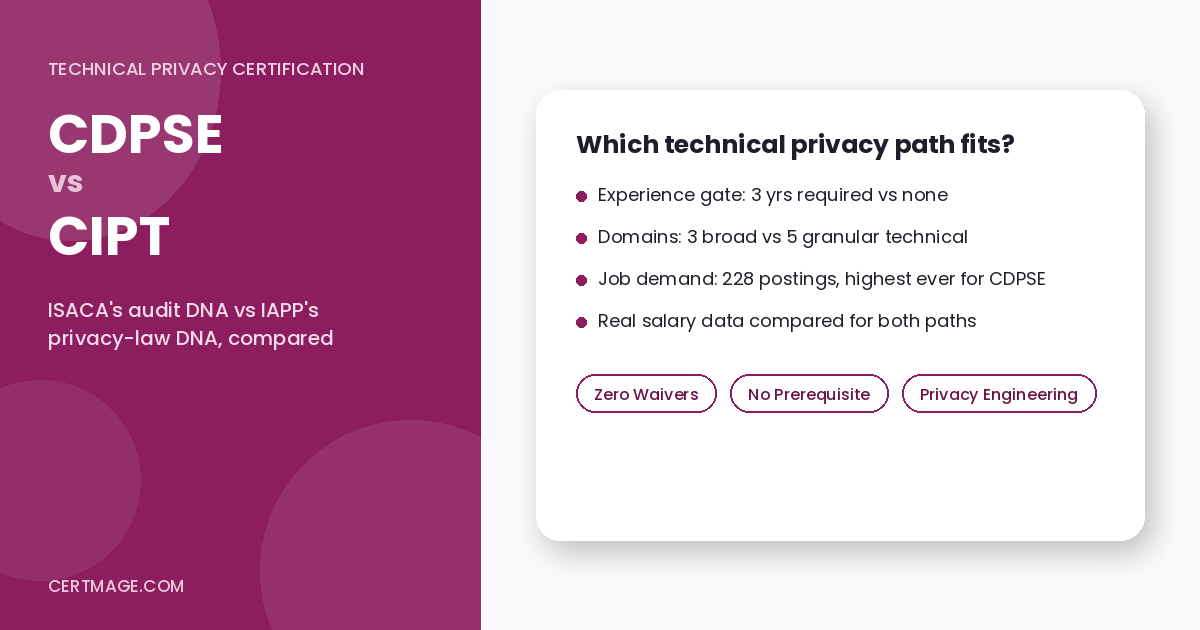
- The biggest practical difference: CDPSE gates on 3 years of real experience with no waivers, so you can’t sit for it as a career-changer with zero technical privacy background. CIPT has no experience requirement at all, making it accessible to engineers and product managers moving into privacy-aware roles for the first time.
- Job market data shows CDPSE with roughly 228 active US postings, described by one tracker as its highest recorded demand level, and salary figures commonly cited between $128,000 and $150,000+. CIPT-specific salary data is thinner and generally trails CIPM’s, though real job postings at companies like Robinhood, Roblox, and Apple describe CIPT-aligned work even when they don’t name the credential directly.
- If you already have 3+ years of hands-on technical privacy implementation work, CDPSE is the credential that matches your experience and ISACA’s audit-adjacent credibility. If you’re newer to privacy-focused technical work or want a credential you can sit for immediately without an experience gate, CIPT is the more accessible entry point.
Quick Facts: CDPSE vs CIPT Side by Side
| CDPSE (ISACA) | CIPT (IAPP) | |
| Full name | Certified Data Privacy Solutions Engineer | Certified Information Privacy Technologist |
| Cost | $575 member / $760 non-member + $50 application fee | $550 first attempt |
| Questions | 120 | 90 |
| Time limit | 3.5 hours | 2.5 hours |
| Passing score | 450/800 scaled | 300/500 scaled |
| Domains | 3 (Privacy Architecture 36%, Governance 34%, Data Lifecycle 30%) | 5 |
| Experience required | 3 years, technical privacy-by-design implementation, no waivers | None formally required |
| Retake policy | 3 attempts, 30-day then 90-day waits, full fee each time | Retake at $375 |
| Active US job postings | ~228 | Thinner, salary data less consolidated |
| Reported salary | 128,000-150,000+ | ~$100,600 average (per CIPM comparison data) |
Sources: ISACA’s official CDPSE page, CSOonline’s CDPSE requirements breakdown, CertMage’s own CIPT Certification Guide.
Two Institutions, Two Different Technical Privacy Credentials
Before comparing domains and costs, it’s worth understanding why these two certifications, which sound like they should be near-identical, actually feel quite different in practice.
ISACA built its reputation on audit, governance, and IT control. Its other flagship credentials, including CISA, CISM, CRISC, and CGEIT, are all fundamentally about governance, risk, and control frameworks (see CertMage’s CRISC vs CISM comparison for how two of those sibling credentials stack up). CDPSE inherits that same DNA: its heaviest domain is Privacy Architecture at 36%, but Privacy Governance at 34% is nearly as large, meaning more than a third of the exam is about governance and control structures around privacy, not just the technical implementation itself. ISACA also gates CDPSE behind a hard 3-year experience requirement with zero waivers, consistent with how it treats its other credentials as validations of already-demonstrated professional practice, not entry points into a field.
IAPP built its reputation on privacy law and policy, and its three credentials (CIPP, CIPM, CIPT) all orbit that core. CIPT is IAPP’s attempt to bridge into the technical audience, engineers, architects, product managers, but it still carries IAPP’s legal-and-regulatory-context DNA more than ISACA’s audit-control DNA. It has no experience requirement, consistent with IAPP’s broader approach of using certification as an accessible entry point into privacy-aware roles rather than a gate for already-experienced practitioners.
The practical result: CDPSE feels like an ISACA credential (governance-heavy, experience-gated, control-framework-oriented) that happens to be about privacy. CIPT feels like an IAPP credential (legally grounded, broadly accessible) that happens to target a technical audience. Neither approach is wrong, but which one fits you depends heavily on whether you already have the hands-on experience CDPSE requires, and whether you want a credential closer to ISACA’s audit-and-governance ecosystem or IAPP’s privacy-law ecosystem.
Domain Comparison: What Each Exam Actually Tests
CDPSE’s 3 domains:
| Domain | Weight | Focus |
| Privacy Architecture | 36% | Infrastructure, applications and software, technical privacy controls |
| Privacy Governance | 34% | Governance, management, and risk management practices |
| Data Lifecycle | 30% | Data purpose and data persistence across its lifecycle |
CIPT’s 5 domains cover the technical privacy lifecycle more granularly, spanning foundational privacy concepts, the technical privacy environment, core privacy technology considerations, privacy engineering practices such as data lifecycle and technical measures, and how privacy fits into online technology specifically. See CertMage’s full CIPT Certification Guide for the complete domain-by-domain breakdown.
The practical difference in how these test: CDPSE’s 3 domains are broader and more evenly weighted (34-36-30%), meaning no single area dominates the exam. CIPT spreads across 5 more granular domains, closer to a full technical curriculum than a 3-bucket framework. If you prefer studying a tightly scoped, governance-and-architecture-focused exam, CDPSE’s structure suits that. If you’d rather see privacy engineering broken into more specific, actionable technical categories, CIPT’s 5-domain structure does that.
Eligibility: The Gate That Actually Decides This For Most People
This is where the real-world decision usually gets made before domain content even matters.
CDPSE requires 3 years of experience specifically in the implementation of technical privacy-by-design solutions, control, or security work aligned with its domains, with that experience needing to fall within the 10 years before you apply. ISACA does not offer waivers. If you pass the exam before you have 3 years of qualifying experience, you have up to 5 years after passing to accumulate it and apply, but you cannot receive the credential without it.
CIPT has no formal experience requirement at all. Anyone can register and sit the exam regardless of background, which is precisely why it’s the more realistic option for engineers, architects, or product managers moving into privacy-aware technical work for the first time, or for people early in a technical privacy career who don’t yet have 3 years of qualifying experience to unlock CDPSE.
The practical read: if you already have 3+ years of hands-on experience building technical privacy controls, you have a genuine choice between the two based on which body’s ecosystem and exam style you prefer. If you don’t yet have that experience, CIPT is your only current option between the two, not because it’s “easier” in content, but because CDPSE’s door is simply not open to you yet.
Career Impact and Salary Data
CDPSE shows real, currently strong job market signals: roughly 228 active US postings, which one industry tracker describes as the highest demand level it has recorded for the credential, with salary figures commonly cited in the $128,000 to $150,000+ range. That’s a meaningfully strong outcome for a relatively niche, experience-gated technical credential.
CIPT-specific salary data is thinner and harder to isolate cleanly, since it’s the least individually tracked of IAPP’s three credentials. For comparison, CIPM (IAPP’s program management credential) shows an average of roughly $100,600 per ZipRecruiter data, and CIPT’s figures generally trail that, reflecting that IAPP’s salary premium data skews toward its more established compliance and program-management credentials rather than its newer technical one. Real job postings that describe CIPT-aligned work, at companies like Robinhood, Roblox, and Apple, exist and pay well, but they often don’t cite the CIPT credential by name the way postings explicitly reference CISSP or CDPSE, making direct salary attribution harder. CertMage’s roundup of audit and compliance certification exams shows a similar pattern: ISACA-branded credentials tend to get cited by name in postings more consistently than IAPP’s newer technical one.
The honest read: CDPSE currently has cleaner, more favorable, directly attributable job market data, partly because its experience gate ensures every CDPSE holder already has real qualifying work behind them. CIPT’s value is more diffuse: it’s a credential that validates real technical privacy knowledge for accessible entry, but the market hasn’t consolidated around citing it by name in job postings the way it has for CDPSE or CIPM.
Which One Should You Take?
Take CDPSE if:
- You already have 3+ years of hands-on experience implementing technical privacy-by-design solutions, controls, or security work.
- You want a credential with strong, directly attributable job market data and salary figures.
- You’re already ISACA-credentialed (CISA, CISM, CRISC, or CGEIT) and want to stay within that governance-and-audit-adjacent ecosystem.
Take CIPT if:
- You don’t yet have the 3 years of qualifying experience CDPSE requires.
- You’re an engineer, architect, or product manager newer to privacy-focused technical work and want an accessible entry point.
- You’re already pursuing or hold other IAPP credentials (CIPP, CIPM) and want to stay within that ecosystem, since CertMage’s CIPP vs CIPM comparison covers how those fit together.
Take both eventually if: you’re building a serious technical privacy engineering career. CIPT now, while you build experience, and CDPSE once you clear its 3-year threshold, gives you accessible entry-level validation followed by a credential with stronger, more directly attributable market recognition.
How to Prepare for Each
- Confirm your eligibility for CDPSE before you register. ISACA’s zero-waiver 3-year experience requirement means passing the exam without qualifying experience leaves you unable to actually receive the credential until you accumulate it.
- For CDPSE, weight study time toward Privacy Architecture (36%) and Governance (34%) roughly equally, since together they’re nearly 70% of the exam.
- For CIPT, budget around 30 hours of study built around IAPP’s official textbooks, consistent with what CertMage’s full CIPT guide recommends, and test your readiness with CertMage’s free CIPT practice questions before booking the real exam.
- If you’re deciding between the two based on ecosystem fit, consider whether you’re more likely to pursue ISACA’s other governance and risk credentials next (CertMage’s ranked list of the best cybersecurity certifications is a useful reference point) or IAPP’s other privacy credentials, since staying within one body’s ecosystem can streamline your longer-term certification path.
- Don’t skip real hands-on practice for either. Both exams test applied technical privacy concepts, not just definitions, and candidates who only memorize terminology tend to struggle with scenario-based questions on both.
Common Mistakes People Make
- Assuming CDPSE and CIPT are interchangeable because they sound similar. They come from institutions with different heritages (audit/governance vs privacy law), and that shows up in domain weighting and eligibility philosophy.
- Attempting CDPSE without 3 years of qualifying experience, then being unable to actually receive the credential after passing. Confirm your experience aligns with ISACA’s specific domain language before registering.
- Expecting CIPT to have the same job market name-recognition as CDPSE or CIPM. Real CIPT-aligned roles exist and pay well, but they don’t consistently cite the credential by name the way CDPSE or CISSP postings do.
- Ignoring which certification body’s broader ecosystem fits your career better. If you’re already ISACA or IAPP credentialed, staying within that ecosystem for your next credential often makes more practical sense than switching bodies.
FAQS
What does CDPSE stand for?
Certified Data Privacy Solutions Engineer, ISACA’s technical privacy credential focused on privacy architecture, governance, and data lifecycle management.
What does CIPT stand for?
Certified Information Privacy Technologist, IAPP’s technical privacy credential for engineers, architects, and product managers building privacy into systems.
Does CDPSE require work experience?
Yes, 3 years of experience implementing technical privacy-by-design solutions, controls, or security work, with no waivers available from ISACA.
Does CIPT require work experience?
No. CIPT has no formal experience prerequisite, making it accessible to anyone regardless of background.
How much do CDPSE and CIPT cost?
CDPSE costs $575 for ISACA members or $760 for non-members, plus a $50 application fee. CIPT costs $550 for a first attempt.
Which certification has better job market demand?
CDPSE currently shows cleaner, stronger, directly attributable job market data, roughly 228 active US postings and salary figures of 128,000-150,000+, described as its highest recorded demand level by one industry tracker.
Can I take CDPSE without ISACA membership?
Yes, but you’ll pay the non-member rate of $760 instead of the $575 member rate.
Are CDPSE and CIPT equivalent to each other?
Not exactly. They cover similar ground (technical privacy implementation) but differ in domain structure, eligibility requirements, and the institutional philosophy behind each (ISACA’s governance/audit heritage vs IAPP’s privacy law heritage).
Which is easier to qualify for?
CIPT, since it has no experience requirement at all. CDPSE requires 3 years of specific, qualifying technical privacy experience with no waivers.
How many domains does each exam cover?
CDPSE covers 3 domains (Privacy Architecture 36%, Privacy Governance 34%, Data Lifecycle 30%). CIPT covers 5 more granular domains across the technical privacy lifecycle.
Should I get CDPSE or CIPT first if I’m new to technical privacy work?
CIPT, since CDPSE’s 3-year experience gate will likely disqualify you until you’ve built that experience. CIPT gives you accessible, credible validation in the meantime.
Do these certifications expire?
Yes, both require ongoing continuing education compliance (ISACA’s CPE policy for CDPSE, IAPP’s continuing privacy education requirements for CIPT) to maintain active status.