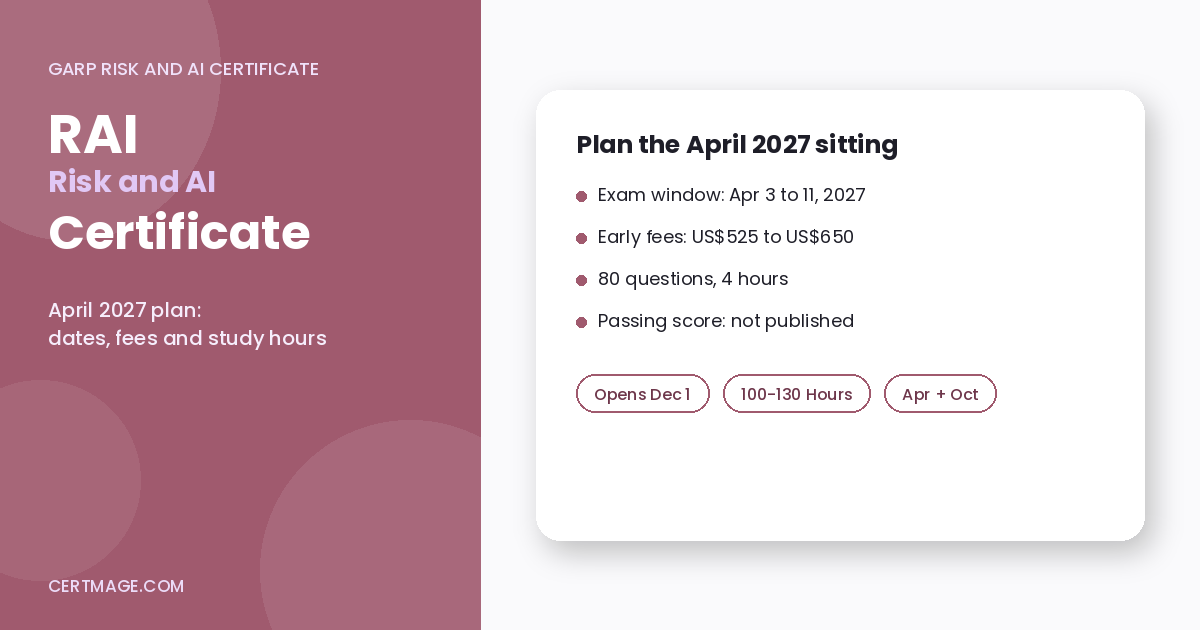
TL;DR: GARP’s Risk and AI (RAI) Certificate is an 80-question, four-hour multiple-choice exam on how AI creates and changes risk, offered twice a year in April and October. The October 2026 sitting ran October 3 to 11 and has closed, so the next window is April 3 to 11, 2027. Early registration opens December 1, 2026 and runs through January 31, 2027, which is 48 days from today (October 14, 2026) to the opening day. Fees on GARP’s page for the April 2027 sitting run from US 525 to US 750 depending on when you register and whether you are an FRM, RAI or ERP holder, an individual member or a non-member. GARP says no prior work experience or AI background is required, and estimates 100 to 130 hours of study. GARP does not publish a passing score, and its own pages disagree on the retake fee (US 300 on one page, US 350 on another). This guide gives you the calendar, the fee ladder, a study-hours plan and the rules that cost candidates money, with every gap labeled.
If you work in risk, compliance, audit or finance and want an AI credential that does not require a prior certification, this is one of the few that fits. If you are comparing it with other AI credentials, the table later in the guide shows where it differs.
Quick Facts
| Item | What we found |
| Credential | Risk and AI (RAI) Certificate, from GARP |
| Exam format | 80 equally weighted multiple-choice questions. Some questions come in groups of three or four that share a scenario |
| Duration | Four hours |
| Sittings | April and October each year |
| Last sitting | October 3 to 11, 2026. Closed |
| Next sitting | April 3 to 11, 2027 |
| Early registration for April 2027 | December 1, 2026 to January 31, 2027 |
| Standard registration for April 2027 | February 1 to March 31, 2027 |
| Scheduling window for April 2027 | December 1, 2026 to April 9, 2027 |
| Delivery | Pearson VUE test centers, or online through Pearson VUE’s OnVUE |
| Language | American English. A Japanese-language option was offered in Japan on October 3, 2026 |
| Prerequisites | None required, per GARP’s candidate guide for 2024 to 2025 |
| Study time | 100 to 130 hours on average, per GARP |
| Passing score | Not published |
| Validity | Not stated on the pages we read. CPD is voluntary |
GARP’s own pages are the source for every row. Where a number comes from a third party, this guide marks it “reported”. All GARP deadlines are 11:59 pm Eastern Time. No salary figures appear in this guide, because we found no source that isolates pay for RAI holders.
The Sitting Calendar and Countdown
Most guides list the exam dates and stop. This calendar adds the day counts, because the registration windows are what decide your cost.
| Sitting | Exam dates | Early registration | Standard registration | Scheduling window |
| October 2026 | October 3 to 11, 2026 | Closed | Closed | May 1 to October 9, 2026 |
| April 2027 | April 3 to 11, 2027 | December 1, 2026 to January 31, 2027 | February 1 to March 31, 2027 | December 1, 2026 to April 9, 2027 |
| October 2027 | October 2 to 10, 2027 | May 1 to July 31, 2027 | August 1 to September 30, 2027 | May 1 to October 8, 2027 |
Days from today (October 14, 2026)
| Milestone | Date | Days away |
| Early registration opens | December 1, 2026 | 48 |
| Early registration closes | January 31, 2027 | 109 |
| Standard registration opens | February 1, 2027 | 110 |
| Standard registration closes | March 31, 2027 | 168 |
| Exam window opens | April 3, 2027 | 171 |
| Exam window closes | April 11, 2027 | 179 |
The practical point: the gap between early and standard registration is a single day, January 31 to February 1, and it costs US$100 in every fee category. That is the cheapest deadline to respect.
What happens if you miss April
The next sitting is October 2, 2027, with early registration from May 1 to July 31, 2027. That is a six-month wait. GARP’s pages describe a one-time deferral and a one-time retake route, covered below, but a first-time candidate who simply misses the window waits for October.
The Fee Ladder
GARP’s fee page lists the same prices for April 2027 and October 2027, in US dollars, before taxes.
| Candidate type | Early registration | Standard registration | Saving by registering early |
| FRM, RAI or ERP holder | US$525 | US$625 | US$100 |
| Individual member | US$550 | US$650 | US$100 |
| Non-member | US$650 | US$750 | US$100 |
What the fee does and does not include
- Taxes: Fees exclude taxes such as VAT and GST, which are added at payment based on your location.
- Membership: Eligible first-time RAI candidates get six months of complimentary GARP Individual Membership, applied automatically at registration, if they have not received it from another GARP program. GARP’s page does not say whether this changes which fee column applies to you, so check the registration screen before you pay.
- Study materials: The full curriculum and a practice exam come through GARP Learning, which is included with registration. Access ends on the last day of the exam window you registered for.
- Printed book: Optional. US100plusshippingforregisteredcandidatesandUS300 for non-candidates, non-refundable.
- Payment methods: Major credit cards and Alipay. Wire and ACH transfers add a US$50 processing fee.
- Changes: GARP states that all fees are subject to change.
The cost of failing or deferring
| Event | Cost | Source |
| Retake in the next window, one time | US300onthefeespage,US350 on the exam policies page and in the 2024 to 2025 candidate guide | GARP. Pages conflict |
| Defer once to the next window | US$150 | GARP exam policies |
| Request a refund | Free, if requested by email within 48 hours of paying | GARP exam policies |
| No-show, late arrival or never scheduling | Forfeit the fee | GARP exam policies |
The conflict we found
GARP’s fees page says candidates who fail, do not schedule, or schedule but do not sit can register for the next window at a one-time reduced price of US300. GARP’s exam policies page and its 2024 to 2025 candidate guide both say US350. We could not find a GARP statement reconciling them. The fees page is the newer-looking source, so US$300 is the likelier current figure, but confirm it on the registration screen.
A cost scenario, as arithmetic
For a non-member who registers early and has to retake, the cost is US 650 plus there take fee: US 950 at US 300, or US 1,000 at US350.For an individual member the same path is US850 or US$900. These are our sums from GARP’s published fees, before taxes and any optional book.
What the Exam Covers
GARP’s 2026 study materials describe five modules: AI concepts and history, AI tools and techniques, risks and risk factors, responsible and ethical AI, and data and AI model governance. The 2024 to 2025 candidate guide gives these weights.
| Module | Weight in the 2024 to 2025 guide |
| 1. AI and Risk: Intro and Overview | 8 to 12% |
| 2. Tools and Techniques | 25 to 35% |
| 3. Risks and Risk Factors | 15 to 25% |
| 4. Responsible and Ethical AI | 15 to 25% |
| 5. Data and AI Model Governance | 15 to 25% |
| 6. Case Studies and Practitioner Perspectives | 0%, optional |
The weights are dated
The weights above come from the 2024 to 2025 guide. GARP’s study-materials page labels the current materials “2026” and lists a Study Guide and Learning Objectives that summarizes the weight of each knowledge area, but we could not read it. Treat the table as a guide to emphasis, and check the current Study Guide before you plan your hours. The study-materials page does not describe what changed between curriculum versions or give a schedule for future updates.
How the module weights translate to study time
The ranges overlap, so exact hours cannot be computed. A rough split of 115 hours, the midpoint of GARP’s estimate, using the midpoint of each range and rounding, looks like this:
| Module | Midpoint weight | Approximate hours of 115 |
| Intro and Overview | 10% | 12 |
| Tools and Techniques | 30% | 35 |
| Risks and Risk Factors | 20% | 23 |
| Responsible and Ethical AI | 20% | 23 |
| Data and AI Model Governance | 20% | 23 |
The midpoints sum to 100% here, so the split works. It is our arithmetic and not a GARP recommendation, and the optional case-study module is excluded because it carries no exam weight.
The Study-Hours Ladder
GARP estimates 100 to 130 hours on average, varying by background. Your weekly load depends on when you start.
| Start date | Weeks to April 3, 2027 | Hours per week at 100 | At 115 | At 130 |
| October 14, 2026 (today) | 24.4 | 4.1 | 4.7 | 5.3 |
| December 1, 2026 (early registration opens) | 17.6 | 5.7 | 6.5 | 7.4 |
| February 1, 2027 (standard registration opens) | 8.7 | 11.5 | 13.2 | 14.9 |
The numbers assume you start studying on the date shown and count the weeks to the first day of the April window. GARP Learning access starts at registration, so starting before December 1 means using outside material or waiting. The table shows that waiting until standard registration leaves you with a heavy weekly load.
What GARP Learning includes
GARP says registered candidates get a free digital platform with the full curriculum, case studies, practitioner videos, a practice exam, study-performance tracking, personalized study plans and end-of-chapter questions. GARP lists third-party exam-prep providers on its study-materials page but says it does not endorse them or verify their claims, including pass rates.
Registration, Deferral and Exam-Day Rules
These rules decide whether your fee is wasted.
| Rule | What GARP says |
| Scheduling | At least 48 hours before the start time, within the window you registered for. First come, first served |
| Rescheduling | Up to 48 hours before the start time, depending on availability |
| Deferral | Once, to the next window. Deadlines are April 1 for the April window and October 1 for the October window. US$150 |
| Accommodations | Request at least 30 days before the appointment, per the 2024 to 2025 candidate guide |
| Refund | Request by email within 48 hours of paying |
| Late arrival | Considered late if after the start time on your confirmation. No refund or deferral, and the fee is forfeited |
| Identification | Original, valid, government-issued photo ID with your signature, issued in the country where you test. Digital IDs are not accepted. Your name must match your registration exactly |
| Delivery | Pearson VUE test center, or OnVUE online |
GARP states there are no exceptions to the ID policy. If the name on your ID does not match your registration, you cannot sit and you forfeit the fee. For that reason, check your registration name against your ID on the day you register, not the night before the exam.
The deferral trap
Deferral deadlines fall before the exam window: April 1 for April, October 1 for October. For the April 2027 sitting, the deadline is April 1, 2027, two days before the window opens on April 3. If you miss it, GARP’s pages describe no deferral.
Who Should Sit It
GARP’s 2024 to 2025 candidate guide names its audiences: executives and decision makers, risk management professionals, innovators and entrepreneurs, and students in business, data analytics, economics, engineering or technology-related programs. The guide says no prior work experience, AI or machine learning background, risk management background or coding background is required.
| Reader | Why the RAI may fit | A caution |
| Risk, compliance or audit professional | The exam centers on how AI creates and changes risk | GARP publishes no passing score or pass rate |
| FRM or ERP holder | Holder fee tier is US$525 early, the lowest on the page | GARP’s page does not say the RAI counts toward other GARP credentials |
| Data or analytics professional in finance | Covers tools, model governance and responsible AI | The exam is four hours of multiple choice, not a hands-on assessment |
| Executive or business leader | No technical prerequisites | The curriculum is still 100 to 130 hours |
| Student or early-career | No experience requirement | Fees are the same as for professionals, aside from the tier chosen |
A third-party exam-prep provider’s article, which we did not link, describes the audience similarly and adds career-path claims. Those claims are the provider’s own and are not attributed to GARP, so we do not repeat them.
How the RAI Differs From Other AI Credentials
The RAI is one of several AI credentials, and the differences matter more than the shared topic. This table sticks to what each issuer publishes and what we have already verified.
| Credential | Issuer | Prerequisite | Delivery pattern |
| RAI Certificate | GARP | None required | 80 multiple-choice questions, four hours, April and October |
| AAISM | ISACA | An active CISM or CISSP, per ISACA | 90 questions, per ISACA. See our AAISM exam page |
| AIGP | IAPP | Not restated here | Details differ by source. We do not restate them |
| ISC2 AI security certification | ISC2 | Not defined | In development. No exam available |
The RAI sits on the risk and finance side of the market. AAISM is aimed at information-security leaders who already hold a senior credential. If your background is risk, audit or finance, the RAI fits without a prior certification. If your background is information security, the credentials in our audit and compliance guide and our CRISC vs CISM comparison show how the risk and security tracks differ. For audit-focused readers, our CIA vs CISA guide covers that fork, and for financial-crime specialists, the CAMS vs CFE and CFE guide pages cover that track. Privacy specialists can read our CIPT guide. You can also browse our practice tests for other exams.
Six Steps to Plan the April 2027 Sitting
- Decide this month whether April is realistic. At 115 hours, starting December 1 means about 6.5 hours a week.
- Mark December 1, 2026 and January 31, 2027. The first is when early registration opens, the second is the last day to save US$100.
- Check your name. Make sure the name on your registration will match your ID exactly.
- Choose your delivery. Test center or OnVUE. Both are offered by Pearson VUE.
- Schedule early in the window. Appointments are first come, first served, and GARP asks for at least 48 hours’ notice.
- Note April 1, 2027. That is the last day to defer, two days before the exam window opens.
Common Mistakes
- Missing the January 31 deadline by a day. The standard fee starts February 1 and costs US$100 more.
- Assuming a passing score exists on paper. GARP does not publish one, so do not plan around a number.
- Planning around a retake fee you have not confirmed. GARP’s pages say US300andUS350. Check the registration screen.
- Using old weights. The module weights we could read come from a 2024 to 2025 guide.
- Letting the name on your ID differ from your registration. GARP says there are no exceptions.
- Forgetting the deferral deadline. It falls before the exam window, on April 1 for the April sitting.
- Counting on GARP Learning after your window. Access ends on the last day of the window you registered for.
- Trusting a pass-rate figure without a source. A third-party provider reported a 66% pass rate for April 2025, without clearly citing GARP. We treat it as unconfirmed.
What We Don’t Know Yet
- The passing score. GARP does not publish it. The 2024 to 2025 guide does not state the passing standard, scoring method or results timing.
- The current module weights. We could not read GARP’s 2026 Study Guide.
- The pass rate. A third-party provider reported 66% for April 2025, not clearly sourced to GARP.
- Validity. The pages we read do not state a validity period. GARP strongly recommends 10 hours of CPD per year, which is voluntary.
- The retake fee. US300ononeGARPpage,US350 on another.
- Whether early-registration fees will change. GARP states all fees are subject to change.
- Results timing. Not found on the pages we read.
- How the six months of complimentary membership interacts with fee tiers. Not stated.
- Salary effects. We did not find a source that isolates pay for RAI holders, so we left salary figures out.
We will update this guide when GARP publishes the 2027 study materials or confirms the retake fee. If you have the current RAI Study Guide, send us the module weights and we will check them.
FAQS
What is the GARP RAI Certificate?
It is GARP’s Risk and AI Certificate, an exam covering AI concepts, tools and techniques, risks and risk factors, responsible and ethical AI, and data and AI model governance.
How many questions are on the RAI exam, and how long is it?
Eighty equally weighted multiple-choice questions in four hours. Some questions come in groups of three or four that share a scenario.
When is the next RAI exam?
April 3 to 11, 2027. The October 2026 sitting ran October 3 to 11 and has closed.
When does registration open for April 2027?
Early registration runs December 1, 2026 to January 31, 2027. Standard registration runs February 1 to March 31, 2027.
How much does the RAI exam cost?
For April 2027, early registration is US525forFRM,RAIorERPholders,US550 for individual members and US650fornon-members.StandardregistrationaddsUS100 in each category. Fees exclude taxes and are subject to change.
Are there prerequisites?
GARP’s 2024 to 2025 candidate guide says no prior work experience, AI or machine learning background, risk management background or coding background is required.
What is the passing score?
GARP does not publish one in the pages we read.
How long should I study?
GARP estimates 100 to 130 hours on average, depending on your background.
What happens if I fail?
GARP’s pages describe a one-time retake in the next window. One page says US 300 and another says US 350, so confirm the fee when you register.
Can I defer my exam?
Once, to the next window, for US$150. The deadlines are April 1 for the April window and October 1 for the October window.
Can I take the exam online?
Yes. GARP offers Pearson VUE test centers and online proctoring through OnVUE.
How long is the certificate valid?
The pages we read do not state a validity period. GARP strongly recommends 10 hours of voluntary CPD each year.