Short answer: the path from help desk to network engineer is CCNA first, then real network work at your job, then CCNP Enterprise. Add A+ only if you do not yet have the IT basics. A certificate alone will not get you promoted, but it is the proof that makes a manager say yes when you ask for network tickets, and it is what many employers screen for when the role opens.
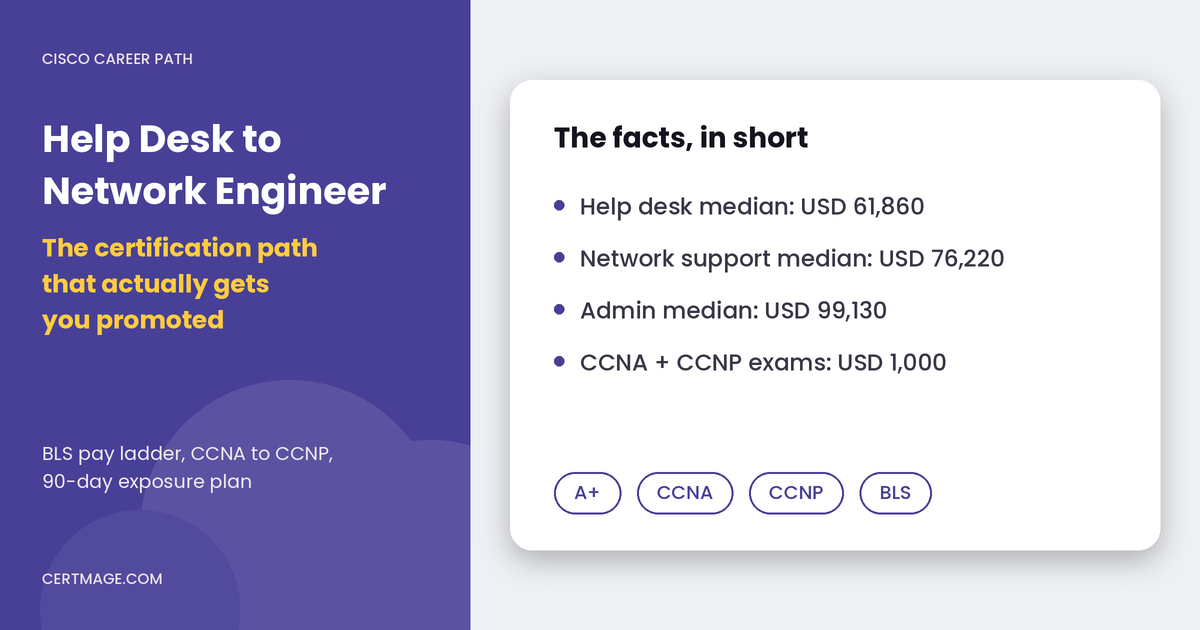
The pay data shows where the biggest jump is. BLS lists help desk (user support) at a median of USD 61,860 and network support specialists at USD 76,220. That is about USD 14,360 more for the first step. Network administrators earn USD 99,130, another USD 22,910 up. The Cisco exam fees for CCNA plus CCNP Enterprise are USD 1,000 plus tax. Our estimate for the whole move is 2 to 3 years if you study 6 to 8 hours a week while working.
One date to know: the current CCNA (v1.1) can be taken until February 2, 2027. The refreshed v2.0 launches February 3, 2027 with the same code, 200-301.
The Path in Five Steps
| Step | What to do | Why it matters |
| 1 | Get the basics (A+ only if you need it) | Proves you can do IT support |
| 2 | Pass the CCNA | Proves you understand how networks work |
| 3 | Move into network tickets or a network support role | This is the promotion that counts |
| 4 | Start CCNP Enterprise (ENCOR plus one concentration) | Opens network engineer and administrator roles |
| 5 | Keep your certifications current | Most Cisco certifications last three years |
What Each Job Level Pays (BLS)
| Role | Median pay, May 2025 (USD) | Outlook 2025 to 2035 | Step up from the one before |
| Help desk (user support specialist) | 61,860 | about -3% | n/a |
| Network support specialist | 76,220 | about +1% | +14,360 |
| Network and computer systems administrator | 99,130 | -4% | +22,910 |
| Computer network architect | 134,050 | +8% | +34,920 |
These are medians for each occupation. BLS does not report pay by certification, so a certificate does not guarantee a number. Your region, employer and experience decide your offer.
Most roadmaps skip the network support row, but it is the realistic first move. It pays more than help desk and its outlook is better. BLS also says many computer support specialists advance to other IT jobs, including network and computer systems administrator.
Step 1: Do You Need A+?
CompTIA A+ is a general IT support credential made of two exams, 220-1201 and 220-1202. Each has a maximum of 90 questions and lasts 90 minutes. The passing scores are 675 and 700 on a 900 scale. CompTIA recommends 12 months of hands-on IT support experience.
- Take it if you are new to IT or your target employers list A+.
- Skip it if you already work on a help desk and can show the basics through your experience. Go straight to CCNA.
Our A+ 220-1201 vs 220-1101 comparison explains which version applies today, and our A+ practice tests help you check your readiness.
Step 2: CCNA, or Network+ First?
| CompTIA Network+ (N10-009) | Cisco CCNA (200-301) | |
| Exam | Up to 90 questions, 90 minutes, pass 720 out of 900 | 120 minutes, USD 300 plus tax |
| Covers | Vendor-neutral networking | Cisco routing, switching, IP services, security basics, automation basics |
| Recommended experience | A+ and 9 to 12 months of hands-on experience | Not stated by Cisco |
| Pick it when | Your employer uses mixed vendors | Your employer uses Cisco, or you plan to go on to CCNP |
If your goal is CCNP, go to CCNA. You do not need both. If you want a gentler start, read our Network+ vs CCNA comparison and our guide to how hard Network+ is, and practice with our Network+ N10-009 tests.
Step 3: Pass the CCNA
Official facts from Cisco:
- Exam: 200-301 CCNA, 120 minutes, USD 300 plus tax (or Cisco Learning Credits)
- Current topics: network fundamentals, network access, IP connectivity, IP services, security fundamentals, and automation and programmability
- Most Cisco certifications are valid for three years
The version change:
| Date | What happens |
| February 2, 2027 | Last day to test on v1.1 |
| February 3, 2027 | v2.0 goes live, same exam code |
Cisco’s v2.0 topic list has five domains: Network Infrastructure and Connectivity (25%), Switching and Network Access (25%), IP Routing (20%), Network Services and Security (20%), and AI, and Network Operations and Management (10%).
Which version should you take? If you already work with switches and routers and can be ready by January, v1.1 is fine. If you are starting from scratch now, plan for v2.0 and buy material that names that version. The core skills are the same.
Our CCNA 200-301 guide covers how to study, and our free CCNA practice tests show where you stand.
Step 4: Get Network Experience While You Are Still on the Help Desk
This step is what turns the certificate into a promotion. You do not need a new job title to start.
- Tell your manager your goal. Say you are working toward CCNA and want to move into network support.
- Take network tickets. VPN, Wi-Fi, DNS, DHCP, switch ports, and printers all count.
- Shadow the network team. Even one hour a week helps.
- Own one small change from start to finish, such as adding a VLAN or changing a switch port, with the network team reviewing.
- Write down what you fix. Keep a short list of the fault, the fix and the result. It makes your review, your resume and your interview answers much easier.
If you have been doing this for about six months and nothing opens up, start applying for network support and NOC roles elsewhere, using the same list as proof.
Ask your employer to pay. Cisco exams can be paid with Cisco Learning Credits, and many employers will cover an exam that supports a role they need. It costs nothing to ask.
Step 5: CCNP Enterprise
Official facts from Cisco:
- You earn it with one core exam and one concentration exam of your choice
- Core exam: 350-401 ENCOR, USD 400 plus tax, 120 minutes
- Concentration exams: USD 300 plus tax each, 90 minutes each
- No prerequisites. Valid for three years
Pick your concentration from what your team does:
| Concentration | Best when |
| 300-410 ENARSI (advanced routing and services) | Your work is routing, VPNs and troubleshooting |
| 300-415 ENSDWI (Catalyst SD-WAN) | Your employer runs or plans SD-WAN |
| 300-420 ENSLD (designing enterprise networks) | You want design or architect roles |
| 300-435 ENAUTO (automation and programming) | Your team automates network changes |
| 300-440 ENCC (secure cloud connectivity) | You work with cloud connectivity |
| 300-445 ENNA (network assurance, English only) | You work in monitoring and assurance |
When to start it: once you are doing network tasks at work and the topics sound like your job. Starting before you have any hands-on exposure usually stalls.
BLS says network architects typically need 5 or more years of related experience, and administrators typically need a bachelor’s degree, though some employers accept a certificate or an associate’s degree. A CCNP helps you qualify, but it does not replace the experience.
What It Costs (Exam Fees Only)
| Step | Exams | Fee (USD, plus tax) |
| CCNA | 200-301 | 300 |
| CCNP Enterprise | ENCOR 400, plus one concentration 300 | 700 |
| Total | 1,000 |
Study materials, practice labs and retakes are extra. If you fail an exam, Cisco requires a five-day wait before you retake it.
A Realistic Timeline (Ours)
| When | Goal |
| Months 1 to 8 | Study for and pass the CCNA while taking network tickets |
| Months 6 to 12 | Move into network support, NOC or Tier 2 |
| Months 12 to 26 | Build experience, then study for ENCOR and a concentration |
| Months 26 to 30 | Complete CCNP and apply for network engineer or administrator roles |
If life gets in the way, move the dates. The order matters more than the speed.
If You Want a Different Direction
BLS names information security analysts, network administrators and software developers as common next steps for support specialists. If networking is not for you, look at our cybersecurity certification ranking or our AWS vs Azure vs GCP comparison. If you want remote work, our remote tech certifications guide shows which credentials fit.
Common Mistakes
- Starting CCNP before any network work. The topics will not stick.
- Studying quietly. If your manager does not know your goal, nobody can promote you.
- Collecting unrelated certificates. Pick a direction and stay with it.
- Choosing a concentration by popularity. Choose it by your employer’s stack.
- Using unauthorized “dumps.” They do not build the skills interviews test, and they put your certification at risk.
- Letting certifications expire. Cisco does not grant extensions. Associate-level renewal needs 30 continuing-education credits and professional-level needs 80, or you can pass another exam.
FAQS
What is the best certification path from help desk to network engineer?
For most people: A+ only if you need the basics, then CCNA, then network-facing work at your job, then CCNP Enterprise (ENCOR plus one concentration). The certificate matters most when paired with documented network work.
Can I become a network engineer from help desk?
Yes, and it is a common route. BLS names network and computer systems administrators as a common next step for computer support specialists. It usually takes experience, a CCNA and often CCNP-level skill, and BLS lists a bachelor’s degree as typical for administrators, though some employers accept a certificate or associate’s degree.
How long does it take to go from help desk to network engineer?
Our estimate is 2 to 3 years for someone studying 6 to 8 hours a week and getting network exposure at work. Cisco and BLS publish no official timeline, so treat it as a planning range.
Do I need A+ before CCNA?
Not always. CompTIA recommends 12 months of hands-on IT support experience for A+. If you already work in help desk and can show basics through experience, you can go straight to CCNA.
Should I take Network+ or CCNA first?
If your employer or target employers run Cisco, go straight to CCNA. If you want a vendor-neutral foundation, Network+ is a gentler start. CompTIA’s page recommends A+ plus 9 to 12 months of hands-on experience for Network+. You do not need both.
Is CCNA enough to become a network engineer?
Usually it is enough to start in network support or NOC roles. Engineer roles often ask for more experience and sometimes CCNP-level skill.
Do I need a CCNP to become a network engineer?
Not always, but it helps. A CCNP Enterprise requires one core exam (ENCOR, USD 400 plus tax) and one concentration exam (USD 300 plus tax). It strengthens your case once you have hands-on experience.
Which CCNP Enterprise concentration should I pick?
Match it to your employer’s stack. ENARSI suits routing and troubleshooting, ENSDWI suits SD-WAN, ENSLD suits design, ENAUTO suits automation, ENCC suits cloud connectivity and ENNA suits network assurance.
How much do the Cisco exams cost in total?
CCNA is USD 300 and CCNP Enterprise is USD 700 (400 plus 300), a total of USD 1,000, all plus tax. Study materials and retakes are extra.
Is the CCNA changing?
Yes. Cisco says v1.1 can be taken until February 2, 2027 and v2.0 launches February 3, 2027 with the same code, 200-301. The v2.0 domains are Network Infrastructure and Connectivity (25%), Switching and Network Access (25%), IP Routing (20%), Network Services and Security (20%), and AI, and Network Operations and Management (10%).
How much more do network jobs pay than help desk?
BLS medians (May 2025): user support specialists USD 61,860, network support specialists USD 76,220, network and computer systems administrators USD 99,130 and computer network architects USD 134,050. These are occupation medians, not certification-specific.
Is it worth leaving help desk for network support?
At the median, the move adds about USD 14,360 a year, and BLS projects network support to grow about 1% while user support falls about 3%. Whether it is worth it for you depends on your region and offer.
What job titles should I search after the CCNA?
Network support specialist, NOC technician, Tier 2 or Tier 3 support, network technician and junior network administrator. Titles with “engineer” or “architect” usually ask for more experience.
Can I get promoted without changing companies?
Often yes, if there is a network team and a supportive manager. Tell your manager your goal, take network tickets, keep a record of your work and ask to be considered for the next opening. If nothing changes in about six months, consider an external move.
How do I get network experience when I only do help desk?
Volunteer for network-related tickets, shadow the network team, take one small change from start to finish and write down what you fix. Step 4 above lays it out.
Will my employer pay for the CCNA?
Many do for roles they need, but it is their policy. Ask with a specific benefit, such as reducing escalations. Cisco exams can be paid with Cisco Learning Credits.
Does the CCNA expire?
Most Cisco certifications last three years, and Cisco’s CCNA page does not state a separate period. You can renew by passing another exam, advancing a level or earning continuing-education credits.
What if I fail the CCNA?
Cisco’s policy requires a five-calendar-day wait before retaking the same exam. The fee page does not say a retake is discounted, so plan for the full fee again.
Final Thoughts
Help desk to network engineer is a clear path: pass the CCNA, get real network work at your job, then add CCNP Enterprise. The certificate opens the door, and your record of network work gets you through it. The first move, from help desk into network support, is the one most people can reach in about a year, and it is where the pay and outlook improve.
Source for pay and outlook: the BLS profile for computer support specialists.