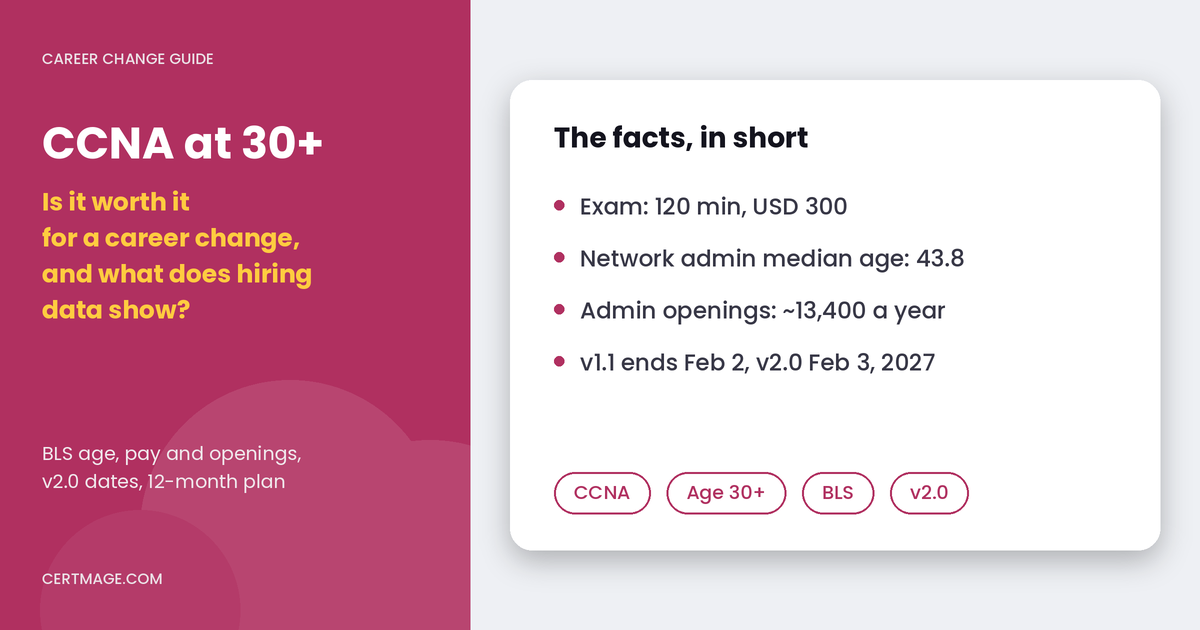
TL;DR: If you are 30 or older and want a networking job, the CCNA is worth it as a door opener and not worth it as a shortcut. The case for: the exam is USD 300 plus tax, 120 minutes, has no stated prerequisites, and the people who work in this field are not young. BLS puts the median age of network and computer systems administrators at 43.8, and about 76% are 35 or older. The case against: BLS says administrators typically hold a bachelor’s degree, projects the occupation to shrink 4% from 2025 to 2035, and counts only about 13,400 openings a year, all from replacement. The realistic way in is through support or network operations, where there are about 48,700 openings a year but a median wage of USD 62,890 (administrators: USD 99,130). Our verdict by situation: strong yes if you already work in IT or can accept a support-level start; conditional yes if you are coming from another field and can fund 6 to 12 months of lower pay; no if you need a network engineer salary in the next few months. Timing: CCNA v1.1 can be taken until February 2, 2027, and v2.0 launches February 3, 2027 under the same code, 200-301. This post is built to help you decide, not to sell you the exam, so it includes a scorecard, six career-changer profiles, the money math and a 30-day test you can run before you spend anything.
Key Takeaways
- Age is not what the data flags. Network administrators have a median age of 43.8 and network architects 45.1 (BLS, 2025). That describes who is employed now. It does not prove a 40-year-old new entrant is hired as often as a 25-year-old, and we say so.
- The CCNA proves skill. It does not create a job. BLS says employers may require vendor certification. Most hiring decisions weigh the certificate, a hands-on story and the interview together.
- The first job is usually support or operations. That pool is about 3.6 times larger than the administrator pool (48,700 versus 13,400 openings a year, BLS).
- The pay gap is the prize. Median pay rises from USD 62,890 (support) to USD 99,130 (administrator) to USD 134,050 (architect). Each step needs experience, not just a certificate.
- The exam is the cheap part. USD 300 plus tax. The expensive parts are your time and any pay cut in year one.
- Test before you commit. A 30-day trial with free tools tells you whether you will survive 150 hours of study. We lay out how.
- Pick your exam version now. v1.1 closes February 2, 2027. For most beginners starting today, v2.0 is the version they will actually sit.
The 60-Second Decision: Three Questions
Answer these before reading the rest. They decide most cases.
- Can you accept a support-level job and support-level pay for 6 to 18 months? If no, the CCNA will probably frustrate you, because the roles that pay the BLS administrator median ask for experience the certificate cannot replace.
- Do you like the work itself? Networking is troubleshooting: reading output, testing a theory, fixing a fault, sometimes at odd hours. If that sounds draining rather than satisfying, a different path may fit better. Our best cybersecurity certifications ranking and remote tech certifications guide cover other directions.
- Can you protect 5 to 10 hours a week for at least four months? If your life cannot give you that, the plan will drift. You can still do it, but you should pick a longer timeline now, not discover it in month three.
Three yeses: continue. One no: read the scorecard and profiles below before spending a cent. Two or more noes: this is probably not the right moment, and that is a fine answer.
What the Hiring Data Actually Says (And What It Cannot Say)
Who already works in these jobs (BLS Current Population Survey, 2025)
| Occupation | Employed (thousands) | Age 25 to 34 | 35 to 44 | 45 to 54 | 55 to 64 | 65+ | Median age |
| Computer support specialists | 677 | 25.9% | 24.1% | 22.7% | 16.2% | 4.9% | 42.4 |
| Network and computer systems administrators | 154 | 22.1% | 31.2% | 27.3% | 13.0% | 4.5% | 43.8 |
| Computer network architects | 96 | 13.5% | 37.5% | 28.1% | 16.7% | 4.2% | 45.1 |
Percentages are our calculations from BLS table 11b counts (2025 annual averages, 11-month average that excludes October 2025).
Our reading:
- Share of workers aged 35 or older: about 76% of administrators, about 68% of support specialists and about 86% of architects.
- This is a snapshot of people employed now. Many started decades ago and stayed. It tells you the field is used to working with people your age. It does not tell you how many 38-year-old beginners got hired last year.
How many jobs exist and where they are heading (BLS Occupational Outlook Handbook)
| Occupation | Median pay, May 2025 (USD) | Outlook 2025 to 2035 | Average openings per year | Typical entry education |
| Computer support specialists | 62,890 | -3% | about 48,700 | Varies: some college or associate’s degree, or high school plus certifications |
| Network and computer systems administrators | 99,130 | -4% (about 13,200 fewer jobs) | about 13,400, all from replacing workers who leave | Bachelor’s degree |
| Computer network architects | 134,050 | +8% | about 9,600 | Bachelor’s degree and 5 or more years in a related job |
What this means for a career changer (ours):
- Openings are concentrated at the entry door. Support has roughly 3.6 times the administrator openings (48,700 divided by 13,400). If you want a first job in IT, that is the larger pool.
- The administrator pool is replacement hiring. BLS says all of its roughly 13,400 openings come from workers leaving, because the occupation is shrinking. Fewer seats means more competition per seat, so visible hands-on skill matters more.
- The jump from administrator support is worth chasing. USD 99,130 minus USD 62,890 is USD 36,240 a year at the median.
- Growth sits in the role with the highest barrier. Architects are projected at +8%, but BLS lists 5 or more years of related experience as typical. The CCNA is the first rung toward that, not the rung that reaches it.
What BLS says about certifications
For administrators, BLS says: “Employers may require their network and computer systems administrators to be certified in the products they use.” The key word is may. For some employers the CCNA is a requirement, for others a tiebreaker, and for others irrelevant if you can show the skill.
What no public dataset tells you
- Pay by certification. BLS does not publish it. Any “CCNA holders earn USD X” figure comes from another source, usually self-reported and usually mixing in years of experience.
- Hiring rates by age. No BLS table says how many applicants of each age get hired.
- How often CCNA appears in postings. We could not find a verifiable public number. Use the local market audit below to get your own.
The Age Question: Evidence, Employer Concerns and Honest Answers
You will meet two loud claims: “age does not matter in tech” and “nobody hires career changers over 40.” The evidence supports neither in full.
Supported by evidence:
- The median network administrator in the U.S. is 43.8. You will not be the only one in the room.
- CompTIA’s April 2026 career-change article says people switch into IT in their 30s, 40s and 50s and treats prior experience as an asset. That article is published by the company that sells the certifications it recommends and cites no hiring statistics, so treat it as encouragement, not proof.
Not supported by evidence:
- That a 45-year-old with no IT experience gets interviews at the same rate as a 25-year-old. We have no data either way, and neither does anyone claiming certainty.
What employers are really screening for (ours)
| The unspoken worry | What it looks like in the interview | How you answer it with proof |
| “Is this person serious, or exploring?” | “Why networking, and why now?” | A finished credential, a dated study log and a concrete target role |
| “Will they stay at entry pay?” | “Are you comfortable starting at this level?” | A specific timeline: “I plan to prove myself in this role for 12 to 18 months, then move toward administration” |
| “Can they actually do the work?” | A troubleshooting scenario | A home lab story: the fault, what you tested, what fixed it |
| “Will they fit a younger team or manager?” | Tone, curiosity, coachability | Ask about the stack, the escalation path and what the best technician on the team does differently |
| “Will they learn fast enough?” | “Tell me about something technical you learned recently” | The CCNA itself, plus one sentence about how you studied it |
Objection scripts you can adapt
- “Why switch careers now?” “I have spent 12 years learning how businesses run and how to keep customers calm when something breaks. I want to apply that to keeping networks running. I proved I can learn the technical side by completing the CCNA while working full time.”
- “Do you mind starting at the bottom?” “I expect to start in a support role. I would rather earn my way up on real tickets than skip the basics.”
- “We usually hire younger candidates for this role.” If an employer says or implies this, that is information about the employer. In the U.S., the Age Discrimination in Employment Act protects people 40 and over from age discrimination in hiring. This is general information, not legal advice, and it does not describe any single employer’s behavior.
Practical consequences if you are 30+ (ours)
- Lead with your history, do not hide it. Customer handling, documentation, responsibility and industry knowledge are rarer in a 22-year-old applicant.
- Target employers who value your old industry. A technician who understands healthcare, logistics, education or finance is useful to companies in those fields.
- Expect a pay cut at first, and plan for it. CompTIA’s article makes the same point. A savings buffer is part of the plan, not an afterthought.
The CCNA Worth-It Scorecard (Ours)
Score yourself honestly. This is our own tool, not an official or validated test. Give yourself the points in each row.
| # | Question | Yes | Partly | No |
| 1 | I already work in or near IT (help desk, sysadmin, telecom, field service) | 3 | 1 | 0 |
| 2 | I have enjoyed troubleshooting something technical (even a home network) | 2 | 1 | 0 |
| 3 | I can protect 5 or more hours a week for 4 or more months | 2 | 1 | 0 |
| 4 | I can survive 6 to 12 months on entry-level pay (savings or a partner’s income) | 3 | 1 | 0 |
| 5 | I am willing to apply for support, NOC or technician roles | 3 | 1 | 0 |
| 6 | There are networking or support postings within commuting distance, or remote ones I can credibly apply for | 2 | 1 | 0 |
| 7 | I have an angle from my past career that an IT employer would value | 2 | 1 | 0 |
| 8 | I am comfortable learning from labs and mistakes, not only from videos | 2 | 1 | 0 |
| 9 | I do not need a network engineer title within the next year | 2 | 1 | 0 |
| 10 | I will treat the first 30 days as a test and stop if it is clearly wrong for me | 1 | 0 | 0 |
Your score (maximum 22):
| Score | Our reading |
| 17 to 22 | Strong fit. Start now. Decide your exam version first |
| 11 to 16 | Conditional fit. Fix the lowest-scoring rows (usually money, time or the target job) before paying for the exam |
| 6 to 10 | Weak fit today. Run the 30-day test, build a savings buffer or choose a lower-cost first credential |
| 0 to 5 | Not now. Reconsider the goal, not just the certification |
Six Career-Changer Profiles: Which One Are You?
These are composites to help you map your own situation. They are our illustrations, not case studies from real people.
1. The retail or hospitality manager (35, 10 years of shift management)
- Your edge: you already de-escalate problems, document incidents and manage people under time pressure.
- Your gap: technical vocabulary and hands-on lab time.
- Route: fundamentals (A+ content or CCST Networking), then CCNA, then help desk or NOC.
- Realistic first role: help desk or desktop support, with networking exposure as your next move.
- Verdict: worth it, if you accept a lateral or lower first-year income.
2. The teacher (38, strong at explaining and documenting)
- Your edge: you can write clear documentation and train users, a real value in support teams.
- Your gap: timing. School-year workload leaves little study energy in term.
- Route: study in summer and holidays, take the exam before you resign, apply for support or training-adjacent IT roles.
- Verdict: worth it, with a timeline built around your calendar, not a generic 12-week plan.
3. The electrician or cabling tradesperson (42, hands-on already)
- Your edge: you understand physical infrastructure, cabling and field work.
- Your gap: IP addressing, switching and routing theory.
- Route: CCNA directly, then field technician or network installation roles.
- Verdict: strong fit. Your physical-layer knowledge is a head start many beginners lack.
4. The office administrator or analyst, 45 and over
- Your edge: you know how business processes work and which systems matter.
- Your gap: the technical depth and the fear of being “too late.”
- Route: first try a role inside your current employer’s IT team. Internal moves face fewer age filters than cold applications.
- Verdict: worth it if you can move internally or accept a support start, and less so if you need an immediate pay match.
5. The help-desk worker who wants networking (any age)
- Your edge: you have tickets, tools and real incidents to talk about.
- Route: CCNA straight away, then ask for network-adjacent tickets and shadow the network team.
- Verdict: the clearest yes. This is the standard progression the certification was built for.
6. The parent returning to work after a gap
- Your edge: flexibility, organization and a clear reason to choose a stable field.
- Your gap: a recent technical resume.
- Route: CCST Networking or A+ content for a quick credential, then CCNA while applying for remote support roles.
- Verdict: worth it if you choose roles that fit your schedule. Remote support postings exist, but competition for them is high (ours).
The Money Model (Ours, With Invented Numbers You Should Replace)
BLS does not give entry-level pay by certification, so every example below uses assumptions we state. Replace them with your own.
Costs you will actually face
| Item | Cost (USD) | Source or note |
| CCNA exam (200-301) | 300, plus tax | Cisco’s exam page and fee page |
| CCST Networking exam (optional) | 125, plus tax | Cisco’s fee page |
| Retake of the same exam | Fee not stated as discounted on Cisco’s page, so plan for the full USD 300 | Cisco’s fee page does not say whether a retake is cheaper |
| Study materials, lab tools | Free to a few hundred (ours) | Many learners use free simulators and one paid course or book |
| Renewal in three years | Retake an exam, advance a level, or earn 30 continuing-education credits | Cisco’s recertification policy |
Break-even formula
Years to break even = (exam cost + materials + income you give up while studying) divided by (yearly pay gain from the new job).
Three illustrative scenarios (all numbers assumed)
| Scenario | Costs | Yearly pay change | Break-even | Our read |
| A. Keep your job, study evenings, then switch. Current pay 45,000, first IT job 52,000 | Exam 300 plus materials 200 = 500 | +7,000 | about 0.07 years (under a month of the new pay) | Low risk. The main cost is your evenings |
| B. Quit, study full time for 4 months. Lost income about 3,500 a month, current pay 45,000, first IT job 52,000 | 4 x 3,500 = 14,000, plus 500 = 14,500 | +7,000 | about 2.1 years | High risk. Only sensible with savings and a short, defined plan |
| C. Current pay 70,000, first IT job 52,000. Keep job during study | 500 | -18,000 in year one | Payoff only if you later reach the BLS administrator median of 99,130 (a gain of 29,130 over 70,000) | The first years cost you money. Worth it only if you want the career, not just the pay |
The lesson (ours): the exam fee is almost never the decisive number. Whether you keep your income while studying decides the risk. Scenario A is the safest because you study while employed.
The 30-Day Test Before You Spend a Cent (Ours)
Run this first. It costs nothing but time.
| Week | What to do | What you are testing |
| 1 | Learn what an IP address, subnet mask and default gateway are. Watch one introductory course | Does the vocabulary click or bore you? |
| 2 | Install a free network simulator. Cisco Networking Academy lists an “Intro to Packet Tracer” self-paced course as free, public and self-paced. Build two PCs and a switch, make them ping each other | Do you enjoy making something work? |
| 3 | Add a router, two subnets and a static route. Break it on purpose, then fix it | Do you like troubleshooting or get frustrated? |
| 4 | Do 20 subnetting problems without a calculator. Check your speed and accuracy | Can you handle the maths side without hating it? |
Decision rule (ours): if you finish week 4 curious and want to continue, book your study plan. If you dread each session, stop and reconsider. A failed 30-day test saves you months and the exam fee. Our free CCNA 200-301 practice tests are useful later, once you have studied, not in week one.
The CCNA in 2026 and 2027: Facts and the Version Decision
Official facts (Cisco’s exam page)
- Exam: Implementing and Administering Cisco Solutions (200-301 CCNA).
- Duration: 120 minutes.
- Fee: USD 300, or Cisco Learning Credits (listed fees are plus tax).
- Current topics: network fundamentals, network access, IP connectivity, IP services, security fundamentals, and automation and programmability.
- Prerequisites and recommended experience: not stated on the page.
- Validity: the page does not state a period. Cisco’s recertification policy says most certifications are valid for three years.
The version change
| Date | Event (per Cisco) |
| May 20, 2026 | Cisco published the refreshed CCNA exam topics |
| February 2, 2027 | Last day to test on CCNA v1.1 |
| February 3, 2027 | CCNA v2.0 goes live. The code stays 200-301 |
CCNA v2.0 domains and weights (Cisco’s official exam-topics document)
| Domain | Weight |
| Network Infrastructure and Connectivity | 25% |
| Switching and Network Access | 25% |
| IP Routing | 20% |
| Network Services and Security | 20% |
| AI, and Network Operations and Management | 10% |
Cisco’s document says candidates may need to review recommendations from agentic AI and digital network assistants during troubleshooting, and that the topics are a general guide that may change without notice. We could not find an official pass mark or question count in the sources we read, so we do not state them.
Which version should you sit? (Ours, as of November 26, 2026)
| Your situation | Recommendation |
| Already working in IT, can be ready by mid-January | v1.1 is fine and has more third-party material today |
| Starting from zero this week | Plan for v2.0. Roughly 2 months is not enough for most beginners |
| Somewhere in between | Decide by your study hours: if you cannot finish 150 hours by January, book v2.0 |
Whichever you choose, buy material that states the version on the cover. The core skills (addressing, switching, routing, security basics) carry across both.
Your Study Plan When You Have a Job and a Life (Ours)
Cisco does not publish a study time, and a third-party training roadmap gives 3 to 6 months for a newcomer. For planning, we assume about 150 hours of focused study and lab time for someone starting with basic computer skills. Adjust it up or down after your 30-day test.
| Hours per week | Calendar time for 150 hours | Fits when |
| 5 | about 30 weeks (7 months) | Heavy job or young children |
| 7 | about 21 weeks (5 months) | Typical working adult |
| 10 | about 15 weeks (3.5 months) | Flexible schedule or leave |
Where to spend those 150 hours (our allocation, using Cisco’s v2.0 weights)
| Domain | Weight | Hours of 150 | What to do in that time |
| Network Infrastructure and Connectivity | 25% | about 38 | Addressing, subnetting, protocols, wireless basics, labs |
| Switching and Network Access | 25% | about 37 | VLANs, trunks, spanning tree, EtherChannel, labs |
| IP Routing | 20% | 30 | Static routes, OSPF, route selection, labs |
| Network Services and Security | 20% | 30 | NAT, DHCP, DNS, ACLs, device security, labs |
| AI, and Network Operations and Management | 10% | 15 | Monitoring, logging, automation basics, reading AI-assisted recommendations |
Our rule: at least 40% of every domain’s hours should be hands-on labs, because the exam and the job both reward doing, not recognizing. Our CCNA 200-301 certification guide gives the longer study sequence, and our Network+ difficulty article helps if you want a gentler first exam.
A weekly rhythm that survives real life
- Three sessions of about an hour: a lesson, then notes in your own words.
- Two lab sessions of about 90 minutes: build, break, fix and write down the fault.
- One review session of about 45 minutes: questions on what you covered, then a note of weak spots.
If you miss a week, do not restart. Pick up where you stopped and shift the exam date. The plan is a rhythm, not a contract.
How to Read Job Postings Like an Insider (Ours)
Because no public dataset tells you how often CCNA is asked for, build your own sample.
The local market audit
Collect 20 postings in your target area (or remote) for these titles: help desk technician, IT support specialist, NOC technician, network technician, field service technician, junior network administrator. Then fill this table:
| Posting | Mention CCNA? | Mentions Network+ or A+? | Says “or equivalent experience”? | Years of experience asked | Pay shown |
| 1 to 20 | yes or no | yes or no | yes or no | number | number or blank |
How to read your result (ours):
- If most postings ask for no certification and 0 to 2 years, the door is wide and a CCNA is a differentiator, not a gate.
- If many say CCNA is required, the credential matters more and your timeline should be shorter.
- If most want 3 or more years for networking titles, plan to enter through support first and use the CCNA to move internally.
- If few postings exist near you, check remote support roles, or plan to relocate or commute, before committing.
Decoding common phrases
| Posting says | What it often means (ours) |
| “CCNA preferred” | A tiebreaker. Apply even without it, but say you are scheduled to test |
| “CCNA or equivalent experience” | The employer cares about skill. Show a lab and a story |
| “Cisco certification required” | A hard filter. The CCNA may be your only way past it |
| “Entry level, 3 years’ experience” | A mismatch. The real requirement is the years, apply if you are close |
| “Bachelor’s degree or equivalent” | BLS says administrators typically need a bachelor’s, but some employers accept a certificate or associate’s degree. Show the equivalent in skills |
Your Resume and Interview Kit
Resume rules
- Summary line that names the target: “Customer-focused professional with 10 years in logistics moving into network support. CCNA candidate, exam scheduled for [month].”
- A technical skills block near the top: only skills you have practiced, such as IP addressing, VLANs, OSPF, ACLs and Cisco IOS command line.
- A projects section: “Built a three-router, two-VLAN lab, configured OSPF and ACLs, documented and fixed five faults.”
- Translate your past into support language: incident handling, shift handoffs, documentation and customer communication.
- Never apologize for “entry level.” Say you are looking for a technician role to build on.
One lab story, structured (use it in interviews)
- Situation: “In my home lab, two subnets could not talk to each other.”
- What I checked: “Interfaces, then the routing table, then the access list.”
- Cause: “An ACL entry was blocking the traffic and sat higher in the list than the permit.”
- Fix and lesson: “I reordered the entries, tested with ping and traceroute, and wrote the rule order in my notes.”
Interviewers remember a specific fault more than a list of certificates.
If It Does Not Go to Plan
If you fail the exam
- Cisco’s policy says you must wait five calendar days before retaking the same entry, associate, professional or specialist exam.
- Cisco’s fee page does not say a retake is discounted, so plan for the full fee again (ours).
- After you pass, you must wait 180 days before taking the same exam number again.
- Use the weak-area breakdown to focus your next two weeks on the lowest domain, usually switching or routing labs.
If you pass and still do not get interviews after 3 months
- Check your applications: are you applying to roles asking for 5 years? Shift to support, NOC and technician titles.
- Strengthen proof: add two more documented labs and one write-up of a fault you fixed.
- Widen the net: include remote, contract and managed-service roles.
- Use your network: tell former colleagues you are looking for IT roles in their industry.
- Consider an internal move first, especially if you are over 45 and your employer has an IT team.
If you decide it is not for you
Stopping after 30 days or after the exam is not failure. Knowing networking helps in security, cloud, support and project work, and the fee you spent was small compared with years in the wrong role.
A Gentler First Step: Network+ Before CCNA?
If your 30-day test went well but the CCNA still looks steep, CompTIA Network+ is a vendor-neutral way to learn the same concepts first. Our Network+ vs CCNA comparison walks through the trade-offs, and our Network+ N10-009 practice tests let you check your level if you choose that route. Use your local market audit to decide: if postings name Cisco, go straight to CCNA.
Beyond the CCNA
- Network administrator or engineer: build experience, then consider CCNP-level study.
- Security: add a security certification. Pick one that matches the roles you saw in your market audit.
- Renewal: most Cisco certifications last three years. You can renew by passing another exam, advancing to the next level or earning 30 continuing-education credits for an associate-level certification. Cisco does not grant extensions.
When the CCNA Is Not the Right Move
- You want a network engineer salary within months and cannot take a support-level start.
- You dislike troubleshooting and detail.
- You cannot protect 5 hours a week and cannot adjust the timeline.
- Your local market has almost no networking or support postings and you cannot relocate or work remotely.
- You are chasing a credential because a video told you it guarantees a six-figure job. The BLS data does not support that promise.
Common Mistakes Career Changers Make
- Waiting for the certificate before applying. Start applications midway through your study.
- Studying only from videos. Labs build the skill the interview tests.
- Aiming at the wrong job title. Administrator and engineer postings often ask for years of experience. Support and NOC are the doors.
- Buying the wrong version’s material. Check the version before you pay.
- Skipping fundamentals when you have no IT background and then losing months on assumed concepts. Our A+ 220-1201 vs 220-1101 guide explains the entry credential.
- Ignoring your old career as an asset. Industry knowledge is often what wins the offer.
- Quitting first, studying second. Scenario B in the money model is the riskiest sequence.
- Using unauthorized “dumps.” Memorized answers do not build the skill an interviewer tests, and they put your certification at risk.
- Forgetting renewal. Three years goes quickly.
FAQS
Is the CCNA worth it for a career change at 30 or older?
Yes, if you want a networking role and are willing to start in support or operations. BLS shows the field is full of people in their 30s, 40s and 50s. It is not worth it if you expect a high-paying engineer job without experience.
Is the CCNA worth it at 40?
It can be. BLS reports a median age of 43.8 for network administrators, so 40 is the typical age of someone already doing the job. What the data cannot tell you is how hiring rates compare by age, so build a lab, a clear story and a plan for a support-level start.
Is the CCNA worth it at 50?
Possibly. About 4.5% of administrators and 4.9% of support specialists are 65 or older, and about 13% of administrators are 55 to 64 (BLS, our calculation). Consider an internal move at your current employer first, and make sure a support-level pay start fits your finances.
Am I too old to start a networking career?
The BLS data does not suggest it. It shows who is employed, not who gets hired, so we cannot promise equal hiring rates. Your best response is proof of skill, a defined plan and employers who value your past experience.
Can a 35-year-old with no IT experience get a networking job?
Often through a support or operations role first. Add a fundamentals step, build a lab, earn the CCNA and apply for technician titles while you study.
Can I get a job with only a CCNA and no experience?
Sometimes, usually in support, NOC or technician roles. BLS says employers may require vendor certifications, and lists a bachelor’s degree as typical for administrators. A CCNA plus labs and a strong story is stronger than the certificate alone.
How much do CCNA holders earn?
BLS does not report pay by certification. It reports occupation medians: USD 62,890 for computer support specialists, USD 99,130 for network and computer systems administrators and USD 134,050 for computer network architects (May 2025).
What jobs can I search for after the CCNA?
Help desk technician, IT support specialist, NOC technician, network technician, field service technician and junior network administrator. Titles with “engineer” or “architect” usually ask for years of experience.
Is the network administrator job market shrinking?
BLS projects a 4% decline from 2025 to 2035, with about 13,400 openings a year from replacement. Support specialists are projected at -3% with about 48,700 openings a year, and network architects at +8% with about 9,600.
Do I need a degree?
Not always. BLS says administrators typically need a bachelor’s degree, but some employers require only a postsecondary certificate or associate’s degree. Support roles vary more.
How much does the CCNA exam cost?
USD 300 per Cisco’s CCNA page, plus tax, or Cisco Learning Credits. Cisco’s fee page does not say a retake is cheaper, so plan for the full fee.
How long does it take to study while working full time?
Cisco publishes no figure, and a third-party roadmap suggests 3 to 6 months for a newcomer. Our planning assumption is about 150 hours: 30 weeks at 5 hours a week, about 21 weeks at 7, or about 15 weeks at 10.
Is the CCNA hard for a complete beginner?
It is broad and hands-on. Beginners who add a fundamentals step and do weekly labs usually manage better than those who only watch videos.
Can I study for the CCNA for free?
Part of it. Free simulators and some Cisco Networking Academy self-paced courses exist, but check current terms. Many people still buy one structured course or book.
What is the best free way to test if networking suits me?
Our 30-day test above: learn addressing, build a small lab in a free simulator, break it, fix it and do subnetting drills.
Is the CCNA changing in 2027?
Yes. Cisco says v1.1 can be taken until February 2, 2027 and v2.0 launches February 3, 2027, with the same exam code, 200-301. The v2.0 domains are Network Infrastructure and Connectivity (25%), Switching and Network Access (25%), IP Routing (20%), Network Services and Security (20%), and AI, and Network Operations and Management (10%).
Should I take v1.1 or wait for v2.0?
If you can be ready before February 2, 2027, v1.1 is fine. If you are starting from scratch, plan on v2.0 and buy material that matches it.
How long is the CCNA valid and how do I renew it?
Cisco’s CCNA page does not state a period, and Cisco’s recertification policy says most certifications are valid for three years. You renew by passing another exam, advancing a level or earning 30 continuing-education credits.
Should I take Network+ or A+ before the CCNA?
If you have no IT background, a fundamentals step helps. A+ builds general support skills, and Network+ is vendor-neutral networking. Which one fits depends on whether your target employers ask for Cisco specifically.
Is networking a better career than cybersecurity or cloud?
It depends on the work you want. Networking has a smaller administrator pool and a stronger architect outlook, while cybersecurity and cloud are different job families with their own certifications.
Final Thoughts
The honest answer to “is the CCNA worth it at 30+” is: yes as a door, no as a destination. The data says your age is common in this field, the exam costs USD 300 plus tax and the credential proves real skill. It also says administrator jobs are shrinking and filled mostly by replacement, the pay you want comes from experience and your first job is more likely to be in support or operations. If you run the 30-day test, protect your income while you study, pick your exam version deliberately and start applying early, the CCNA is a sound bet. If you are hoping the certificate alone will change your salary, the numbers will disappoint you.
Where to read the primary data: the full BLS profile for network and computer systems administrators has the pay, outlook and certification language we quoted.