PMP vs CISSP — take CISSP if your career is in cybersecurity and you are targeting security leadership, architecture, or CISO roles. Take PMP if your career is in project management and you lead teams and deliver initiatives across any industry. These two certifications are not competing options for the same job. They validate completely different professional capabilities and lead to completely different career paths. CISSP and PMP are not really competitors, the question is which one aligns with what you actually do and where you want your career to go.
If you work in security and manage security projects, you might eventually want both.
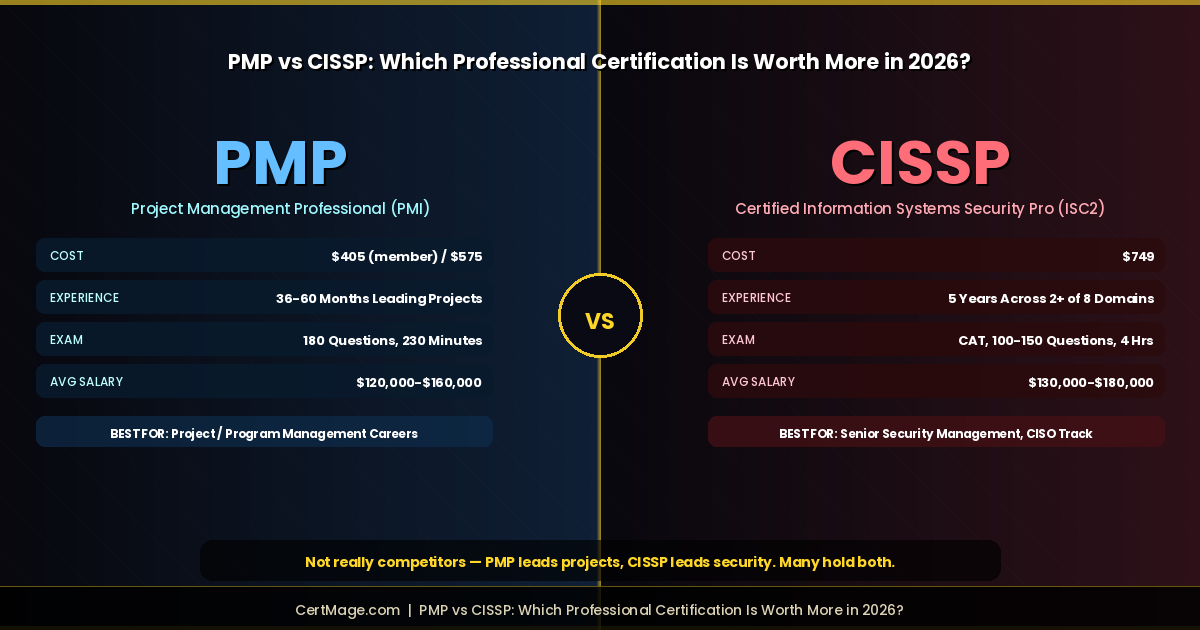
PMP vs CISSP: Key Differences at a Glance
| Factor | CISSP | PMP |
| Full name | Certified Information Systems Security Professional | Project Management Professional |
| Issuing body | ISC2 | Project Management Institute (PMI) |
| Industry | Cybersecurity and information security | Project management across all industries |
| Exam cost | $749 USD | $405 for PMI members, $575 for non-members |
| Exam duration | Up to 4 hours (CAT format) | 4 hours |
| Number of questions | 100 to 150 adaptive | 180 questions |
| Exam format | Computer Adaptive Testing — gets harder as you answer correctly | Fixed — can mark and return to questions |
| Passing score | 700 out of 1000 scaled | Pass or fail — no numeric score published |
| Experience required | 5 years in at least 2 of 8 security domains | 36 months leading projects with a bachelor’s degree, or 60 months with high school diploma |
| Education required | None beyond experience | 35 hours of project management education |
| Annual maintenance | $135 per year | Renewal fee every 3 years |
| Continuing education | 120 CPE credits every 3 years | 60 PDUs every 3 years |
| DoD 8570 approved | Yes — IAM Level III | No — but increasingly required for US government contracts |
| Average US salary | $120,552 to $141,452 | $116,000 to $120,000 |
| Job postings requiring it | 4,100 plus manager-level security roles | 22,700 plus roles across all industries |
| Best for | Security leaders, CISOs, security architects | Project managers, program managers, PMO directors |
What Is the Main Difference Between PMP and CISSP?
Comparing CISSP and PMP is like comparing apples to oranges. Both hold significant prestige in the IT and security industries but pave the way for very different career paths.
CISSP is about the what — the security program itself. It validates that you understand information security deeply across eight domains and can design, implement, and manage enterprise security programs. PMP is about the how — the process of executing projects to build and improve any organizational initiative. It validates that you can plan, lead, control, and close projects successfully across any industry.
The reason these two certifications get compared at all is that security professionals often manage projects and project managers sometimes lead security initiatives. In practice the overlap happens in roles like Security Project Manager, IT Program Manager, and Chief Information Security Officer where both credentials carry genuine value.
What Does CISSP Cover?
CISSP covers 8 domains representing the complete body of knowledge required for senior security leadership. It is one of the most comprehensive certification examinations available in any professional field — commonly considered equivalent to a master’s level degree in information security in terms of the knowledge breadth required.
CISSP Exam Domains
| Domain | Weight | What You Prove |
| Security and Risk Management | 15-19% | CIA triad, governance, compliance, ethics, legal and regulatory issues, risk management frameworks |
| Asset Security | 10-12% | Data classification, ownership, privacy, retention, handling requirements |
| Security Architecture and Engineering | 13-16% | Secure design principles, cryptography, security models, physical security |
| Communication and Network Security | 13-16% | Network protocols, secure architecture, wireless security, transmission security |
| Identity and Access Management | 13-16% | Identity lifecycle, authentication, authorization, access control models |
| Security Assessment and Testing | 12-14% | Assessment strategies, audit logs, vulnerability scanning, penetration testing oversight |
| Security Operations | 13-16% | Incident management, disaster recovery, BCP, change management |
| Software Development Security | 10-13% | SDLC security, DevSecOps, application security, acquired software assessment |
The golden rule for CISSP exam questions: The least expensive answer that accomplishes the security objective is almost always the best answer. CISSP rewards risk management thinking over technical perfection thinking. When choosing between two technically correct options, the one that is more cost-effective, more risk-proportionate, and more aligned with business needs is typically correct.
CISSP uses Computer Adaptive Testing. The exam adapts to your performance — get questions right and difficulty increases. Get questions wrong and the exam gives you easier questions. This means every candidate’s exam is different and some candidates finish at 100 questions while others go all the way to 150. You cannot mark and return to previous questions as you can with PMP.
What Does PMP Cover?
PMP validates your ability to manage projects using any approach — predictive, agile, or hybrid. The current PMP exam reflects the modern project management reality where roughly half of the exam covers agile and hybrid methodologies alongside traditional waterfall project management.
PMP Exam Content Areas
| Content Area | Weight | What You Prove |
| People | 42% | Team leadership, conflict management, stakeholder engagement, collaboration, servant leadership |
| Process | 50% | Project lifecycle, planning, execution, monitoring, controlling, delivery |
| Business environment | 8% | Benefits realization, organizational change management, compliance, strategic alignment |
The agile shift in PMP: Approximately 50 percent of PMP exam questions are agile or hybrid in context as of the current PMP exam update. Candidates who prepare only for traditional waterfall project management consistently underperform on the current exam. Study Scrum, Kanban, and hybrid approaches alongside traditional PMBOK methodology.
PMP exam mechanics: The PMP is a fixed exam with 180 questions over 4 hours. You can mark questions and return to them, which many candidates find less stressful than CISSP’s adaptive format. Questions frequently present multiple answers that are all technically correct — you must identify the most correct answer based on PMI’s ethical and professional judgment framework.
The PMP experience requirement: To qualify with a 4-year degree, you need 36 months of leading projects plus 35 hours of project management education. With a high school diploma or associate degree, you need 60 months of leading project experience plus the same 35 hours of education.
PMP vs CISSP: Difficulty Comparison
Both exams are genuinely challenging. Both have first-attempt pass rates estimated below 50 percent across all candidates. Both require significant study investment beyond work experience alone.
| Factor | CISSP | PMP |
| Difficulty | Harder overall — broader technical and managerial scope | Moderately difficult — requires judgment under ambiguity |
| Exam format | Adaptive — cannot go back | Fixed — can mark and return |
| Hardest aspect | Breadth across 8 domains plus managerial mindset shift | Identifying the most correct answer among several plausible options |
| Study time | 3 to 6 months | 2 to 4 months |
| Common failure reason | Thinking technically instead of thinking as a security manager | Insufficient preparation for agile and hybrid content |
| Golden rule | Choose the least expensive risk-proportionate option | Choose the option that follows PMI ethical and professional standards |
| Pass rate | Below 50 percent first attempt | Below 50 percent first attempt |
| Exam duration | Up to 4 hours — no fixed ending | Fixed 4 hours — candidates choose when to submit |
When asked which is harder, most professionals who hold both say the CISSP exam is significantly more difficult than the PMP. The breadth of CISSP content across 8 technical and managerial domains combined with the adaptive format creates a more demanding exam experience than PMP’s fixed 180 questions.
PMP vs CISSP: Salary Comparison
Both certifications command comparable top-tier salaries. The difference is in which industry and role each credential opens.
CISSP Salary Data
CISSP certified professionals earn an average of $120,000 to $160,000 per year according to ISC2 2024 data. According to a survey conducted by ISC2, the average salary of CISSP certified professionals in the United States is $141,452 annually.
| Role | Average US Salary |
| Information Security Manager | $130,000 to $165,000 |
| Security Engineer (CISSP level) | $115,000 to $150,000 |
| Security Architect | $135,000 to $175,000 |
| Director of Security | $155,000 to $195,000 |
| Chief Information Security Officer | $180,000 to $300,000 plus |
| Cybersecurity Consultant | $120,000 to $165,000 |
PMP Salary Data
PMP certified professionals earn an average of $100,000 to $130,000 per year according to the PMI Salary Survey 12th Edition. PMI’s research consistently shows that PMP holders earn about one-third more than project managers without the credential. According to a recent survey by PMI, the average salary of PMP certified professionals is $96,000 to $200,000 depending on experience, industry, and specific role.
| Role | Average US Salary |
| Project Manager (IT) | $95,000 to $130,000 |
| Senior Project Manager | $115,000 to $150,000 |
| Program Manager | $120,000 to $160,000 |
| PMO Director | $135,000 to $170,000 |
| Lead Transmission Line Engineer (energy sector) | $132,000 to $205,000 |
| Project Director | $140,000 to $180,000 |
The salary verdict: CISSP has a slight edge in average salary surveys due to high demand for senior security experts. However PMP can reach comparable and sometimes higher ceilings in senior program director and PMO leadership roles, and it opens 22,700 plus job postings across all industries versus CISSP’s 4,100 plus security management positions.
Both certifications lead to high six-figure incomes. Neither is clearly superior in compensation — the difference is in which career path and which industry you are pursuing.
Job Market Comparison
| Factor | CISSP | PMP |
| US job postings | 4,100 plus security manager roles | 22,700 plus roles across all industries |
| Industry scope | Cybersecurity and information security | Every industry — IT, construction, healthcare, finance, energy |
| Role types | Security manager, CISO, security architect, security director | Project manager, program manager, PMO director, portfolio manager |
| Government demand | DoD 8570 approved — required for federal positions | Increasingly required for US government contracts |
| Career ceiling | CISO and VP of Security roles | PMO Director, VP of Program Management, Chief Operating Officer track |
| Versatility | Deep specialization in one field | Broad applicability across every industry and role type |
The job posting reality: CISSP opens 4,100 plus senior security roles. PMP opens 22,700 plus roles across every industry imaginable. PMP has significantly more total job openings, but CISSP roles are almost exclusively senior leadership positions with correspondingly high salaries. PMP roles range from entry project coordinator to senior program director.
Who Should Take CISSP?
Take CISSP if:
Your career is in cybersecurity and you are targeting leadership roles. CISSP is nearly universal among Chief Information Security Officers. If you are building a career managing information security programs, security architecture, or security operations at the organizational level, CISSP is the credential that hiring managers expect to see. Try finding a CISO job posting that does not list CISSP and you will quickly understand why it matters.
You have 4 or more years of security experience and are ready to move up. CISSP validates expertise at the senior level. For professionals at this career stage, it can unlock $25,000 to $40,000 salary increases within the first year by opening roles that require the credential.
You need DoD 8570 compliance at IAM Level III. CISSP meets DoD 8570 IAM Level III requirements. For government contractors and federal employees, this compliance requirement drives certification decisions as much as career goals do.
You want the most recognized cybersecurity credential globally. CISSP is consistently ranked among the top three most globally recognized and highest-paid IT certifications across all major salary surveys. Its 25-year track record and global employer recognition make it the standard-bearer for cybersecurity leadership credentials.
For the complete CISSP worth-it analysis including detailed salary data, ROI calculation, and preparation guide, our Is CISSP Worth It guide covers every detail.
Who Should Take PMP?
Take PMP if:
Your career is in project management and you lead teams and deliver projects. PMP applies to construction, healthcare, finance, technology, and yes, security. If your value is in the management side rather than the technical side, PMP validates what you actually do. It is the gold standard for project management professionals globally.
You want the most versatile professional credential available. PMP applies across 22,700 plus roles in every industry imaginable. It is the only major professional credential that commands premium salaries in both technical and non-technical environments simultaneously. A PMP holder in energy sector project management earns comparable salaries to a PMP holder in IT program management.
You are a security professional who manages security projects and initiatives. Security work increasingly happens through projects. Implementing a SIEM, deploying endpoint protection, migrating to zero trust architecture, achieving SOC 2 compliance — these are all projects with budgets, timelines, stakeholders, and deliverables. Someone has to manage them. Security professionals who lead these initiatives often find their project management skills matter as much as their technical knowledge.
Your employer or contract requires PMP for government or regulated environments. PMP holders are increasingly included as a requirement for US Government contracts, particularly for project and program management roles supporting federal initiatives.
Can You Hold Both PMP and CISSP?
Yes — and for the right professional, holding both is a strategic career advantage rather than a redundancy.
The combination of PMP and CISSP is particularly valuable in specific roles. Security project managers who run large-scale security programs benefit from both — CISSP signals they understand what needs to be protected and why, while PMP signals they know how to deliver the initiatives that protect it on time and within budget. Holding both certifications does not double your salary, but it expands your opportunity set significantly.
Senior security professionals targeting program management or PMO leadership roles within cybersecurity divisions may find that PMP complements CISSP by validating the delivery skills that technical expertise alone does not prove.
The practical sequence: Most security professionals should earn CISSP first as their primary career credential, then add PMP when their role increasingly involves project delivery and stakeholder management responsibilities. Dedicated project managers should earn PMP first and may add CISSP if they specialize deeply in security program management.
How to Prepare for CISSP
Step 1: Adopt the managerial mindset from day one. Every CISSP study session should be framed around the question “what would a senior security manager decide here and why?” — not “how is this configured technically?” This mindset shift is the single most important preparation strategy for CISSP. Think like a manager managing risk, not a technician solving a configuration problem.
Step 2: Use Mike Chapple and David Seidl’s official ISC2 study guide. The official guide covers all 8 domains at the right depth. Read it completely before attempting any practice exams. Understanding why answers are correct is more valuable than memorizing which answers are correct.
Step 3: Remember the golden rule on exam questions. When two answers both seem correct, choose the least expensive option that proportionately addresses the risk. CISSP consistently rewards cost-effective, risk-proportionate thinking over technically perfect solutions.
Step 4: Use current practice materials. CertMage’s ISC2 CISSP practice exams include over 2,000 questions across all 8 domains with complete answer explanations that explain the managerial reasoning behind correct answers.
How to Prepare for PMP
Step 1: Complete the required 35 hours of project management education first. This is a formal requirement for PMP eligibility. Many candidates use PMI-approved online courses that count toward both the 35-hour requirement and exam preparation simultaneously.
Step 2: Study agile and hybrid methodologies as primary content, not supplementary. Approximately 50 percent of current PMP exam questions are agile or hybrid. Candidates who treat Scrum, Kanban, and hybrid approaches as secondary topics consistently underperform. Study agile as a primary discipline alongside traditional PMBOK methodology.
Step 3: Practice the most-correct-answer discipline. PMP questions frequently present multiple answers that are all technically correct. The exam rewards PMI’s ethical and professional judgment framework. Practice identifying which correct answer is the most correct based on PMI’s values of transparency, integrity, and stakeholder focus.
Step 4: Join a PMP study group. PMP exam candidates who study in groups report higher first-attempt pass rates than those who study alone. The discussion of why specific answers are most correct is more effective preparation than reading explanations individually.
The Dual Credential Path: PMP and CISSP Together
| Year | Action | Career Impact |
| Years 1 to 3 | Build security expertise, earn Security+, gain hands-on experience | Entry-level to mid-level security career |
| Years 3 to 5 | Earn CISSP — primary security leadership credential | Opens senior security roles paying $120,000 to $160,000 |
| Years 5 to 8 | Earn PMP as security project management grows | Adds program delivery credibility for senior leadership roles |
| Years 8 plus | Hold both CISSP and PMP | Qualifies for CISO, VP Security, or Security PMO Director roles at top salaries |
For the complete cybersecurity certification path including all ISC2 credentials and how CISSP fits within the broader security landscape, our Best Cybersecurity Certifications 2026 guide covers every path. For the detailed CISSP versus CEH comparison covering which credential is right at each career stage, our CISSP vs CEH guide covers every difference.
Decision Framework: PMP vs CISSP
| Your Situation | Take This |
| Your career is in cybersecurity and information security | CISSP |
| Your career is in project management across any industry | PMP |
| You are targeting CISO or security director roles | CISSP |
| You are targeting PMO director or program manager roles | PMP |
| You need DoD 8570 compliance | CISSP |
| You lead security projects and want delivery credibility | PMP as complement to CISSP |
| You have 4 plus years of security experience | CISSP |
| You have 3 plus years of project leadership experience | PMP |
| You want the broadest industry applicability | PMP — 22,700 plus roles versus 4,100 plus for CISSP |
| You want the highest cybersecurity salary ceiling | CISSP |
| You are a security professional managing large programs | Consider both — CISSP first then PMP |
| Exam fee is primary concern | PMP — $405 for members versus $749 for CISSP |
| You want a harder credential to demonstrate commitment | CISSP — most professionals find it significantly harder |
| You want to advance to COO or operations leadership | PMP — broader organizational applicability |
Frequently Asked Questions: PMP vs CISSP
What is the difference between PMP and CISSP?
CISSP validates cybersecurity expertise across eight security domains for professionals targeting security leadership and CISO roles. PMP validates project management expertise for professionals who lead and deliver projects across any industry. CISSP is deep specialization in one field. PMP is broad professional leadership applicable everywhere.
Which pays more — PMP or CISSP?
CISSP has a slight salary edge in security-specific roles with an average of $120,552 to $141,452. PMP averages $116,000 to $120,000 but can reach $200,000 plus in senior program director roles and applies across more total job openings. Both certifications lead to high six-figure incomes.
Which is harder — PMP or CISSP?
CISSP is harder for most professionals. It covers 8 technical and managerial domains with adaptive testing that adjusts difficulty in real time. Most professionals who hold both certifications describe CISSP as significantly more difficult than PMP.
How much does PMP cost compared to CISSP?
PMP costs $405 for PMI members or $575 for non-members. CISSP costs $749 USD. CISSP also requires $135 per year in annual maintenance fees and 120 CPE credits every 3 years. PMP requires a renewal fee and 60 PDUs every 3 years.
Can you take PMP without CISSP or vice versa?
Yes. Neither certification is a prerequisite for the other. They are completely independent credentials from different organizations targeting different professional domains. Most professionals pursue whichever aligns with their current career, not both simultaneously.
Is PMP or CISSP better for government contracting?
Both are valued in government contracting but for different roles. CISSP meets DoD 8570 IAM Level III requirements for security positions. PMP is increasingly required for project and program management roles on US government contracts. For security-specific government contractor roles, CISSP is the more directly required credential.
How many job openings require CISSP versus PMP?
Research shows over 4,100 manager-level security roles listing CISSP and over 22,700 roles across all industries listing PMP in the US. PMP has significantly more total job openings due to its industry-agnostic applicability. CISSP roles are primarily senior security leadership positions.
Should security professionals get PMP?
Security professionals who increasingly manage security projects and programs benefit from PMP as a complement to CISSP. Security work happens through projects and professionals who can both understand what needs to be secured and deliver the projects that secure it command premium value in senior leadership roles.
What is the experience requirement for each certification?
CISSP requires 5 years of paid full-time work experience in at least 2 of the 8 security domains. PMP requires 36 months of leading projects with a bachelor’s degree, or 60 months with a high school diploma, plus 35 hours of project management education.
Which certification is recognized in more countries?
Both are globally recognized. CISSP is recognized in 180 plus countries through ISC2’s global presence. PMP is recognized globally through PMI with over 1 million active PMP holders worldwide. Neither has a meaningful geographic advantage in most global job markets.