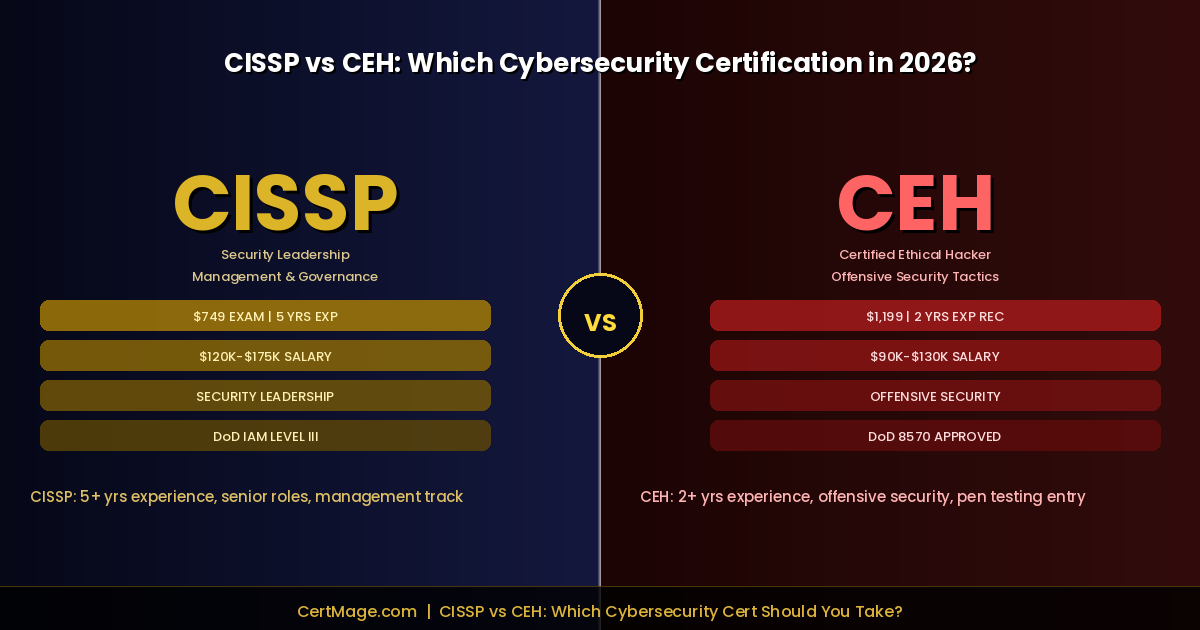
CISSP vs CEH — take CEH if you are in the first 5 years of your security career, targeting offensive security or penetration testing roles, or need DoD 8570 compliance. Take CISSP if you have 5 or more years of security experience and are targeting senior engineer, security architect, security manager, or CISO-track roles. The primary difference between these two paths lies in their perspective: CISSP serves as the gold standard for security management and leadership, while CEH remains the premier credential for offensive technical tactics.
You do not choose between these two certifications based on which is better. You choose based on where you are in your career right now.
CISSP vs CEH: Key Differences at a Glance
| Factor | CISSP | CEH v13 |
| Full name | Certified Information Systems Security Professional | Certified Ethical Hacker |
| Issuing body | ISC2 | EC-Council |
| Level | Senior — expert level | Intermediate |
| Exam cost | $749 USD | $1,199 USD (self-paced with training) |
| Exam duration | Up to 6 hours (CAT format) | 4 hours |
| Questions | 100 to 150 adaptive | 125 multiple choice |
| Passing score | 700 out of 1000 | 60 to 85 percent depending on exam bank |
| Experience required | 5 years in at least 2 of 8 domains | 2 years in information security recommended |
| No experience path | Associate of ISC2 | Take exam with eligibility application |
| DoD 8570 approved | Yes — IAM Level III | Yes — multiple categories |
| AI content | Not primary focus | Core — CEH v13 is EC-Council’s first AI-powered cert |
| Focus | Security management, governance, risk | Ethical hacking methodology, tools, offensive tactics |
| Hands-on practical exam | No | Optional CEH Practical (separate 6-hour exam) |
| Annual maintenance | $125 per year plus 120 CPE credits over 3 years | 120 ECE credits over 3 years |
| Average US salary | $120,000 to $175,000 | $90,000 to $130,000 |
| Career direction | Security leadership, architecture, management | Penetration testing, red teaming, SOC analysis |
| Best next after | Security+, CySA+, or 5 years experience | Security+ |
What Is the Main Difference Between CISSP and CEH?
The main difference between CEH and CISSP lies in their focus areas. CEH focuses on ethical hacking and penetration testing while CISSP focuses on cybersecurity management, governance, and risk management. CEH is more technical and offensive whereas CISSP is strategic and leadership-oriented.
Think of it this way. The CEH professional learns how attackers break into systems so they can find the same vulnerabilities and report them. The CISSP professional learns how to design, govern, and manage the security architecture that prevents those attacks from succeeding in the first place.
CEH can help you enter cybersecurity faster. CISSP can help you scale within it. If you try to skip the entry step, you risk building authority without foundation.
What Does CISSP Cover?
CISSP covers 8 domains representing the complete body of knowledge required for senior security leadership. The exam tests your ability to make risk-informed security decisions at the management level — not to configure individual security tools.
CISSP Exam Domains
| Domain | Weight | What You Prove |
| Security and Risk Management | 15-19% | CIA triad, governance frameworks, compliance, ethics, risk management, legal and regulatory issues |
| Asset Security | 10-12% | Data classification, ownership, privacy, retention, asset handling requirements |
| Security Architecture and Engineering | 13-16% | Secure design principles, cryptography, security models, physical security, vulnerability mitigation |
| Communication and Network Security | 13-16% | Network protocols, secure network architecture, transmission security, wireless security |
| Identity and Access Management | 13-16% | Identity management lifecycle, authentication, authorization, access control models |
| Security Assessment and Testing | 12-14% | Assessment strategies, security testing types, audit logs, vulnerability scanning, penetration testing oversight |
| Security Operations | 13-16% | Incident management, investigations, disaster recovery, BCP, change management, resource protection |
| Software Development Security | 10-13% | SDLC security, application security controls, DevSecOps, acquired software security assessment |
The managerial mindset requirement: Experienced leaders often find the CISSP more challenging because it requires a managerial mindset. You are often asked to choose the best solution from several technically correct options, focusing on business risk and resource allocation rather than just the most secure technical configuration. Candidates who approach CISSP as a technical exam consistently underperform. Every answer must be evaluated from the perspective of a senior security leader managing risk — not a technician solving implementation problems.
What Does CEH v13 Cover?
CEH v13 covers 20 modules teaching the complete ethical hacking methodology from reconnaissance through covering tracks. It is the most updated version of CEH and the first to integrate AI-powered attack and defense techniques throughout the curriculum.
CEH v13 Exam Modules
| Module Category | Key Topics |
| Reconnaissance | Footprinting, OSINT, DNS enumeration, social engineering |
| Scanning and enumeration | Network scanning, OS fingerprinting, vulnerability identification |
| System hacking | Password cracking, privilege escalation, maintaining access |
| Malware and threats | Trojans, ransomware, rootkits, fileless malware |
| Social engineering | Phishing, vishing, impersonation, insider threats |
| Web application attacks | SQL injection, XSS, CSRF, OWASP Top 10, API security |
| Network attacks | Sniffing, session hijacking, DoS, wireless hacking |
| Cloud security | AWS, Azure, GCP misconfigurations, container security |
| IoT and OT security | Industrial control systems, embedded devices, SCADA |
| AI-powered attacks | ShellGPT, FraudGPT, WormGPT, AI-assisted reconnaissance |
The 2026 AI integration: CEH v13 is EC-Council’s first AI-powered ethical hacking certification. AI tools including ShellGPT for AI-assisted command generation, FraudGPT for understanding AI-generated fraud, and WormGPT for AI-powered malware awareness are explicitly covered. This integration makes CEH v13 significantly more relevant to the 2026 threat landscape than any previous version. CertMage’s CEH v13 practice exams cover all 20 modules with complete scenario-based question banks.
CISSP vs CEH: Difficulty Comparison
| Factor | CISSP | CEH |
| Type of difficulty | Managerial judgment across 8 domains | Breadth of offensive knowledge across 20 modules |
| Hardest aspect | Choosing the best business-risk answer from multiple technically correct options | Memorizing tool names, attack categories, and methodology steps across 20 modules |
| Study time | 3 to 6 months of focused preparation | 6 to 8 weeks of focused preparation |
| Hands-on skills required | Not tested — conceptual and managerial | Basic familiarity with tools helps but not required for written exam |
| Pass rate | Approximately 49 to 55 percent first attempt | 60 to 85 percent prepared candidates |
| Exam format | Computerized Adaptive Testing — 100 to 150 questions | Fixed 125 multiple choice questions |
| Most common failure reason | Thinking technically instead of managerially | Insufficient breadth across all 20 modules |
CEH is generally considered easier than CISSP. CEH focuses on practical hacking techniques and tools while CISSP covers a wide range of security management topics and requires more professional experience.
CISSP vs CEH: Salary Comparison
Salary by Certification
| Certification | Entry Salary | Average Salary | Senior Salary |
| CEH | $80,000 to $95,000 | $90,000 to $125,000 | $120,000 to $145,000 |
| CISSP | $100,000 to $120,000 | $120,000 to $155,000 | $155,000 to $300,000 plus |
Salary by Role
| Role | CEH Typical Salary | CISSP Typical Salary |
| Security Analyst | $85,000 to $110,000 | $105,000 to $130,000 |
| Penetration Tester | $90,000 to $130,000 | Not typical path |
| Security Architect | $130,000 to $160,000 | $135,000 to $175,000 |
| Information Security Manager | $110,000 to $140,000 | $130,000 to $165,000 |
| Director of Security | Less common path | $155,000 to $195,000 |
| CISO | Less common path | $180,000 to $300,000 plus |
When it comes to average salary, CISSP outperforms CEH in providing excellent remuneration. CISSP aligns with senior and leadership roles that command significantly higher compensation at every experience level.
The salary gap explained: The salary difference between CEH and CISSP is not about which certification is more valuable — it is about which career stage each credential validates. CEH validates that you can find vulnerabilities. CISSP validates that you can lead the organization that responds to them. Leadership roles pay more in every industry and cybersecurity is no exception.
CISSP vs CEH: Experience Requirements
Understanding the experience requirements prevents the most common and expensive planning mistake candidates make — attempting to earn CISSP too early.
CISSP Experience Requirements
| Requirement | Detail |
| Years of experience | 5 years cumulative paid full-time in at least 2 of 8 domains |
| Waiver options | 1 year waived by 4-year degree or approved certification |
| No experience path | Associate of ISC2 — pass exam, fulfill experience within 6 years |
| Endorsement required | Must be endorsed by an active ISC2 member after passing |
| April 2026 waiver update | Waiver certification list reduced from 50 to 25 certifications |
The April 2026 waiver change matters: Starting in April 2026, the list of certifications that can waive one year of the CISSP experience requirement is being significantly reduced. CEH, CISA, CRISC, and OSCP were removed from the waiver list. Security+, CISM, and CCSP still qualify. If you were planning to use CEH to reduce your CISSP experience requirement, that path closed in April 2026.
CEH Experience Requirements
| Requirement | Detail |
| Years recommended | 2 years in information security |
| No experience option | Complete official EC-Council training course |
| Application fee | $100 non-refundable eligibility application if skipping training |
| Endorsement | Not required |
CEH is significantly more accessible than CISSP in terms of experience requirements. This accessibility is both its strength and its limitation — it means anyone can earn CEH, which affects how technical hiring managers perceive it compared to CISSP’s five-year validated experience requirement.
Who Should Take CISSP?
Take CISSP if:
You have 4 or more years of hands-on security experience targeting senior roles. CISSP is the gateway credential for security architect, security manager, director of security, and CISO roles. Without it, your resume is filtered before human review for most senior security leadership positions at enterprise organizations.
You want to transition from technical security into security leadership. CISSP validates the strategic thinking, risk management, and governance knowledge that technical specialists need when they move into roles with organizational accountability. It signals that you can think beyond individual security controls to enterprise security programs.
Your employer requires CISSP for promotion or senior-level clearance. Many enterprises, government agencies, and consulting firms require CISSP for specific role classifications and promotion criteria. If a concrete career opportunity is attached to the credential, the ROI calculation is immediate.
You are building toward CISO roles. CISSP is basically a prerequisite for security management roles — try finding a CISO job posting that does not list it.
Do not take CISSP if you have fewer than 4 years of security experience — the exam tests applied judgment from real security leadership work and studying without that foundation produces memorized answers rather than genuine competency.
Who Should Take CEH?
Take CEH if:
You are in the first 3 to 5 years of your security career. CEH provides the structured offensive security framework that entry-level and mid-level professionals need before specializing. It teaches the five phases of ethical hacking in a way that makes you a more effective analyst, tester, and defender.
You need DoD 8570 compliance. CEH meets DoD 8570/8140 requirements for multiple position categories. Government contractors, defense agencies, and federal security professionals who need DoD-compliant credentials should prioritize CEH. CISSP also meets DoD requirements but at a higher experience level.
You want to move into penetration testing or red team roles. CEH provides the knowledge foundation for offensive security. For hands-on penetration testing credibility, follow CEH with OSCP. For the full comparison of those two, our CEH vs OSCP guide covers every detail.
Your budget and timeline favor a faster, lower-cost credential. CEH costs less than CISSP in some scenarios (EC-Council’s official training bundles can be pricier, but the exam alone is less) and takes 6 to 8 weeks to prepare for versus 3 to 6 months for CISSP.
Can You Get Both CISSP and CEH?
Yes — and many senior security professionals hold both. The typical sequence is:
Security+ first for foundational validation. Then CEH for offensive security knowledge and DoD compliance. Then real-world security experience. Then CISSP when the experience requirement is met and career direction points toward leadership.
If you are early or focused on offensive security, start with CEH or equivalent hands-on preparation. If you are moving toward architecture or management, plan for CISSP once your experience aligns. Use your daily work as study material. Position yourself for decision-making roles.
Holding both certifications on your resume tells a complete story — you understand how attackers think (CEH) and you understand how to govern and manage the systems that defend against them (CISSP). That combination is particularly powerful for senior security consultants, security architects, and professionals building CISO-track careers.
CISSP vs CEH vs Security+: How All Three Relate
Many candidates ask how Security+ fits between CEH and CISSP. Here is the complete picture:
| Certification | Level | Best Time to Take |
| Security+ | Entry | First certification — 0 to 2 years experience |
| CEH | Intermediate | 2 to 5 years experience, offensive security focus |
| CISSP | Senior | 5 plus years experience, leadership direction |
Security+ is not redundant once you earn CEH or CISSP. All three can and should coexist on your resume — they represent different stages of your career progression and validate different competencies. CertMage covers Security+ preparation in our Is Security+ Worth It guide and the complete cybersecurity certification path in our Best Cybersecurity Certifications 2026 guide.
CISSP vs CEH: Employer Perception
Understanding how different employers view each credential prevents misaligned applications and wasted preparation time.
| Employer Type | CISSP Perception | CEH Perception |
| Large enterprise security teams | Gold standard for senior roles | Acceptable for mid-level analyst and tester roles |
| Government and defense contractors | Required for senior IAM roles | Required for multiple DoD categories |
| Dedicated penetration testing firms | Less relevant — OSCP preferred for pen test | Acceptable — OSCP preferred for senior roles |
| Consulting firms | Expected for senior client-facing roles | Useful for technical credibility with clients |
| Financial services | Required for security leadership | Valued for testing and analysis roles |
| Healthcare organizations | Expected for CISO and security director | Valued for security analyst roles |
| Startups | Sometimes expected for security leads | Valued for offensive security expertise |
Decision Framework: CISSP vs CEH
| Your Situation | Take This |
| Under 3 years of security experience | CEH — CISSP requires 5 years |
| 5 plus years, targeting senior or leadership roles | CISSP |
| Want to become a penetration tester | CEH then OSCP |
| Want to become a CISO or Security Director | CISSP |
| Need DoD 8570 compliance now | CEH — faster and accessible earlier |
| Building toward DoD senior IAM Level III | CISSP |
| Budget is primary concern | CEH written exam costs less than CISSP |
| Offensive security is your passion | CEH |
| Governance and risk management interests you | CISSP |
| Want both eventually | CEH first, then OSCP, then CISSP after 5 years |
| No IT background at all | Security+ first — then CEH |
| Already hold CEH, want to move to management | Plan for CISSP when experience aligns |
How to Prepare for CISSP in 2026
Step 1: Verify your experience before investing time and money. Confirm you have 5 years of paid full-time security work in at least 2 of the 8 domains. If you are close but not there, assess whether the Associate of ISC2 path fits your timeline.
Step 2: Adopt the managerial mindset immediately. Every study session should be framed around the question “what would a senior security manager decide here and why?” — not “how is this configured technically?” This mindset shift is the single most important preparation strategy for CISSP.
Step 3: Use Mike Chapple and David Seidl’s official ISC2 study guide. The official guide is the best single preparation resource covering all 8 domains at the right depth. Read it completely before touching practice exams.
Step 4: Practice with CertMage’s ISC2 CISSP exam preparation materials. CertMage’s CISSP practice exams include over 2,000 questions across all 8 domains with complete answer explanations. Score consistently above 70 percent before booking your real exam.
How to Prepare for CEH v13 in 2026
Step 1: Build your IT foundation first. CEH assumes networking knowledge, basic security concepts, and operating system familiarity. If Security+ level knowledge is not yet solid, build that foundation before attempting CEH.
Step 2: Study all 20 modules systematically. CEH is a breadth exam. Do not spend disproportionate time on interesting modules at the expense of less engaging ones. Every module appears in the exam.
Step 3: Practice with 500 plus scenario-based questions before booking. CertMage’s CEH v13 practice exams are built around the current 312-50 blueprint with scenario-based questions covering all 20 modules and complete answer explanations.
Step 4: Consider the CEH Practical for hands-on credibility. The optional CEH Practical exam adds a 6-hour hands-on component that validates real skills beyond the written exam. Technical hiring managers who discount the written CEH respect the Practical much more.
Frequently Asked Questions: CISSP vs CEH
What is the main difference between CISSP and CEH?
CISSP validates security management, governance, and risk leadership skills for senior professionals with 5 years of experience. CEH validates ethical hacking methodology and offensive security knowledge for intermediate professionals. CISSP is strategic and leadership-focused. CEH is technical and offensively focused.
Which is harder — CISSP or CEH?
CISSP is significantly harder. CEH requires 6 to 8 weeks of preparation and has a 60 to 85 percent pass rate. CISSP requires 3 to 6 months and has a 49 to 55 percent first-attempt pass rate. CISSP also requires 5 years of verified experience before full certification.
Which pays more — CISSP or CEH?
CISSP pays more. CISSP holders average $120,000 to $175,000 in the US. CEH holders average $90,000 to $130,000. The gap reflects the seniority of roles each credential opens rather than the relative difficulty or value of the certification itself.
Can I take CISSP without CEH?
Yes. CISSP has no requirement to hold CEH first. Many CISSP holders never take CEH. The two certifications validate completely different skills and neither is a prerequisite for the other.
Should I take CEH before CISSP?
For most professionals, yes — but not because CEH is a prerequisite. CEH provides practical offensive security knowledge earlier in your career while you are accumulating the experience that CISSP requires. The natural sequence is Security+ then CEH then CISSP as your experience grows.
Does CEH count toward CISSP experience waiver?
No — not anymore. As of April 2026, CEH was removed from the CISSP experience waiver list. CEH no longer reduces the CISSP experience requirement from 5 years to 4 years. You must fulfill the full 5-year requirement.
Which is better for government and defense careers?
Both meet DoD 8570 requirements but for different categories. CEH is accessible earlier in your career and meets multiple DoD categories. CISSP meets IAM Level III requirements and is required for more senior government security roles. Most long-term government security careers eventually require both.
Is CISSP worth more than CEH on a resume?
For senior roles, yes — significantly more. Hiring managers for security architect, security manager, director, and CISO positions view CISSP as essential and CEH as useful context. For penetration testing and analyst roles, CEH is more directly relevant than CISSP.
What comes after CEH?
The most common next steps after CEH are OSCP for hands-on penetration testing credibility, CySA+ for security analytics, or beginning the experience accumulation needed for CISSP. For the complete comparison of CEH and OSCP, our CEH vs OSCP guide covers every detail.
What comes after CISSP?
Common next steps after CISSP include CCSP for cloud security specialization, CISM for security management focus, or leadership development toward CISO roles. Many CISSP holders also pursue CISSP concentrations including ISSAP (architecture), ISSMP (management), or ISSEP (engineering).