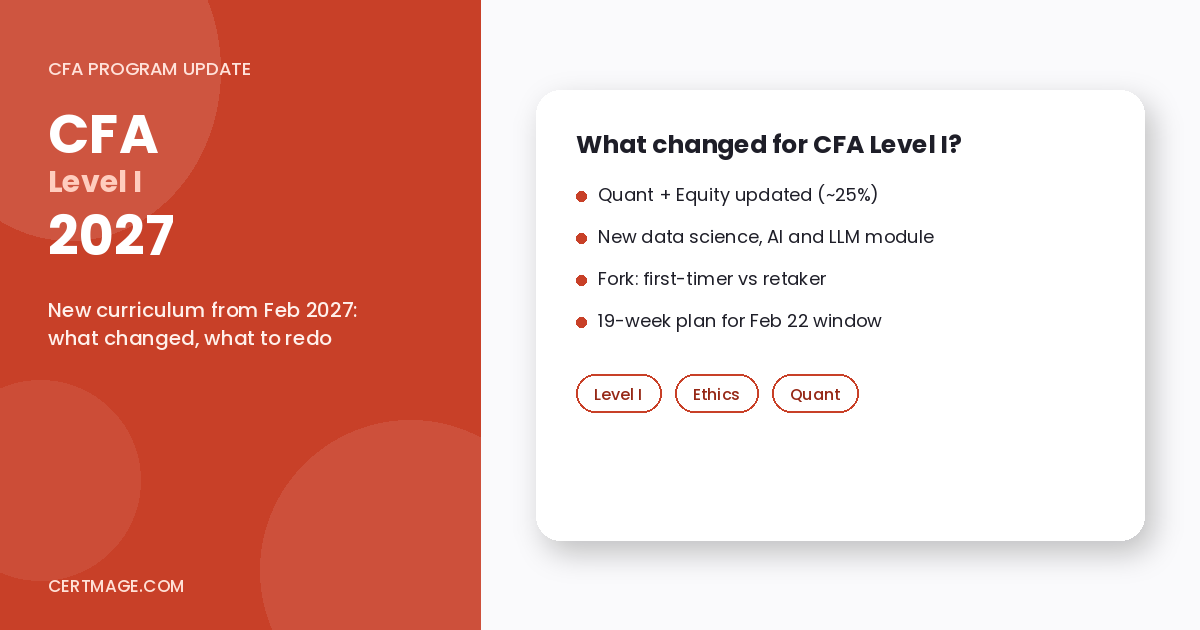
TL;DR: CFA Institute announced the 2027 CFA Program curriculum on May 26, 2026. It applies to candidates sitting exams from February 2027. The official changes are concentrated in Level I: Quantitative Methods and Equity Investments, which together make up about 25% of the Level I exam, get new learning modules, including one on financial data science, AI and large language models. Ethics content is updated across the curriculum, and the Practical Skills Modules for Equity Analysis, Macro Insights for Investing and Python are enhanced at Levels I and II. A new Level III module on Due Diligence is scheduled for later in 2026. The announcement does not mention any change to the exam format. Third-party breakdowns report that topic weights are unchanged at all three levels, and that Levels II and III change mainly in Ethics. If you are a first-time Level I candidate, study from the 2027 materials. If you are a retaker or a Level II or III candidate, the answer depends on which topics you are rebuilding, and the fork table below walks through it.
The practical question is not “what is new?” It is “does any of this change what I should buy and study this month?” For most people, the answer is yes for Level I and mostly no for Levels II and III.
Quick Facts
| Item | What we found |
| Curriculum name | 2027 CFA Program curriculum |
| Announced | May 26, 2026 by CFA Institute |
| Applies to | Candidates sitting exams beginning February 2027 |
| Main focus of the update | Level I Quantitative Methods and Equity Investments (about 25% of the Level I exam combined, per CFA Institute) |
| New content named by CFA Institute | Financial data science, AI and large language models module. Estimation, simulation and portfolio optimization. Cost of equity estimation and multi-factor approaches |
| Interactive tools | “Equation Explorers” for time value of money, implied return and cash-flow relationships |
| Practical Skills Modules | Equity Analysis, Macro Insights for Investing and Python updated at Levels I and II. New Level III Due Diligence module due later in 2026 |
| Ethics | Updated across the curriculum |
| Exam format | Multiple choice, 4.5 hours, two content sessions of 135 minutes each (CFA Institute exam page) |
| Pass rate | CFA Institute lists a 10-year average Level I pass rate of 41% |
| Format changes announced | None mentioned in the announcement |
| Level II and III content | Not described beyond Practical Skills Modules and Ethics in the official announcement |
The Fork: Which Candidate Are You?
Most guides to a curriculum change list what is new and leave you to work out what it means for you. This one starts with the decision, because the right move depends on who you are.
| Your situation | What to do | Why |
| First-time Level I candidate, sitting February 2027 | Use 2027 materials only | The 2027 curriculum applies to every exam from February 2027, and Level I has the most changes |
| First-time Level I candidate, sitting May or August 2027 | Use 2027 materials only | Same curriculum applies, and you have more time to absorb the new Quantitative Methods and Equity content |
| Level I retaker with 2026 materials, sitting 2027 | Re-buy or re-source Quantitative Methods, Equity and Ethics at minimum | These are the areas CFA Institute and third-party breakdowns say were rewritten or reorganized |
| Level II candidate sitting in 2027 | Study the 2027 Ethics content, reuse most other 2026 notes with caution | Reported changes at Level II are mainly in Ethics, but check CFA Institute’s curriculum pages for the exact list |
| Level III candidate sitting in 2027 | Update Ethics, check the Practical Skills Modules, reuse core notes with caution | Reported changes at Level III are mainly in Ethics, and a new Due Diligence module is scheduled |
| Already passed Level I | Nothing to redo | Your result stands. The change affects future exam content |
| Considering starting the program in 2027 | Plan around the 2027 curriculum from day one | You will never see the older version |
| Using a prep provider’s older books | Confirm they are labeled 2027 | Providers update on different schedules, and mismatched content wastes weeks |
How confident are we in each row?
The first row is confirmed by CFA Institute’s announcement. The Level II and III rows rely on third-party breakdowns, and we could not verify them against a full official change list. We say so at each step below.
What CFA Institute Officially Changed
This section uses only what CFA Institute’s own announcement states.
Level I Quantitative Methods
| Change | Detail from the announcement |
| Estimation, simulation and portfolio optimization | Expanded coverage |
| New learning module | Financial data science, AI and large language models |
| Interactive tools | “Equation Explorers” for time value of money, implied return and cash-flow relationships |
The new module is the headline. It places financial data science and AI inside the core Level I Quantitative Methods material, not as an add-on.
Level I Equity Investments
| Change | Detail from the announcement |
| Emphasis | Practical application, including modelling, valuation and communicating investment insights |
| Strategy link | Stronger connections between company strategy and investment decisions |
| New content | Cost of equity estimation and multi-factor approaches |
| Audience note | Aimed at candidates in student-managed investment funds and the CFA Institute Research Challenge |
Practical Skills Modules
| Module | Change |
| Equity Analysis (Levels I and II) | Updated |
| Macro Insights for Investing (Levels I and II) | Updated |
| Python (Levels I and II) | Updated |
| Due Diligence (Level III) | New, scheduled for release later in 2026 |
Ethics
CFA Institute states that Ethics content is updated, “reflecting its central role across the curriculum.” The announcement does not describe the specific edits.
What the announcement does not say
- No changes to Level II content beyond the Practical Skills Module updates.
- No exam windows other than the February 2027 start.
- No topic weights beyond the roughly 25% figure for Level I Quantitative Methods and Equity Investments combined.
- No exam format changes.
What Third-Party Breakdowns Add
Several prep providers published detailed breakdowns. One of them, 300Hours, was published on September 1, 2026, and reports the items below. We label these as reported, because the breakdown is a prep provider’s analysis and not CFA Institute’s own document.
| Reported item | What the breakdown says |
| Level I topic update | Most older learning modules in Quantitative Methods and Equities were removed and new ones added |
| Level I learning module count | Rose from 93 (2026) to 102 (2027) |
| Level I Ethics | The seven Standards were split into individual learning modules and updated |
| Level I topic renames | Corporate Issuers to Corporate Finance, Equity Investments to Equities, Portfolio Management to Portfolio Construction |
| Level II | Ethics guidance split into individual modules. Module count 51, which is 6 more than 2026. Other content unchanged |
| Level III | Ethics split and updated. Other Core readings and all three Specialized Pathways (Portfolio Management, Private Markets, Private Wealth) unchanged |
| Topic weights | No changes at any level |
| Level I weights quoted | Ethics 15 to 20%, Quantitative Methods 6 to 9%, Equities 11 to 14% |
Where the sources disagree
| Point | Source A | Source B | How we treat it |
| Quantitative Methods plus Equity share of Level I | CFA Institute: about 25% combined | 300Hours: 6 to 9% plus 11 to 14%, which is 17 to 23% | We cite the CFA Institute figure as official and note the third-party ranges. The gap may reflect rounding or different groupings, but we cannot confirm which |
| How big the Level II Ethics update is | One summary in the breakdown calls it major | The body text calls it small | We say Ethics changed at Level II and do not size it |
| Results timing for Level I | CFA Institute exam page text: within 5 to 9 weeks after the exam window closes | Same page table: 5 to 7 weeks after taking the exam and completing the Practical Skills Module | We report both and say the page conflicts with itself |
If you plan around any of these numbers, check CFA Institute’s current curriculum and exam pages first.
Level by Level: How Much Does Your Level Change?
| Level | Official changes | Reported changes (third-party) | Overall impact |
| Level I | Quantitative Methods and Equity Investments updated. New data science, AI and LLM module. Ethics updated. Practical Skills Modules updated | Most Quant and Equities modules replaced. Ethics Standards split. Module count 93 to 102. Topic renames | High |
| Level II | Practical Skills Modules updated. Ethics updated | Ethics guidance split into modules. Module count 51 | Low to moderate |
| Level III | New Due Diligence module due later in 2026. Ethics updated | Ethics split. Core and Pathways unchanged | Low |
The “Impact” column is our summary, not a CFA Institute rating.
Why the Update Lands Where It Does
This section is interpretation, not fact, and we mark it that way.
CFA Institute puts its changes where the practice of investing has shifted most visibly: data science and AI, and the modelling side of equity analysis. Putting a financial data science, AI and large language models module inside Level I Quantitative Methods means a first-year candidate meets these ideas early, before specializing. Putting cost of equity estimation and multi-factor approaches inside Equity Investments pushes candidates away from memorizing valuation formulas and toward using them.
What this probably means for study time: if you learned finance mostly through formulas, the new emphasis on application and communication may feel different from older question styles. We have not seen the 2027 question bank, so treat that as a reason to practice with scenario-style questions, not as a prediction of the exam.
What Has Not Changed
| Area | Status |
| Exam format | Multiple choice, no change announced |
| Exam length | 4.5 hours, two content sessions of 135 minutes |
| Result type | Pass or fail, with a score report at Level I |
| Level I pass rate context | 10-year average of 41% |
| Topic weights | Reported unchanged at all levels |
| Level II and III core structure | Reported largely unchanged |
The pass rate matters because a curriculum update does not make the exam easier or harder by itself. A 41% average means that most candidates who sit Level I do not pass the first time, and the safest assumption is that the bar stays where it is.
The 2027 Calendar and Where You Stand Today
The dates below come from a prep provider’s compilation (300Hours), not from CFA Institute’s own registration page, which we could not open. The compilation labels the entries as CFA Institute dates but does not say they are confirmed. Verify every date on the official registration site before you pay.
| Milestone | February 2027 (Levels I and III) | May 2027 (Levels I and II) | August 2027 (all levels) |
| Level I exam window | February 22 to 28 | May 11 to 17 | August 15 to 22 |
| Level II exam window | Not offered | May 18 to 22 | August 23 to 27 |
| Level III exam window | February 18 to 21 | Not offered | August 11 to 14 |
| Registration opens | May 5, 2026 | August 12, 2026 | November 3, 2026 |
| Early registration deadline | July 7, 2026 | October 14, 2026 | January 20, 2027 |
| Final registration deadline | November 5, 2026 | February 10, 2027 | April 29, 2027 |
| Scheduling deadline | November 10, 2026 | February 16, 2027 | May 6, 2027 |
What this means as of October 9, 2026
- February 2027: the early deadline has passed. Only the final registration deadline of November 5 remains, which is under four weeks away on the reported dates.
- May 2027: the early registration deadline of October 14 is five days away on the reported dates, so that is the most time-sensitive date if you want the lower fee.
- August 2027: registration opens November 3, so there is no rush.
The reported February Level I window starts February 22, 2027, about 19 weeks from today.
Fees
| Item | Reported amount |
| Registration fee at the early deadline | US1,140toUS1,240, depending on level |
| Registration fee at the final deadline | US1,490toUS1,590, depending on level |
| Rescheduling within the same window | US$250 for computer-based tests, only if you change your exam date |
| Print curriculum | Optional, US$150 plus shipping. The registration fee includes the e-version |
The source gives ranges and does not list a per-level 2027 fee. If you are choosing between early and final registration, the reported gap is roughly US$350 per exam, which is a reason to book early when you are confident of the window.
A 19-Week Countdown for the February 22 Window
If you are sitting Level I in the reported February window, this plan counts back from February 22. It assumes you are starting now with 2027 materials. The weekly structure is ours, not a CFA Institute recommendation, and you should scale it to the hours you actually have.
| Weeks | Focus | Output |
| 1 | Set up. Confirm your materials are 2027 editions. Read the curriculum overview and the Level I outline | A weekly schedule and a topic checklist |
| 2 to 3 | Ethics (15 to 20% per the third-party breakdown) | Notes on each Standard, now arranged as separate learning modules |
| 4 to 6 | Quantitative Methods including the new data science, AI and LLM module | Worked examples for time value of money, estimation and simulation |
| 7 to 9 | Economics and Financial Statement Analysis | Practice sets with timed blocks |
| 10 to 11 | Corporate Finance and Equities, including cost of equity and multi-factor ideas | Valuation problems from scratch |
| 12 to 13 | Fixed Income, Derivatives, Alternatives | Short summaries per topic |
| 14 | Portfolio Construction | Review of the reorganized topic |
| 15 to 16 | Full topic review, weakest areas first | Error log from all practice questions |
| 17 | Two full practice exams in two sessions of 135 minutes | Scores by topic |
| 18 | Remediation of the lowest three topics | Redo missed questions |
| 19 | Light review, logistics, rest | Exam-day checklist |
Why Ethics comes first
Ethics sits first because it is a large block in the reported Level I weights, and because the Standards were reportedly split into individual learning modules in 2027. Early study of Ethics gives you more repetitions across the weeks.
Why the new Quantitative content gets its own block
The financial data science, AI and LLM module is new and sits in a topic where formulas support everything that follows. A candidate who is shaky on estimation and simulation will find Equities and Portfolio Construction harder.
If you only have 12 weeks
Cut the plan from the middle, not the ends. Keep Ethics, Quantitative Methods and the two full practice exams. Compress Economics, Financial Statement Analysis, Fixed Income, Derivatives and Alternatives into shorter blocks, and rely on your error log to decide what to revisit.
Can You Reuse Your 2026 Materials?
| Topic | Reuse 2026 notes? | Reason |
| Level I Quantitative Methods | No, replace | Official update, new module, reported replacement of most modules |
| Level I Equity Investments | No, replace | Official update, new cost of equity and multi-factor content |
| Level I Ethics | Partly | Content is updated and reportedly reorganized, so read the new modules |
| Level I other topics | Mostly yes, with spot checks | Not named in the official announcement, though topic names and module counts may differ |
| Level II topics other than Ethics | Mostly yes, with spot checks | Reported unchanged |
| Level III Core and Pathways | Mostly yes, with spot checks | Reported unchanged |
| Practical Skills Modules | Use current versions | Several are officially updated |
“With spot checks” means opening the 2027 curriculum outline for that topic and comparing the list of learning outcomes against your old notes. A mismatch is the signal to re-read.
Practice Scenarios
These show how the fork plays out. They are illustrations, not real candidates.
Scenario 1: A first-time candidate starting this week. She bought a 2026 book set last year and never opened it. She should not use it. The book would teach the older Quantitative Methods and Equity content, and the new data science module would be missing. She should buy 2027 materials and treat the first week as setup.
Scenario 2: A Level I retaker who failed in August. He holds 2026 notes. His weakest topics are Ethics and Equity, which are two of the areas that changed. He should rebuild those two from 2027 material, keep his Fixed Income and Derivatives notes, and test them against the 2027 outline.
Scenario 3: A Level II candidate sitting in May. Her main risk is not new content but old Ethics notes. She should read the 2027 Ethics modules end to end, check the updated Practical Skills Modules, and spot-check her other topics against the outline.
Scenario 4: A Level III candidate with a pathway. He picked Private Markets. The pathways are reported unchanged, so he should keep his pathway notes, update Ethics, and look at the new Due Diligence module once CFA Institute releases it.
Scenario 5: A finance student considering CFA next year. He has time. He should wait for the 2027 materials to stabilize across providers, start in the summer, and plan for the August window if he wants a long runway.
Where CFA Sits Among Finance and Audit Credentials
The CFA charter is an investment analysis credential, and many readers of this blog sit in neighboring fields. If you are weighing it against other paths, these guides cover the alternatives.
- If your work is financial crime and compliance, our comparison of CAMS vs CFE lays out the two main credentials and the careers behind them.
- If you are moving into AML work, our CAMS certification guide covers the path in more detail.
- If fraud examination is your focus, our Certified Fraud Examiner guide explains what the credential validates.
- If you work in audit, our guide to CIA vs CISA compares internal audit and IT audit paths.
- If your audit work touches security and compliance, our overview of cybersecurity certification exams for audit and compliance maps the options.
- For practice resources across our exam catalog, start with our practice tests hub.
We omit salary figures for the CFA charter in this post. We did not find a source that isolates charterholders from broader investment roles, and a guessed number would mislead you.
What We Don’t Know Yet
We would rather list gaps than guess, so here is what we could not confirm.
- The full list of Level I learning modules. The announcement names topics, and a prep provider reports a module count, but we did not see the complete official module list.
- The exact Level I weights. CFA Institute gives about 25% for Quantitative Methods and Equity Investments together. A prep provider gives ranges that add to less. We could not reconcile them.
- Whether Level II and III content changed beyond Ethics. The official announcement is silent, and the third-party report says no, so we treat it as reported only.
- The official 2027 registration dates and fees. The calendar and fees above come from a prep provider’s compilation. Confirm them with CFA Institute.
- Results timing. CFA Institute’s own exam page gives two different figures, and the compilation gives none for 2027.
- The content of the Level III Due Diligence module. It is scheduled for later in 2026 and has not been described.
- How the new question styles feel. We have not seen the 2027 exam, and neither CFA Institute nor the prep providers have published a changed question format.
- Whether prep providers’ 2027 materials match the official curriculum. Check the edition and publication date on anything you buy.
FAQS
When does the 2027 CFA curriculum start?
CFA Institute says it applies to candidates sitting exams beginning in February 2027.
Which CFA level changes the most?
Level I. CFA Institute’s announcement focuses on Level I Quantitative Methods and Equity Investments. Third-party breakdowns report that Levels II and III change mainly in Ethics.
What is the new AI content?
CFA Institute names a new learning module on financial data science, AI and large language models inside Level I Quantitative Methods. The announcement does not give the module’s detailed contents.
Did the exam format change?
The announcement mentions no format change. CFA Institute’s exam page describes a multiple choice exam of 4.5 hours with two content sessions of 135 minutes each.
Did the topic weights change?
A prep provider reports that weights are unchanged at all three levels. CFA Institute’s announcement gives about 25% for Level I Quantitative Methods and Equity Investments combined, and the two sources do not match exactly on the split.
Can I still use 2026 study materials?
For a first-time Level I candidate, no. For Level II and III candidates, much of the core content is reported unchanged, but Ethics is updated and you should check the outline topic by topic.
I failed Level I in 2026. What should I do?
Rebuild Quantitative Methods, Equity and Ethics from 2027 materials, since these are the main changed areas. Keep other notes if they match the 2027 outline.
What are the Practical Skills Modules?
They are hands-on modules that sit alongside the core curriculum. CFA Institute updated Equity Analysis, Macro Insights for Investing and Python at Levels I and II, and is adding a Due Diligence module at Level III. The exam page’s results table ties Level I results timing to completing the Practical Skills Module.
What is the Level I pass rate?
CFA Institute lists a 10-year average of 41%.
How much does it cost?
A prep provider’s compilation reports registration fees of US1,140toUS1,240 at the early deadline and US1,490toUS1,590 at the final deadline, depending on level. Confirm current fees on CFA Institute’s site.
Is the February 2027 deadline still open?
On the reported dates, the final registration deadline is November 5, 2026, and the scheduling deadline is November 10, 2026. Verify on the official registration page.
Where is the official information?
CFA Institute’s program pages carry the curriculum announcement, exam format and registration details, at the CFA Institute CFA Program site.