Last reviewed: November 26, 2026. Job and pay data come from the U.S. Bureau of Labor Statistics (BLS) Occupational Outlook Handbook (May 2025 pay, 2025 to 2035 projections). Hiring-manager data comes from ISC2’s 2025 hiring trends study (survey of 929 hiring managers, fielded December 2024, published June 2025). Job-listing counts come from CyberSeek (reported by NIST). Exam details come from CompTIA’s and ISC2’s official pages, government-workforce details from the DoD 8140 program page and the NSA’s academic-excellence program page, and college cost data from the National Center for Education Statistics (NCES). No public dataset measures “time to get hired” by cert versus degree, so when we move from data to judgment, we say “ours.” Prices that an official page did not state are marked as not stated.
Short answer: for most people trying to get their first cybersecurity job, a certification plus hands-on proof (and ideally some IT experience) gets you in faster than a degree. A degree is the stronger long-term credential, because BLS lists a bachelor’s degree in a computer science field as the typical entry requirement for information security analysts. The honest way to put it: a certification is the faster door, a degree is the wider door, and the strongest candidates eventually have both, often in that order.
The data behind it:
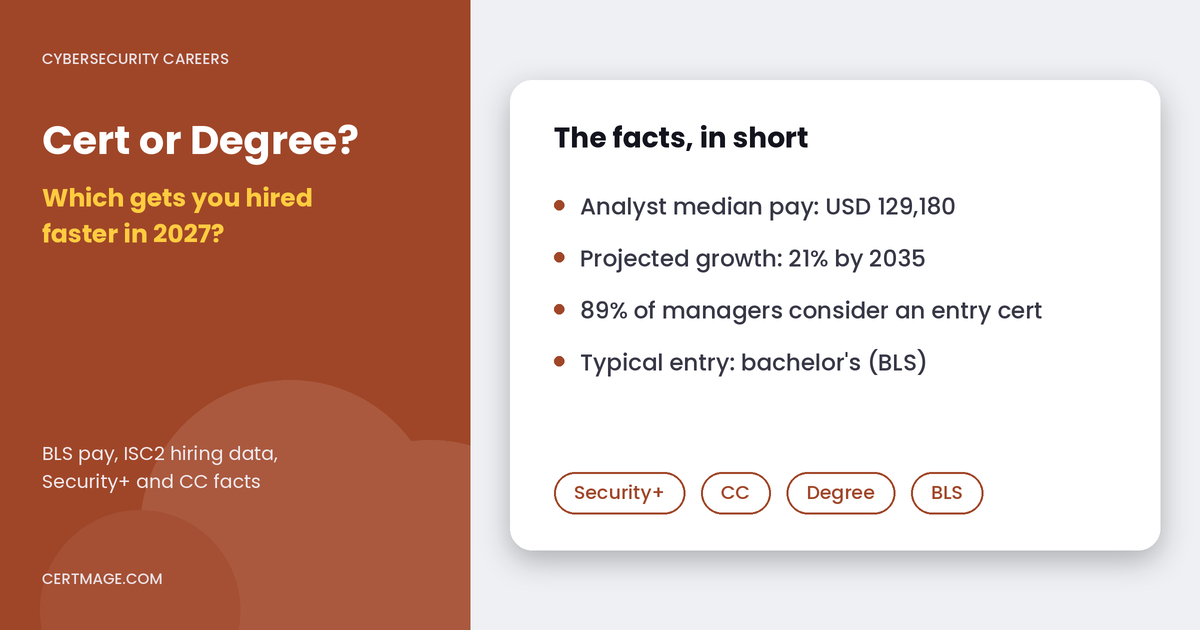
- The job is worth chasing. BLS puts information security analysts at a median of USD 129,180, with employment projected to grow 21% from 2025 to 2035 (about 40,600 more jobs) and about 14,100 openings a year.
- Employers say they will look at certifications and experience. In ISC2’s survey, 89% of hiring managers would consider a candidate with only an entry-level cybersecurity certification, and 90% would consider a candidate with only IT work experience. Both were weighted above candidates with only IT, cybersecurity, or computer science education.
- But the degree is not dead. Among attributes managers called critical, certifications were named by 47%, IT experience by 44%, and relevant education by 43%. That is close, so education still counts.
- The cost gap is huge. NCES puts average tuition and fees at about USD 9,800 a year at public four-year colleges and USD 40,700 at private nonprofit four-year colleges (2022-23, constant dollars). ISC2 lists the Certified in Cybersecurity exam fee at USD 199, about 2% of one year of public four-year tuition on our arithmetic. CompTIA’s page does not state a Security+ price.
What the Data Says
The job: information security analyst (BLS)
| Measure | BLS figure |
| Median pay, May 2025 | USD 129,180 a year |
| Lowest 10% earned less than | USD 75,090 |
| Highest 10% earned more than | USD 199,850 |
| Employment, 2025 | about 192,900 |
| Projected growth, 2025 to 2035 | 21% (about 40,600 jobs) |
| Average openings per year | about 14,100 |
| Typical entry education | Bachelor’s degree in a computer science field |
| Work experience in a related occupation | Less than 5 years |
BLS also says:
- Some workers enter with a high school diploma plus relevant industry training and certifications.
- “Many employers prefer to hire candidates who have information security certification.”
- “Many analysts have experience in an information technology department,” often as a network and computer systems administrator.
- Analysts can advance into roles such as chief security officer, computer and information systems manager, or lead a team within the occupation.
What this means (ours): the typical analyst has a degree and IT experience, but BLS explicitly names a certificate-plus-training route. It also means the job is rarely a day-one role for a complete beginner. Most people get there through IT or entry-level security roles first.
The hiring managers (ISC2 2025 hiring trends study)
| Finding | Number |
| Would consider a candidate with only IT work experience | 90% |
| Would consider a candidate with only an entry-level cybersecurity certification | 89% |
| Attribute named critical: certifications | 47% |
| Attribute named critical: IT experience | 44% |
| Attribute named critical: relevant education | 43% |
| Managers who planned to hire more cybersecurity staff in 2025 | 75% |
| Managers with open positions | nearly 90% |
| Internships seen as strong ways to find early-career talent | 55% |
| Apprenticeships seen as strong ways to find early-career talent | 46% |
| Organizations using skills-based assessments | 84% |
| Internal hires who came from IT | 85% |
| Internal hires who came from help desk | 68% |
| Undergraduate hires from colleges who came from non-CS, IT or cyber programs | 27% |
Sample: 929 cybersecurity hiring managers across Canada, Germany, India, Japan, the U.K. and the U.S. (about 155 per country), margin of error plus or minus 3% globally. The ISC2 summary says managers “prioritize hands-on experience and certifications over relevant education.”
What the data cannot tell you
- It does not measure time to get hired. No public dataset compares how fast certified candidates and degree holders land jobs. The ISC2 figures describe what managers say they will consider, not outcomes.
- ISC2 sells certifications, including an entry-level one. That does not make the survey wrong, but read it with that in mind.
- The ISC2 sample in the U.S. is about 155 managers, so country-level conclusions are limited.
- BLS describes typical requirements, not what every employer does. Some postings require a degree, and some accept equivalent experience.
The Job Market Snapshot: How Many Jobs Are Open?
CyberSeek, the cybersecurity jobs data project that NIST reports on, counted 514,359 cybersecurity job listings over the 12 months from May 2024 to April 2025, nearly 57,000 or 12% more than the 12 months before (released June 2, 2025). CyberSeek describes these as listings for dedicated cybersecurity and adjacent technical roles.
How to read that number (ours):
- Listings are not the same as openings for beginners. The count includes adjacent technical roles and many jobs that ask for experience.
- Do not compare it directly with BLS. BLS’s 14,100 average annual openings for information security analysts is a projection based on job growth and workers leaving, for one occupation. CyberSeek counts online listings across many titles, including duplicates and adjacent roles. They measure different things.
- The direction is what matters. Both sources point the same way: BLS projects 21% growth and CyberSeek reports listings rising 12% year over year.
Certification vs Degree: Side by Side
| Factor | Certification (entry level) | Bachelor’s degree |
| Time to complete | A few months to a year, depending on your background (ours) | Typically four years |
| Cost | Exam fee plus study materials (ISC2 lists CC at USD 199, and CompTIA’s page does not state a Security+ price) | NCES average tuition and fees about USD 9,800 a year (public) to USD 40,700 (private nonprofit) |
| What it proves | You know defined skills at a point in time | Broad education and sustained effort |
| Fits BLS “typical” entry path | The certificate route BLS names for some workers | Yes, the standard entry requirement for analysts |
| Hiring manager view (ISC2) | 89% would consider an entry cert alone | Education alone ranks below cert-only and IT-experience-only candidates |
| Strongest for | Your first interview and proving hands-on skill | Long-term ceiling, management paths, jobs with formal degree requirements |
| Weakness | Expires, can be hard to stand out if you have no experience | Slow, costly, may leave you with theory but no hands-on proof |
| Best use | Get in the door | Widen the door |
Our reading: the two are not rivals so much as different tools. If speed matters, certification plus experience wins the first round. If your goal is a senior or management path, the degree usually matters at some point.
The Money Math: Degree Cost vs Cert Cost
NCES reports average undergraduate tuition and fees for 2022-23 in constant dollars: USD 9,800 (public four-year), USD 40,700 (private nonprofit four-year) and USD 4,000 (public two-year). Our arithmetic, assuming the average is paid for each year and ignoring financial aid:
| Route | Tuition and fees only (our arithmetic) |
| Two years, public two-year college | about USD 8,000 |
| Four years, public four-year college | about USD 39,200 |
| Four years, private nonprofit four-year college | about USD 162,800 |
NCES also gives total cost of attendance for first-time full-time students living on campus: USD 27,100 a year (public four-year) and USD 58,600 (private nonprofit four-year), which gives roughly USD 108,400 and USD 234,400 over four years in our arithmetic. Actual net prices vary a lot with scholarships and aid, and many students live at home or study part time.
Cert costs: ISC2’s program page lists the Certified in Cybersecurity (CC) exam fee at USD 199. CompTIA’s Security+ page and cost FAQ do not state a SY0-701 price, so check CompTIA’s store before you budget. CompTIA’s FAQ also says that if you do not pass, you must buy another voucher to retake, so plan for that possibility. Either way, the fee is a small fraction of tuition. The real cost of a cert route is your study time and hands-on practice.
The takeaway (ours): the question is not “cert or degree” in isolation. It is “what do I need to get my first role, and what is the cheapest way to get it?” For many people that is a certification and a plan. For others, especially school leavers who can get a low-cost or funded degree, the degree is the long game.
The Entry-Level Certifications That Matter
CompTIA Security+ (SY0-701)
Facts from CompTIA’s page:
- Questions and format: maximum of 90, a mix of multiple-choice and performance-based questions
- Duration: 90 minutes
- Passing score: 750 on a scale of 100 to 900
- Recommended experience: CompTIA Network+ and two years of experience in a security or systems administrator role
- Domains: security operations 28%, threats, vulnerabilities and mitigations 22%, security program management and oversight 20%, security architecture 18%, general security concepts 12%
- Price and renewal terms: not stated on the page
Note the recommended experience. It is a recommendation, not a requirement, and many people pass without it. But it tells you the exam assumes working knowledge. Our Network+ difficulty guide helps if you need the networking base first, and our Security+ SY0-701 practice tests help you check readiness.
ISC2 Certified in Cybersecurity (CC)
Facts from ISC2’s page and exam outline:
- No work experience required. ISC2 describes it as entry level and says you do not need experience to start.
- Accreditation: ANAB accredited under ISO/IEC 17024, and listed as approved under U.S. DoDM 8140.03.
- Exam outline: effective September 1, 2026, with five domains: Security Principles, Security Governance, Identity and Access Management Concepts, Networking and Cloud Security Concepts, and Security Operations and Incident Response.
- Exam fee: USD 199, as listed on ISC2’s program page.
- Exam length, number of questions and passing score: not stated in the pages we read.
- Purchase options: exam only (with a 365-day window) or bundles, including one with two attempts within 180 days.
- Free program ended: ISC2 stopped new enrollments in its free One Million Certified in Cybersecurity program on May 20, 2026 (details in the free and low-cost section below).
Security+ vs CC: Which Entry Certification First?
| Factor | CompTIA Security+ (SY0-701) | ISC2 Certified in Cybersecurity (CC) |
| Experience | CompTIA recommends Network+ and two years in a security or systems administrator role (a recommendation, not a requirement) | No work experience required, per ISC2 |
| Exam format | Up to 90 questions, 90 minutes, passing score 750 out of 900 | Length, questions and passing score not stated in the pages we read |
| Exam price | Not stated on CompTIA’s page | USD 199 per ISC2’s program page |
| Focus | Security operations 28%, threats and mitigations 22%, program management 20%, architecture 18%, general concepts 12% | Five domains: security principles, governance, IAM concepts, networking and cloud security concepts, security operations and incident response |
| Government use | Check the DoD 8140 matrix for your role | ISC2 lists it as approved under DoDM 8140.03 |
| Pick it when (ours) | You have IT experience, or the postings you want name it | You have no experience and want a low-barrier first credential |
Our reading: neither is a magic key. Open 20 postings for the role you want, count which one they name, and choose that one. If postings name neither, the one with the lower barrier (CC) is a reasonable first step, and Security+ is a natural second.
Moving up: SSCP, CEH, CISSP and others
Once you have an entry credential and a role, there are more advanced certifications. ISC2’s CISSP page describes a five-year experience requirement with one-year waivers, and ISC2 says the waiver requirements changed on April 1, 2026. We could not read the details of the new waiver rules, so check ISC2 before you plan around a degree-based waiver. Our SSCP vs Security+ comparison, CEH vs PenTest+ comparison and CISSP vs CEH comparison help you pick the next step, and our cybersecurity certifications ranking puts the options in order.
One more warning from the ISC2 survey: some managers list senior certifications for entry-level roles. Per ISC2, 34% require CISSP for entry-level and 33% for junior roles. That is a mismatch in many postings, and a reason to read requirements critically.
Where a Degree Still Matters
A cert-first route is not the right answer in every case. Consider a degree when:
- Your target postings require one. BLS lists a bachelor’s degree as typical for analysts, and some employers filter on it. Check 20 postings for your target role before you decide.
- You are early in life and can study cheaply. A public two-year or public four-year degree can be a good long-term investment, particularly if you can work part time in IT.
- You want management or senior paths. BLS names chief security officer and computer and information systems manager as advancement routes. Those roles often come with degree expectations (ours).
- You will need a CISSP-style credential later. ISC2 describes degree-based experience waivers (rules changed April 2026, so check the current terms).
- You want broad options. A degree in a computer-related field keeps IT, software and data roles open as well as security.
A degree is not a guaranteed ticket. ISC2 reports 27% of undergraduate hires from colleges came from non-CS, IT or cyber programs, which shows employers hire from outside the field, but it also shows a degree alone does not prove skill. A degree with no hands-on work can lose to a certificate with a lab portfolio.
Government and Defense Jobs: What DoD 8140 Means
If you want a Department of Defense or defense-contractor role, qualification rules matter, and a degree is not the only route.
- How DoD 8140 works. The DoD program page says each foundational qualification option is mapped to a cyber workforce role and a proficiency level (Basic, Intermediate or Advanced). Options include education, training and personnel certification.
- Higher levels cover lower ones. The page says options aligned to higher proficiency levels qualify at lower levels.
- What the page does not say. It lists education options but does not state whether a degree satisfies a given role, and it tells readers to consult their organization before choosing a qualification option, because requirements can change.
- CC and DoD. ISC2’s CC page lists it as approved under DoDM 8140.03.
Practical steps (ours):
- Ask the recruiter or hiring manager which qualification options apply to the specific role.
- Do not assume a certification or a degree alone will qualify you. Check the matrix for the role.
- Plan for both a qualification and any required clearance process, which varies by role and is outside this post.
Degree Options: Associate, Bachelor’s and CAE-Designated Programs
| Option | What it is | Cost anchor (NCES, 2022-23 constant dollars, tuition and fees) | Best when (ours) |
| Associate degree (public two-year) | Two-year degree, often cheaper and a common transfer route | about USD 4,000 a year, roughly USD 8,000 over two years on our arithmetic | You want a lower-cost start or need to work while studying |
| Bachelor’s degree (public four-year) | The BLS typical entry credential for analysts | about USD 9,800 a year, roughly USD 39,200 over four years | You want the widest long-term door |
| Bachelor’s degree (private nonprofit four-year) | Same credential at a higher average price | about USD 40,700 a year, roughly USD 162,800 over four years | Only if aid or a specific program justifies the cost |
What “CAE-designated” means. The NSA’s National Centers of Academic Excellence in Cybersecurity program is managed by the NSA’s National Cryptologic University with federal partners including CISA, the FBI and NIST. The CAE-CD (Cyber Defense) designation goes to regionally accredited institutions offering cybersecurity degrees or certificates at the associate, bachelor’s and graduate levels, and designated schools must validate a Program of Study. The NSA page links to a list of current institutions at caecommunity.org. The page does not mention scholarships or hiring advantages, so we do not claim any.
Our advice: if you choose a degree, prefer an accredited program with a hands-on component and internship access. Check whether your target employers or government roles value a CAE designation before you pay extra for it. Starting at a public two-year college and transferring is a common cost-saving route, but confirm credit transfer with the school before you enrol.
Free and Low-Cost Ways In
- ISC2’s free CC program has closed to new enrollment. ISC2 says it concluded new enrollments in the One Million Certified in Cybersecurity program effective May 20, 2026. If you already hold an unexpired exam code, you can schedule and sit the exam until December 31, 2026 (35 days after this review date), and expired codes cannot be reactivated. Completing the course is not required to sit the exam. After that, CC exams and education are paid, with the exam fee listed at USD 199.
- Security+ pricing. CompTIA’s pages do not state a SY0-701 price. Its FAQ notes you may qualify for discounts or bundles, and that you must buy another voucher to retake.
- Employer-paid training. In ISC2’s survey, 75% of managers had budget for professional development and 91% offered it during work hours. Once you are hired, ask what your employer will fund.
- Internships and apprenticeships. 55% and 46% of managers see them as strong ways to find early-career talent.
- A public two-year college. NCES puts average tuition and fees at about USD 4,000 a year.
Which Is Faster for You? A Decision Guide (Ours)
| Your situation | Faster route | Why |
| No degree, no IT experience, need work soon | Entry cert plus a help desk or IT support job, then security | BLS says many analysts come from IT, and ISC2 says 68% of internal hires came from help desk |
| Already in IT (help desk, sysadmin, networking) | Security+ or a cert matching your job, then move into security tasks | You already have the experience managers weight |
| Have a bachelor’s in an unrelated field | Security+ plus a hands-on project portfolio | The degree helps with BLS filters, and the cert plus projects shows security skill |
| School leaver, can afford or fund a degree | Degree in a computer field plus a cert and an internship while studying | BLS typical path, and internships are seen as strong by 55% of managers |
| Working adult with a degree in progress | Finish the degree and add a cert for hands-on proof | You are close, so do not drop it |
| Want to reach a senior or management track | Both, in the order your situation allows | The senior path rewards experience and credentials |
Two Realistic Timelines (Ours)
Cert-first path (typical for career changers)
| Months | Goal |
| 1 to 3 | Build IT and networking basics, start a home lab |
| 3 to 8 | Study for and pass Security+ or CC |
| 6 to 12 | Apply to IT support, SOC trainee and junior security roles. Build a short project portfolio |
| 12 to 24 | Gain experience, add a second certification matching your role |
Degree-first path (typical for school leavers)
| Years | Goal |
| 1 | Foundation courses, join a security club or competition, start a lab |
| 2 to 3 | Add Security+ or CC, apply for IT or security internships |
| 4 | Graduate with a degree, a cert and internship experience |
| 4 and on | Apply for junior analyst roles, then consider advanced certifications |
These timelines are planning ranges, not guarantees. No official source publishes them.
Entry-Level Roles to Target and What to Show (Ours)
BLS’s information security analyst is usually the destination, not the first job. These are common entry points. Titles vary by employer, so read each posting’s real duties.
| Role to search | What the work looks like | What to show |
| Help desk or IT support technician | Fixing user problems, accounts, devices and access | A basics certification or IT experience, plus clear communication |
| Junior SOC or security operations analyst | Watching alerts, triaging, escalating incidents | A security certification, log-analysis practice and a short incident write-up |
| IT security technician | Patching, access changes, endpoint and email security tasks | Security+ or CC, lab work, a record of fixes |
| Vulnerability or compliance support analyst | Scanning results, tracking fixes, evidence for audits | A certification, spreadsheet and reporting skill, attention to detail |
| Junior information security analyst | The BLS occupation: protecting systems, monitoring, reporting | A degree or certificate plus IT experience, and a hands-on portfolio |
Why IT jobs count (ISC2): 85% of internal hires came from IT and 68% from help desk, so an IT support job is one of the most common bridges into security.
Hands-On Proof That Passes a Skills Assessment (Ours)
ISC2 reports that 84% of organizations use skills-based assessments, so show you can do the work, not only name it.
- A home lab. A few virtual machines you can break and fix, with notes on what you did.
- Log analysis practice. Read sample logs, find the suspicious event and write a one-page explanation.
- Capture-the-flag or practice challenges. Keep a short list of what you solved and how.
- One write-up per project. Problem, steps, result and what you would do differently.
- Basic scripting or automation. Even a small script that parses a log file shows initiative.
- A public profile. A simple page or repository where an interviewer can read your write-ups.
What a Hiring Manager Sees: Three Resume Stacks (Ours)
| Stack | What is on the resume | Our reading |
| A. Certification plus IT job plus lab | Security+ or CC, 6 to 12 months in IT support, two documented projects | Strong for entry roles, and matches the experience ISC2 managers say they weigh |
| B. Degree plus internship plus certification | Bachelor’s in a computer field, one internship, Security+ or CC | Strongest overall for BLS’s typical path, though it takes the longest |
| C. Certification only | One credential, no projects, no IT job | The weakest, because skills-based assessments will test what the certificate cannot show |
A 90-Day Plan to Become Interview-Ready (Ours)
| Weeks | Focus | Output |
| 1 to 3 | IT and networking basics: IP addresses, operating systems, accounts and permissions | A simple home lab |
| 4 to 8 | Study for Security+ or CC, using the exam’s domains as a checklist | A weekly practice score and a list of weak topics |
| 9 to 10 | Log analysis and incident write-up | One or two portfolio write-ups |
| 11 to 12 | Resume, LinkedIn and 20 tailored applications | Application tracker and interview practice |
| 13 | Book the exam if you are not ready yet | A clear next date |
Adjust it to your schedule. Many people need longer, and that is fine.
How to Get Hired Faster, Whichever You Choose
The ISC2 data points to a few things that help regardless of your route:
- Get hands-on proof. 84% of organizations use skills-based assessments, so a home lab, capture-the-flag results or a documented project helps you pass that stage.
- Look for internships and apprenticeships. 55% of managers see internships as strong ways to find early-career talent, and 46% say the same for apprenticeships.
- Use IT as a stepping stone. 85% of internal hires came from IT, including 68% from the help desk. Many security teams hire from inside the company.
- Show soft skills. ISC2 reports teamwork, problem-solving and analytical thinking among managers’ top skills, ahead of data security and cloud security.
- Write a resume that fits the posting. Match the role’s keywords and show projects, not only course titles.
- Apply broadly. Roles titled SOC analyst, IT security technician, help desk with security duties and junior analyst can all be entry points. Our remote tech certifications guide can help if you want remote work.
Common Mistakes
- Treating the choice as either-or. Many strong candidates start with a cert and add a degree later, or the reverse.
- Taking an advanced certification too early. CISSP has a five-year experience requirement with waivers, so it is not an entry credential.
- Collecting certificates without projects. A skills-based assessment tests what you can do, not what you hold.
- Ignoring the job postings. Check 20 postings for requirements before you spend time or money.
- Paying for a degree you cannot finish. Debt without a degree is the worst outcome, so choose a program you can complete.
- Using unauthorized exam “dumps.” They do not build the skills interviews test, and they put your certification at risk.
- Skipping IT basics. Security builds on networking, operating systems and support experience.
- Letting certifications lapse. Check the renewal rules on the certifying body’s site and plan for them.
FAQS
Is a certification or a degree better for cybersecurity?
They do different jobs. A certification is usually the faster way into a first role, and BLS says many employers prefer candidates with security certification. A degree is the typical entry requirement for information security analysts and has a higher long-term ceiling. The strongest candidates often have both.
Which gets you hired faster, a cert or a degree?
Our reading of the data is a certification plus hands-on proof, because a degree takes about four years. No public dataset measures time to hire by credential, though. ISC2’s survey found 89% of hiring managers would consider a candidate with only an entry-level certification.
Can you get a cybersecurity job without a degree?
Yes, in some roles. BLS says some workers enter with a high school diploma plus relevant industry training and certifications. It is easier if you have IT experience, since BLS notes many analysts come from IT departments.
Do I need a degree to be a security analyst?
BLS lists a bachelor’s degree in a computer science field as typical for information security analysts, but it also describes the certificate route. Requirements vary by employer, so check postings for your target role.
Are certifications worth it without experience?
They help, but experience matters. ISC2 found managers rank certifications, IT experience and education close together (47%, 44% and 43% named them critical), so a certificate alone is stronger when paired with a lab, a project or an IT job.
How much do information security analysts earn?
The BLS median was USD 129,180 in May 2025. The lowest 10% earned less than USD 75,090 and the highest 10% earned more than USD 199,850. Entry-level pay is usually below the median.
Is cybersecurity still in demand in 2027?
BLS projects 21% growth for information security analysts from 2025 to 2035, about 40,600 more jobs, with about 14,100 openings a year. ISC2’s survey reports 75% of managers planned to hire more staff in 2025.
Is entry-level cybersecurity hard to get into?
It can be competitive, since many analyst roles prefer experience. BLS lists less than five years of related experience as typical, and many analysts come from IT. Starting in help desk, IT support or a SOC trainee role is a common way in.
What jobs can I get with just a certification?
Common entry points include IT support, help desk, security technician and SOC trainee or junior analyst roles. Titles vary by employer, so read each posting’s requirements.
How many cybersecurity jobs are open?
CyberSeek counted 514,359 cybersecurity job listings from May 2024 to April 2025, nearly 57,000 or 12% more than the previous 12 months. That count includes adjacent technical roles and many jobs that ask for experience, so it is not the number of beginner openings.
Which entry-level cybersecurity certification should I get first?
Security+ and ISC2 Certified in Cybersecurity are the two entry options we covered. Security+ (SY0-701) is up to 90 questions and 90 minutes with a passing score of 750, and CompTIA recommends Network+ and two years of experience. CC requires no work experience.
Do I need experience for Security+?
CompTIA recommends Network+ and two years in a security or systems administrator role, but it is a recommendation. Many candidates build the skills through study and labs.
Do I need experience for the ISC2 CC?
No. ISC2’s page lists no work experience required and calls it an entry-level certification.
Can I take the CISSP without a degree?
ISC2 describes a five-year experience requirement with one-year waivers, and says the waiver requirements changed on April 1, 2026. Check ISC2’s current requirements for the exact rules.
Do certifications expire?
Most do. Security+ and CC renewal terms were not stated on the pages we read, so check the certifying body’s site and plan for renewal.
How much does a cybersecurity degree cost?
It depends on the school. NCES reports average tuition and fees for 2022-23 of about USD 9,800 a year at public four-year colleges, USD 40,700 at private nonprofit four-year colleges and USD 4,000 at public two-year colleges (constant dollars). Over four years that is about USD 39,200 (public) or USD 162,800 (private nonprofit) in tuition and fees on our arithmetic, before aid.
Is a degree still worth it if I already have a certification?
It can be, especially if you want management or senior paths or your target employers list a degree. It matters less if you already have a degree in another field or strong IT experience.
Can I study for a degree and a certification at the same time?
Yes, and it is a strong approach. Add a certification and an internship while you study, so you graduate with credentials and experience.
What do hiring managers value most?
In ISC2’s survey, among attributes called critical, certifications ranked at 47%, IT experience at 44% and relevant education at 43%. Managers also ranked teamwork, problem-solving and analytical thinking among their top skills.
Is the ISC2 Certified in Cybersecurity exam free?
Not for new participants. ISC2 concluded new enrollments in its free One Million Certified in Cybersecurity program effective May 20, 2026. People who already hold an unexpired exam code can sit the exam until December 31, 2026. After that, ISC2’s page lists the CC exam fee at USD 199.
Is Security+ or ISC2 CC better for a beginner?
CC requires no work experience, and ISC2 lists the exam at USD 199. Security+ is a broader and more widely listed credential, and CompTIA recommends Network+ and two years of experience. Check which one the postings for your target role name.
Is Security+ enough to get a cybersecurity job?
Sometimes, especially for IT security technician or junior roles, but it works best with IT experience or hands-on projects. ISC2’s survey found 84% of organizations use skills-based assessments, so be ready to show what you can do.
Can I switch into cybersecurity at 30 or 40?
Yes. ISC2’s survey found 85% of internal hires came from IT and 68% from help desk, and 27% of undergraduate college hires came from non-CS, IT or cyber programs. BLS notes many analysts have IT department experience. A support job plus a certification is a common bridge.
What entry-level cybersecurity jobs can I apply for?
Help desk or IT support, junior SOC analyst, IT security technician, vulnerability or compliance support analyst and junior information security analyst. Titles vary, so read the duties in each posting.
How long does it take to get a cybersecurity job?
There is no public data on time to hire by route. Our planning range for the cert-first path is 6 to 12 months before you are applying with a certification and projects, and longer for a security-specific first role if you start with no IT background.
Is a cybersecurity bootcamp better than a degree?
We found no public outcome data comparing bootcamps with degrees or certifications, so we cannot rank them. If you consider one, ask for verified placement data, check what credential or experience it gives you and compare the cost with a public two-year college (about USD 4,000 a year in tuition and fees, per NCES).
Do government or defense cybersecurity jobs require a degree?
Not always, and it depends on the role. The DoD 8140 program lists education, training and personnel certification as qualification options mapped to work roles and proficiency levels, but its page does not say whether a degree qualifies for a given role. Ask the recruiter which options apply.
Does the DoD accept the ISC2 CC?
ISC2’s CC page lists it as approved under DoDM 8140.03. Requirements can change and depend on the role, so confirm with your organization.
What is a CAE-designated school and does it matter?
It is a college or university designated under the NSA’s National Centers of Academic Excellence in Cybersecurity program. The CAE-CD designation covers institutions with cybersecurity degrees or certificates at the associate, bachelor’s and graduate levels. The NSA page does not state hiring advantages, so check whether your target employers value it.
Is an associate degree in cybersecurity worth it?
It can be a lower-cost start, since NCES puts public two-year tuition and fees at about USD 4,000 a year. BLS lists a bachelor’s degree as typical for analysts, so plan to add a certification, IT experience and possibly a transfer to a four-year program.
Is a cybersecurity degree worth it?
It is worth it if you want the BLS typical path, management options or jobs that list a degree. It is less necessary if you already have a degree, IT experience or a strong certification and portfolio. Weigh cost against the postings you actually want.
Final Thoughts
If your goal is to get hired as quickly as you can, a certification plus hands-on proof, and ideally an IT job as a stepping stone, is usually the faster path, and ISC2’s survey shows most hiring managers will consider it. If your goal is the widest long-term door, a degree in a computer-related field matches what BLS lists as the typical requirement for information security analysts. The two are not enemies. Many people start with a certificate to get in, then add a degree, or study for a degree while earning a certification and an internship. Check the postings for the role you want, pick the cheapest route that clears their requirements and build something you can show.
Source for pay, outlook and entry requirements: the BLS profile for information security analysts.